
Revision summary
The UN marked 2016 to highlight pulses as food and as a farming solution. Dal supplies protein and micronutrients beside cereals. Nodules fix nitrogen and spare fertiliser in rotations. Many pulses suit rainfed land and catch-crop slots. Smallholders gain if seed, price, and storage match the crop’s public value.
Model answer
Copper italics in this answer — like this — are the key facts. Each one is unpacked in the Facts & figures rail.
Introduction
The United Nations named 2016 the International Year of Pulses to put beans, lentils, chickpeas, and peas back at the centre of farming and diet. The advantages that justified that year are nutritional, ecological, and economic, especially for dryland and smallholder India.
Body
Nutrition and food security
- Pulses are a cheap plant protein and a source of iron, folate, and fibre for households that eat little meat or milk.
- They complement cereal diets of rice and wheat, which is why dal-roti is a complete-protein idea in ordinary kitchens.
- Low fat and a low glycaemic load help public health where diabetes and hidden hunger sit together.
- Storage as dry grain cuts waste compared with many vegetables, so pulses support buffer stocks and lean-season food.
Soil, water, and climate-smart farming
- Rhizobium in root nodules fixes atmospheric nitrogen, which reduces the urea bill and leaves residual fertility for the next cereal crop in a rotation.
- Many pulses such as moong, urad, arhar, gram, and masoor fit rainfed and residual-moisture lands where rice or sugarcane would thirst.
- Short-duration moong can be a catch crop between wheat and rice, raising cropping intensity without a full extra irrigation season.
- Pulse systems often need less energy than irrigated cereals and can cut greenhouse intensity per protein unit.
Livelihoods and biodiversity
- Small and marginal farmers in Madhya Pradesh, Rajasthan, Maharashtra, and the north-east already grow pulses; better seed and price support raise cash without a new plantation model.
- A wide set of species and landraces supports farm biodiversity and reduces pest risk compared with a single cereal monoculture.
- Inclusive markets for dal also matter for nutrition schemes and for cutting import dependence when domestic output lags.
Way forward
- Keep the IYP message as more area under pulses on drylands, MSP and procurement that work like wheat, and kitchens that still cook dal.
- Pair cultivation with storage, processing, and research on wilt and drought so the advantages are realised on the field, not only in a UN year.
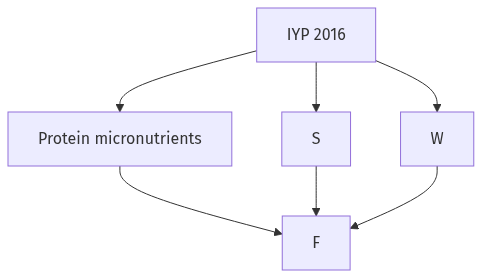
Flow diagram
Conclusion
Pulses earned a UN year because they feed people, feed the soil, and fit water-scarce farms. Cultivation advantages are protein, nitrogen, and resilience; policy has to make those advantages pay the grower.
Quick related
Students also ask
-
Account for variations in oceanic salinity and discuss its multi-dimensional effects. (250 words).
Next question on this syllabus topic (2017 · Q14). View answer →
-
Are pulses only a nutrition topic?
No. The UN year also stressed soil health, small-farm income, and sustainable agriculture.
-
Why does India still import pulses if they are so advantageous?
Yield gaps, climate risk, and weaker procurement than wheat and rice keep domestic supply tight in some years.
Same topic · past papers
UPSC has asked this before
These previous-year questions sit on the same topic. Open one to practise the earlier ask.
-
2022 · Q16 · GS I · 15 marks
Mention the significance of straits and isthmus in international trade. -
2021 · Q14 · GS I · 15 marks
Briefly mention the alignment of major mountain ranges of the world and explain their impact on local weather conditions, with examples. -
2018 · Q17 · GS I · 15 marks
Mention core strategies for the transformation of aspirational districts in India and explain the nature of convergence, collaboration and competition for its success.
More from this topic
Q17 · UPSC Mains 2026 · GS I · 15 marks · Solution
Analyze the major drivers of human-induced land-use changes in India and their geographical consequences.
World's Physical Geography
India's land-use change is driven by agricultural intensification, urban growth, infrastructure, mining, plantations, tourism and livelihood shifts. These changes support food, connectivity and jobs, but they also disturb hydrology, soil, habitats, microclimates, hills, coasts and access to commons. Sustainable land governance must combine mapping, carrying-capacity assessment and local participation.
Q16 · UPSC Mains 2026 · GS I · 15 marks · Solution
"The centre of global trade is gradually shifting from the Atlantic region to the Indo-Pacific region." Examine this statement.
World's Physical Geography
Global trade’s centre of gravity is moving towards the Indo-Pacific because manufacturing, consumption, energy shipping and new tech rules are concentrating between the Indian and Pacific Oceans. China-plus-one, ASEAN growth, India’s market, Malacca–Hormuz lanes, RCEP/IPEF and semiconductor corridors drive the trend. The Atlantic still matters in finance and standards, so the change is gradual rebalancing. India gains only if ports, manufacturing and sea-lane security keep pace.
Q14 · UPSC Mains 2026 · GS I · 15 marks · Solution
Compare the Loo, Chinook and Foehn winds with respect to their regions of prevalence, their nature and climatic impacts.
World's Physical Geography
The Loo is a hot, dusty pre-monsoon wind of northwestern India and the Indo-Gangetic plains. Chinook and Foehn are warm, dry downslope winds of the Rockies and Alps, formed by adiabatic compression. Their impacts differ from Indian heat stress to snowmelt and mountain hazards.