
Revision summary
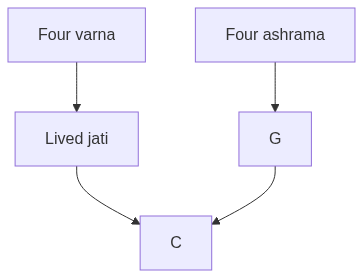
Varna is fourfold rank; ashrama is four life-stages; together they are a Brahmanical ideal. Lived organisation is jati, with Sanskritisation toward varna images. Law (Arts. 14–17, atrocities Act, personal-law judgments) breaks purity as public rule. Ashrama is thin: the householder remains, vanaprastha is rare. Politics uses Savarna/Bahujan and Mandal lists, not Manu’s chart as administration.
Model answer
Copper italics in this answer — like this — are the key facts. Each one is unpacked in the Facts & figures rail.
Introduction
Varnashrama is the paired ideal of four varnas and four ashramas. It is a Brahmanical design for a whole life and a whole society. Contemporary India does not live inside that design, but it still uses pieces of it in ritual, politics and family talk.
Body
The scheme
Varna: Brahmana, Kshatriya, Vaishya, Shudra, with those outside the four as a fifth social fact (today’s Dalit history). Ashrama: brahmacharya, grihastha, vanaprastha, sannyasa. Texts (Manu, Gita, Dharmasutras) present duty by stage and by birth. Anthropology, from Dumont to Béteille, treats this as ideology: ranking by purity, with the householder as the real centre even when the sannyasi is praised.
Jati, not varna, is what villages actually marry. Srinivas’s Sanskritisation is a jati climbing toward a varna image.
Contemporary relevance
- Residual ritual: Thread, shraddha, temple entry, and who cooks for whom still mime varna. Ashrama is weaker: few urban men become forest-dwellers; sannyasa is a vocation or a TV role, not a mass fourth stage.
- Legal rupture: The Constitution abolishes untouchability (Art. 17), equality (14–16), and Indian Young Lawyers (Sabarimala), Shayara Bano (triple talaq), and temple-entry histories show personal law and public worship under fundamental rights. SC/ST Atrocities Act criminalises some purity-enforcement.
- Political afterlife: Varna language returns as “Savarna” versus Bahujan, as Puri mutt politics, as demands that Hindus be one vote bank. Mandal used jati lists, not Manu’s four.
- Gender: Ashrama assumed a male subject. Women’s education, delayed marriage and paid work break brahmacharya–grihastha timing. Karva Chauth and kanyadan keep grihastha theatre alive.
- Hindutva and reform: One current wants a single Hindu without jati; lived marriage markets refuse. Another wants to restore varna as harmony; Ambedkar’s Annihilation remains the counter-text.
Relevance is therefore partial and contested. The scheme still supplies words for rank and for a “complete life”. It does not supply the organisational chart of the Republic, which runs on citizenship, lists and parties.
Flow diagram
Conclusion
Varnashrama is an ideal grammar of birth and life-stage. Jati, class and the Constitution organise the present. The grammar survives in ritual and rhetoric, not as a working four-plus-four machine.
Quick related
Students also ask
-
Lothal dockyard and international trade relations.
Next question on this syllabus topic (2025 · Q5(e)). View answer →
-
Do Indians still pass through four ashramas?
Almost no one does as a full sequence. Education and retirement sometimes mimic brahmacharya and vanaprastha in name only.
-
Is OBC reservation a varna policy?
No. It is a jati-and-class administrative list. It exists because varna equality never happened.
Same topic · past papers
UPSC has asked this before
These previous-year questions sit on the same topic. Open one to practise the earlier ask.
-
2016 · Q1(c) · Anthropology GS 2 · 10 marks
Relevance of caste in contemporary Indian politics -
2015 · Q8(b) · Anthropology GS 2 · 15 marks
Critically examine the concept of tribe-caste continuum and its relevance in contemporary India -
2026 · Q8(b) · Anthropology GS 2 · 15 marks
What are the major challenges tribal communities are facing in contemporary India? -
2025 · Q7(a) · Anthropology GS 2 · 20 marks
Identify the contemporary limitations in the process of tribal development. How can anthropological knowledge contribute in this process? -
2024 · Q8(b) · Anthropology GS 2 · 15 marks
Distinguish a 'Theocratic State' from a secular, liberal, democratic state. Illustrate your answer with examples from tribal and contemporary societies.
More from this topic
Q6(a) · UPSC Mains 2026 · Anthropology GS 2 · 20 marks · Solution
Make a critical appraisal of the mesolithic culture of Ganga basin with reference to artifacts, faunal and human skeletal remains excavated from different sites
Evolution of the Indian Culture and Civilization
• Ganga basin Mesolithic sites like Sarai Nahar Rai, Mahadaha, and Damd
Q5(e) · UPSC Mains 2026 · Anthropology GS 2 · 10 marks · Solution
Contribution of L. K. Ananthakrishna Iyer in Anthropology.
Evolution of the Indian Culture and Civilization
L. K. Ananthakrishna Iyer is a pioneering figure in Indian anthropology, known for his monumental ethnographic surveys like The Cochin Tribes and Castes and The Mysore Tribes and Castes. Working during the colonial era, he bridged western anthropological methods with indigenous scholarship. His documentation of social stratification, material culture, and folklore laid the empirical foundation for Indian sociology and anthropology. Iyer also established the first department of anthropology in India at the University of Calcutta, shaping institutional teaching and research.
Q5(c) · UPSC Mains 2026 · Anthropology GS 2 · 10 marks · Solution
Article 371A of the Indian Constitution.
Evolution of the Indian Culture and Civilization
Article 371A of the Indian Constitution grants special autonomous status to Nagaland, protecting its traditional socio-religious practices, customary laws, and land ownership rights. Enacted via the 13th Constitutional Amendment Act, 1962, following the 16-point Agreement, it reflects the asymmetrical federal framework of India. The article places a special responsibility on the Governor regarding law and order and regional financial allocations. It balances tribal autonomy with national integration, though it faces implementation challenges in modern governance.