
Revision summary
Tribalism is modern ethnic-political self-making among Adivasi and hill peoples. Pseudotribalism is the accusation of performing tribe for ST entry or capture of benefits. Lokur tests and Gazette politics sit in the middle; courts follow the list more than folklore. Powerful listed groups and unlisted forest people show why one word “tribe” is too coarse. Grade vulnerability (PVTG to dominant ST) instead of only true versus fake.
Model answer
Copper italics in this answer — like this — are the key facts. Each one is unpacked in the Facts & figures rail.
Introduction
Tribalism is the making of a political “we” out of clan, language, hill and memory. Pseudotribalism is the charge that a group performs tribe to enter a list, a quota or a council, without the historical life that the word was meant to name. Anthropology has to use both terms carefully, because the state invented the list that people now perform.
Body
Tribalism
It is not a primitive leftover. Naga nationalism, Mizo Zawlbuk-to-church public, Jharkhand adivasi mobilisation, Bodo assertion, and Dongria defence of Niyamgiri are tribalism as modern politics. Xaxa treats this as historically injured people using ethnicity. Article 342, Fifth and Sixth Schedules, PESA and FRA are the legal stage.
- Tribalism can be exclusive: a majority tribe squeezing a smaller one inside a Sixth Schedule council, or hill–valley violence in Manipur. Then tribalism is also a dominant ethnicity, close to what Srinivas described for caste.
Pseudotribalism
The term appears in Indian debate when communities with peasant or caste histories seek ST status (some Gujjar–Meena conflicts in Rajasthan, tea-tribe claims in Assam, demands in Uttarakhand and Himachal). Administrators say: they are not isolated, not “shy”, not “primitive” — the Lokur tests again. Anthropologists should not swallow the insult, but they should admit strategic essentialism: folklore teams, dress, and a newly written origin myth for the Gazette.
André Béteille warned that tribe and caste are colonial-administrative cousins. Pseudotribalism is often the state’s word for a claim it does not want to grant. Sometimes the word is fair: a locally dominant group seeks ST to capture land and jobs meant for a more vulnerable neighbour.
The middle
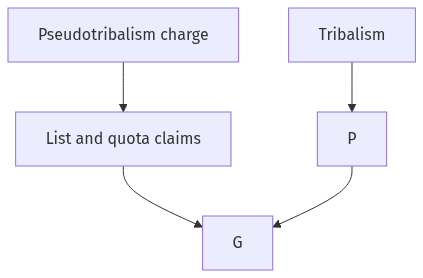
Courts rarely “scientifically” certify tribe. They ask whether the President’s list and the state process were followed. Inclusion and exclusion are political. A better language is graded vulnerability: PVTGs at one end, powerful listed groups at the other, unlisted forest people in between. Pseudotribalism as a slur cannot replace that grading.
- Elections heat both: ST reserved seats reward a tribal we; they also reward whoever can look most tribal on polling day.
Flow diagram
Conclusion
Tribalism is real politics of historically distinct communities. Pseudotribalism names opportunistic listing, but it is also a bureaucratic weapon. The ST list, PVTG layer and Gram Sabha rights are the test, not costume.
Quick related
Students also ask
-
Varnashrama and its contemporary relevance
Next question on this syllabus topic (2025 · Q5(d)). View answer →
-
Is every ST inclusion demand fake?
No. Some communities were missed by colonial lists. Each claim needs history, livelihood and neighbour-impact, not only a dance video.
-
Can tribalism be oppressive?
Yes. A numerically strong tribe can dominate a council or a district the way a dominant caste dominates a village.
More from this topic
Q6(a) · UPSC Mains 2026 · Anthropology GS 2 · 20 marks · Solution
Make a critical appraisal of the mesolithic culture of Ganga basin with reference to artifacts, faunal and human skeletal remains excavated from different sites
Evolution of the Indian Culture and Civilization
• Ganga basin Mesolithic sites like Sarai Nahar Rai, Mahadaha, and Damd
Q5(e) · UPSC Mains 2026 · Anthropology GS 2 · 10 marks · Solution
Contribution of L. K. Ananthakrishna Iyer in Anthropology.
Evolution of the Indian Culture and Civilization
L. K. Ananthakrishna Iyer is a pioneering figure in Indian anthropology, known for his monumental ethnographic surveys like The Cochin Tribes and Castes and The Mysore Tribes and Castes. Working during the colonial era, he bridged western anthropological methods with indigenous scholarship. His documentation of social stratification, material culture, and folklore laid the empirical foundation for Indian sociology and anthropology. Iyer also established the first department of anthropology in India at the University of Calcutta, shaping institutional teaching and research.
Q5(c) · UPSC Mains 2026 · Anthropology GS 2 · 10 marks · Solution
Article 371A of the Indian Constitution.
Evolution of the Indian Culture and Civilization
Article 371A of the Indian Constitution grants special autonomous status to Nagaland, protecting its traditional socio-religious practices, customary laws, and land ownership rights. Enacted via the 13th Constitutional Amendment Act, 1962, following the 16-point Agreement, it reflects the asymmetrical federal framework of India. The article places a special responsibility on the Governor regarding law and order and regional financial allocations. It balances tribal autonomy with national integration, though it faces implementation challenges in modern governance.