
Revision summary
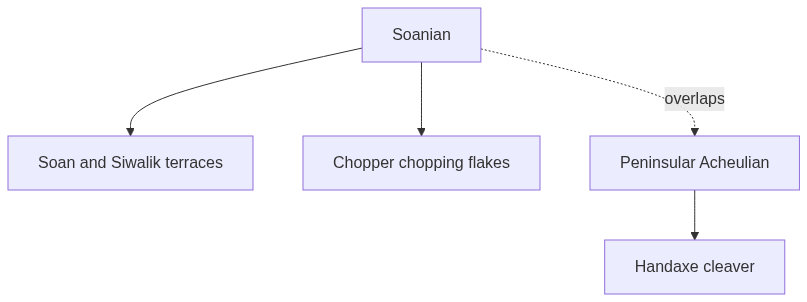
The Soanian is a cobble-tool tradition of the north-west Siwalik rivers, named by de Terra and Paterson. Typical tools are choppers, chopping tools and flakes in quartzite, not handaxe–cleaver sets. Indian occurrences include Pinjore–Nalagarh, Guler and related Beas–Sutlej terraces. Movius once opposed it to Acheulian Asia; later work finds overlap and mixed surface collections. It records Pleistocene foothill settlement, not a separate race of makers.
Model answer
Copper italics in this answer — like this — are the key facts. Each one is unpacked in the Facts & figures rail.
Introduction
The Soanian is a pebble-tool tradition of the north-west Himalayan foothills, named from the Soan river in present-day Punjab, Pakistan. It is one of the oldest named Palaeolithic industries of the subcontinent. The question asks for the cultural tradition as a whole, not only one terrace or one tool type.
Body
Time, space and tools
Helmut de Terra and T. T. Paterson, working with the Yale–Cambridge expedition in the 1930s, defined the Soanian from river terraces of the Soan valley. They linked tool stages to glacial and interglacial terraces. Later work by H. D. Sankalia, G. C. Mohapatra, R. V. Joshi and Parth Chauhan kept the name but loosened the strict glacial chronology.
The industry is a chopper–chopping-tool and flake tradition. Cores are cobbles of quartzite. Typical pieces are unifacial choppers, bifacial chopping tools, discoids and simple flakes. Handaxes and cleavers, the Acheulian signature of peninsular India, are rare or absent in classic Soanian assemblages.
- Geographically the tradition sits in the Siwalik frontal zone: Potwar Plateau, Soan, Beas, Sutlej, Sirsa and Ghaggar catchments, with Indian concentrations in Himachal Pradesh, Punjab and Haryana. Sites such as Pinjore–Nalagarh, Tikka Bai, Guler and terraces near Chandigarh are repeatedly cited.
Relation to Acheulian
Peninsular Acheulian — Attirampakkam, Hunsgi–Baichbal, Bhimbetka, Didwana — is a Large Flake Acheulian with handaxes and cleavers. The Soanian looks closer to the East Asian chopper–chopping picture that Hallam Movius once drew as a line across Asia. That line is no longer a wall. Acheulian pieces occur in the Siwaliks too, and some Soanian-looking cobble tools are now read as expedient use of river pebbles rather than a separate “race” of makers.
Robin Dennell and later surveys treat many Soanian collections as mixed surface material. Stratified, dated Soanian living floors remain scarce. The tradition is still a useful regional label for cobble-based Pleistocene technology in the north-west, not a closed culture with a single hominin author.
Settlement meaning
The Soanian shows that the Himalayan foothills were used through the Middle Pleistocene by groups who worked river cobbles on terraces and fans. It records a foothill adaptation, not a cave civilisation. Climate, terrace formation and raw-pebble supply shaped the toolkit more than a unique “Soan people”.
Flow diagram
Conclusion
Soanian names a cobble-chopper tradition of the Siwalik rivers, defined by de Terra and Paterson and later qualified by Indian prehistorians. It is distinct from peninsular Acheulian in tool choice, not in human worth. Dated stratified sites remain the test of the label.
Quick related
Students also ask
-
Caste domination, factionalism and political power
Next question on this syllabus topic (2025 · Q1(b)). View answer →
-
Is Soanian older than Acheulian in India?
Some terrace schemes placed early Soanian very old, but many collections are undated surface mixes. Age must be argued site by site.
-
Who made Soanian tools?
No hominin fossil is tied to a sealed Soanian floor. The makers were Pleistocene hominins using Siwalik cobbles; the species name is not fixed.
Same topic · past papers
UPSC has asked this before
These previous-year questions sit on the same topic. Open one to practise the earlier ask.
-
2022 · Q3(a) · Anthropology GS 2 · 20 marks
Make a critical appraisal of Megalithic tradition in India with special reference to North-East India
More from this topic
Q6(a) · UPSC Mains 2026 · Anthropology GS 2 · 20 marks · Solution
Make a critical appraisal of the mesolithic culture of Ganga basin with reference to artifacts, faunal and human skeletal remains excavated from different sites
Evolution of the Indian Culture and Civilization
• Ganga basin Mesolithic sites like Sarai Nahar Rai, Mahadaha, and Damd
Q5(e) · UPSC Mains 2026 · Anthropology GS 2 · 10 marks · Solution
Contribution of L. K. Ananthakrishna Iyer in Anthropology.
Evolution of the Indian Culture and Civilization
L. K. Ananthakrishna Iyer is a pioneering figure in Indian anthropology, known for his monumental ethnographic surveys like The Cochin Tribes and Castes and The Mysore Tribes and Castes. Working during the colonial era, he bridged western anthropological methods with indigenous scholarship. His documentation of social stratification, material culture, and folklore laid the empirical foundation for Indian sociology and anthropology. Iyer also established the first department of anthropology in India at the University of Calcutta, shaping institutional teaching and research.
Q5(c) · UPSC Mains 2026 · Anthropology GS 2 · 10 marks · Solution
Article 371A of the Indian Constitution.
Evolution of the Indian Culture and Civilization
Article 371A of the Indian Constitution grants special autonomous status to Nagaland, protecting its traditional socio-religious practices, customary laws, and land ownership rights. Enacted via the 13th Constitutional Amendment Act, 1962, following the 16-point Agreement, it reflects the asymmetrical federal framework of India. The article places a special responsibility on the Governor regarding law and order and regional financial allocations. It balances tribal autonomy with national integration, though it faces implementation challenges in modern governance.