
Revision summary
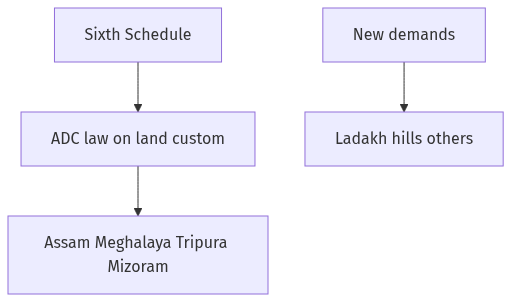
Sixth Schedule creates Autonomous District Councils in Assam, Meghalaya, Tripura and Mizoram. Councils can legislate on land, forest (non-reserved), shifting cultivation, village government and social custom. They have limited alienation better than many Fifth Schedule areas, but elites and minorities remain problems. BTR is a thicker later council; Ladakh and others now ask for the Schedule. It is not PESA and not a pan-Indian tribal government.
Model answer
Copper italics in this answer — like this — are the key facts. Each one is unpacked in the Facts & figures rail.
Introduction
The Sixth Schedule to the Constitution provides Autonomous District Councils (and regional councils) for specified tribal areas in Assam, Meghalaya, Tripura and Mizoram. It is a stronger, older autonomy device than PESA. Its present status is mixed: real law-making on land and custom, uneven democracy, and rising demands to copy it elsewhere.
Body
Design
Paragraphs of the Sixth Schedule allow councils to make laws on land, forest (other than reserved forest), shifting cultivation, village administration, marriage and social custom, inheritance, and some local taxes, subject to the Governor. Councils have elected members and nominated seats. They run local courts for specified disputes. Article 244(2) is the hook. This is not the Fifth Schedule, which uses Tribes Advisory Councils and the Governor’s regulations, and which PESA later tried to democratise.
Meghalaya’s whole state is under Sixth Schedule councils (Khasi, Jaintia, Garo). Assam has several ADCs (including Karbi Anglong, Dima Hasao, and the Bodoland Territorial Region after successive accords). Mizoram and Tripura have councils for Chakma, Lai, Mara, and Tripura tribal areas.
Present status
Councils have protected land alienation rules better than many Fifth Schedule districts. They have also been captured by local elites, accused of excluding women and smaller minorities (Bru/Reang, non-Bodo in BTR, non-Khasi in Shillong). Funds and state departments often bypass them. Inner Line and Sixth Schedule together structure the North-East’s ethnic federalism.
Demands to extend Sixth Schedule — Ladakh after 2019, some Gorkha and hill groups, parts of Arunachal and Manipur hills — show that the Schedule is now a political brand of autonomy. Parliament can amend the Schedule; it has not become a general tribal law for all India. Status today: constitutionally robust in four states, socially contested, fiscally dependent, and politically attractive to regions that lack it.
Flow diagram
Conclusion
Sixth Schedule Areas are autonomous council territories in four North-Eastern states with law-making on land and custom. They work as ethnic federalism, not as perfect local democracy. Their prestige now exceeds their delivery.
Quick related
Students also ask
-
Elucidate the difference between secularism, religiosity, religious fundamentalism, and spiritualism from an anthropological perspective.
Next question on this syllabus topic (2024 · Q6(b)). View answer →
-
Does the Sixth Schedule cover all North-Eastern tribes?
No. Nagaland, Manipur, Arunachal and Sikkim use other special provisions (including Article 371 and Inner Line), not the full Sixth Schedule.
-
Is PESA the same as the Sixth Schedule?
No. PESA extends panchayats to Fifth Schedule areas. Sixth Schedule is council-based autonomy in four states.
Same topic · past papers
UPSC has asked this before
These previous-year questions sit on the same topic. Open one to practise the earlier ask.
-
2024 · Q6(c) · Anthropology GS 2 · 15 marks
Discuss the contribution of P.K. Bhowmick in decriminalising the status of the Lodha tribe.
More from this topic
Q6(a) · UPSC Mains 2026 · Anthropology GS 2 · 20 marks · Solution
Make a critical appraisal of the mesolithic culture of Ganga basin with reference to artifacts, faunal and human skeletal remains excavated from different sites
Evolution of the Indian Culture and Civilization
• Ganga basin Mesolithic sites like Sarai Nahar Rai, Mahadaha, and Damd
Q5(e) · UPSC Mains 2026 · Anthropology GS 2 · 10 marks · Solution
Contribution of L. K. Ananthakrishna Iyer in Anthropology.
Evolution of the Indian Culture and Civilization
L. K. Ananthakrishna Iyer is a pioneering figure in Indian anthropology, known for his monumental ethnographic surveys like The Cochin Tribes and Castes and The Mysore Tribes and Castes. Working during the colonial era, he bridged western anthropological methods with indigenous scholarship. His documentation of social stratification, material culture, and folklore laid the empirical foundation for Indian sociology and anthropology. Iyer also established the first department of anthropology in India at the University of Calcutta, shaping institutional teaching and research.
Q5(c) · UPSC Mains 2026 · Anthropology GS 2 · 10 marks · Solution
Article 371A of the Indian Constitution.
Evolution of the Indian Culture and Civilization
Article 371A of the Indian Constitution grants special autonomous status to Nagaland, protecting its traditional socio-religious practices, customary laws, and land ownership rights. Enacted via the 13th Constitutional Amendment Act, 1962, following the 16-point Agreement, it reflects the asymmetrical federal framework of India. The article places a special responsibility on the Governor regarding law and order and regional financial allocations. It balances tribal autonomy with national integration, though it faces implementation challenges in modern governance.