
Revision summary
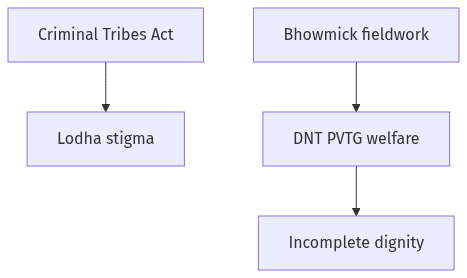
Lodhas of south-west Bengal were notified under the Criminal Tribes Act and later denotified, remaining a PVTG. P. K. Bhowmick’s ethnography showed crime statistics as a product of land and forest loss plus police labelling. He combined research with cooperatives, education and state advocacy. Decriminalisation is legal repeal plus social destigmatisation; the second is unfinished. He stands in the Indian tradition that refused racial criminal types.
Model answer
Copper italics in this answer — like this — are the key facts. Each one is unpacked in the Facts & figures rail.
Introduction
P. K. Bhowmick of Calcutta University spent decades with the Lodha (also Lodha-Savara) of western Bengal’s jungle mahals. He showed that their “criminality” was a colonial label, not a racial trait, and he worked to dismantle that status in law and in the village.
Body
Criminalisation
The Criminal Tribes Act, 1871 (amended 1911, 1924) notified communities as hereditary criminals, with roll-call, restricted movement and police stigma. Lodhas of Midnapore–Jhargram, forest-edge people with hunting, gathering and later wage work, were so notified. After Independence the Act was repealed (1952) and groups became Denotified Tribes (DNTs). Stigma, police suspicion and poverty continued. Lodhas are listed as PVTG in West Bengal — vulnerability after criminalisation, not a primitive essence.
Bhowmick’s contribution
Bhowmick’s ethnography (The Lodhas of West Bengal and later papers) reconstructed Lodha economy, kinship and the history of notification. He argued that theft and dacoity statistics were produced by land loss, forest closure and police expectation, a labelling loop. He combined participant fieldwork with applied anthropology: cooperatives, education, settlement, and representation to the state. He helped make the Lodha a subject of welfare anthropology rather than of the thana.
- Decriminalising status meant: (1) insisting legally that Lodhas are citizens and a Scheduled Tribe/PVTG, not a crime caste; (2) changing police and neighbour practice; (3) building livelihood alternatives so that survival did not confirm the stereotype. Bhowmick’s students and the Lodha development literature in Bengal follow that programme.
Limits
Denotification did not end encounter killings, bonded work or school dropout. Xaxa’s wider DNT point applies: without land and dignity, a repealed Act still lives in the file. Bhowmick did not “save” a people by himself; he reframed them for the university and the secretariat. That reframing is the anthropological contribution: from criminal tribe to dispossessed forest people.
Place him with S. C. Roy (who humanised Mundas) and against Risley’s typed criminality. Ghurye’s assimilation is not Bhowmick’s path; Bhowmick sought specific rehabilitation, closer to Elwin’s protection without isolation as romance.
Flow diagram
Conclusion
- Bhowmick decriminalised the Lodha in knowledge and in advocacy: he replaced a hereditary crime type with a history of forest dispossession and a PVTG welfare claim. Law had already repealed the Criminal Tribes Act; he worked on the stigma that survived the repeal.
Quick related
Students also ask
-
Critically examine existing paradigms of holistic health for the marginalized sections of society drawing inferences from COVID-19 pandemic.
Next question on this syllabus topic (2024 · Q7(a)). View answer →
-
Did Bhowmick repeal the Criminal Tribes Act?
No. Parliament repealed it in 1952. Bhowmick fought the ethnographic and police afterlife of the label among Lodhas.
-
Are Lodhas still called a criminal tribe in law?
No. The legal category is gone. Social stigma and PVTG poverty are the remaining facts.
More from this topic
Q6(a) · UPSC Mains 2026 · Anthropology GS 2 · 20 marks · Solution
Make a critical appraisal of the mesolithic culture of Ganga basin with reference to artifacts, faunal and human skeletal remains excavated from different sites
Evolution of the Indian Culture and Civilization
• Ganga basin Mesolithic sites like Sarai Nahar Rai, Mahadaha, and Damd
Q5(e) · UPSC Mains 2026 · Anthropology GS 2 · 10 marks · Solution
Contribution of L. K. Ananthakrishna Iyer in Anthropology.
Evolution of the Indian Culture and Civilization
L. K. Ananthakrishna Iyer is a pioneering figure in Indian anthropology, known for his monumental ethnographic surveys like The Cochin Tribes and Castes and The Mysore Tribes and Castes. Working during the colonial era, he bridged western anthropological methods with indigenous scholarship. His documentation of social stratification, material culture, and folklore laid the empirical foundation for Indian sociology and anthropology. Iyer also established the first department of anthropology in India at the University of Calcutta, shaping institutional teaching and research.
Q5(c) · UPSC Mains 2026 · Anthropology GS 2 · 10 marks · Solution
Article 371A of the Indian Constitution.
Evolution of the Indian Culture and Civilization
Article 371A of the Indian Constitution grants special autonomous status to Nagaland, protecting its traditional socio-religious practices, customary laws, and land ownership rights. Enacted via the 13th Constitutional Amendment Act, 1962, following the 16-point Agreement, it reflects the asymmetrical federal framework of India. The article places a special responsibility on the Governor regarding law and order and regional financial allocations. It balances tribal autonomy with national integration, though it faces implementation challenges in modern governance.