
Revision summary
Ethnic identity is a group’s self-recognition in language, kin, and memory. Ethnicity is identity mobilised as a political boundary, as Barth argued. Tribal conflict factors include land alienation, outsider demography, council majorities, jobs, religion, and security laws. Naga nationhood, Jharkhand, Bodo territoriality, and Bru exclusion are illustrations. Conflict is organised by elites and the state, not by a tribal essence.
Model answer
Copper italics in this answer — like this — are the key facts. Each one is unpacked in the Facts & figures rail.
Introduction
- Ethnic identity is a group’s sense of who they are: language, origin, clan, and memory. Ethnicity is the political use of that identity in a field of other groups and the state. Conflict in tribal areas grows when ethnicity organises land, jobs, and votes.
Body
Distinction
- Ethnic identity can be quiet: a Munda or Khasi knows kin, myth, and tongue without a militia.
- Ethnicity is identity mobilised as a claim — for a state, a council, a job quota, or exclusion of “outsiders”.
- Fredrik Barth treated ethnicity as a boundary maintained in contact, not a museum of traits. Paul Brass and Indian political sociology stress elite competition and the state.
- G. S. Ghurye reduced many tribes to incomplete Hindus; that erasure itself can produce a later ethnic rebound (sarna flags, student unions).
Factors of conflict in tribal areas
- Land and forest: alienation, mining, and dams. Jharkhand, Odisha Niyamgiri, and Chhattisgarh show ethnicity forming around jal, jungle, jameen.
- Demography and “outsider” labour: Inner Line politics in Nagaland, Mizoram, and Arunachal; Bodo–Adivasi–Muslim contests in Assam; Tripura’s tribal–Bengali history.
- State boundaries and councils: a Sixth Schedule or new district that privileges one group creates inner minorities (Bru/Reang in Mizoram, non-Bodo in Bodoland).
- Resources and jobs: coal, oil, and government posts in ST-reserved belts. F. G. Bailey already saw conflict as political, not as ancient tribal nature.
- Religion and custom: church versus valley Hindu or Meitei; sarna versus Hindu code; conversion debates in Arunachal.
- Insurgency and security laws: Naga, Mizo (historical), and later smaller armed groups; AFSPA belts where the army is a party to the ethnic field.
- Development displacement without consent, as Xaxa noted, turns a livelihood crisis into an ethnic story.
Ethnographic illustrations
- Naga identity was clan and village; twentieth-century ethnicity became a national claim across administrative lines (Fürer-Haimendorf described the older village world).
- Santal identity is old; Jharkhand ethnicity joined several tribes against a Bihar plains elite.
- Bodo mobilisation for a territorial council shows language plus land plus party.
Caution
- Not every riot is primordial. Leaders, census categories, and resource rents organise the fight.
Flow diagram
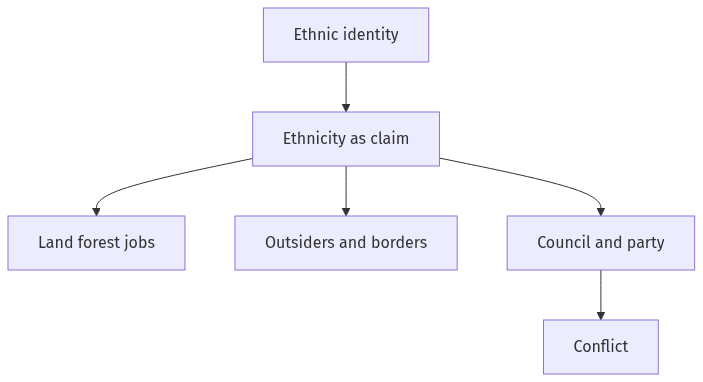
Conclusion
Ethnic identity is belonging. Ethnicity is that belonging turned into a political boundary. Tribal-area conflict follows land, outsiders, councils, jobs, and security, as Naga, Bodo, Jharkhand, and Bru cases show. Anthropology should name the resources, not an eternal tribal feud.
Quick related
Students also ask
-
Elucidate the shifting terrains of India's tribal policies in colonial and post-colonial periods.
Next question on this syllabus topic (2023 · Q7(a)). View answer →
-
Is every tribe an ethnic group in Barth’s sense?
A tribe has identity. It becomes ethnicity when that identity is organised against others for territory or office.
-
Does Sixth Schedule end ethnic conflict?
It can freeze a majority’s win. Inner minorities may then face a new exclusion inside the council.
Same topic · past papers
UPSC has asked this before
These previous-year questions sit on the same topic. Open one to practise the earlier ask.
-
2025 · Q7(b) · Anthropology GS 2 · 15 marks
Discuss the rising ethnic conflicts in India and propose their possible remedial measures -
2025 · Q4(a) · Anthropology GS 2 · 20 marks
What are the different types of caste mobility in India? Highlight the various factors responsible for it -
2021 · Q6(b) · Anthropology GS 2 · 15 marks
Examine the factors responsible for malnutrition in tribal India and suggest interventions required to overcome the problem -
2016 · Q7(a) · Anthropology GS 2 · 20 marks
Examine the factors responsible for the exploitation of scheduled castes in India
More from this topic
Q8(b) · UPSC Mains 2026 · Anthropology GS 2 · 15 marks · Solution
What are the major challenges tribal communities are facing in contemporary India?
The concept of ethnicity
• Tribal communities face severe displacement from ancestral lands due to large-scale mining, dams, and industrial projects. • Protective laws like the CNT and SPT Acts often fail to prevent illegal land transfer to non-tribals and corporations. • Delays in implementing the Forest Rights Act (FRA) restrict access to minor forest produce and disrupt traditional livelihoods. • State restrictions and ecological pressures are forcing a decline in traditional Jhum (shifting cultivation) practices. • Mainstreaming pressures, market forces, and religious conversions are eroding indigenous languages, beliefs, and customary governance. • Remote tribal areas suffer from acute health deficits—like malnutrition and sickle cell anaemia—and high educational dropout rates. • Sustainable solutions require moving past paternalistic welfare toward self-determination and strictly enforcing PESA and FRA.
Q5(a) · UPSC Mains 2026 · Anthropology GS 2 · 10 marks · Solution
Buddhist tribes of India.
The concept of ethnicity
• Major Buddhist tribes include the Monpa, Sherdukpen, Khampti, Singpho, Chakma, and Bhutia. • They are geographically concentrated in the Himalayan belt and Northeast India, specifically across Arunachal Pradesh, Assam, Sikkim, Mizoram, Tripura, and West Bengal. • Their religious practice is a syncretism of canonical Buddhism (Mahayana, Theravada, or Tibetan) and indigenous animism or Bon beliefs. • Rituals frequently honor local mountain deities and spirits alongside formal monastic practices led by lamas or bhikthus. • Unlike rigid caste systems, their societies remain relatively egalitarian, guided by clan ties and customary village councils. • They primarily speak Tibeto-Burman or Tai dialects, maintaining oral traditions alongside written scriptures in Tibetan or Tai scripts. • Preserving their unique identity requires balancing modernization with constitutional protections under the Scheduled Tribes framework.
Q4(a) · UPSC Mains 2026 · Anthropology GS 2 · 20 marks · Solution
Write an account on the contribution of Verrier Elwin in developing policies for the tribal populations in post-independent India
The concept of ethnicity
Verrier Elwin played a foundational role in shaping post-independent India's tribal policy by advocating for cultural autonomy, protection of land rights, and cautious assimilation. Influenced by his anthropological work in Central India and NEFA, his ideas directly shaped Jawaharlal Nehru's Tribal Panchsheel. While critiqued for encouraging isolationism, his emphasis on tribal heritage ensured a distinct administrative framework under the Sixth Schedule.