
Revision summary
Scheduled Areas are Fifth Schedule territories notified for tribal protection under Article 244. The Governor, Tribes Advisory Council, and land regulations are the core devices. PESA 1996 tries to put Gram Sabha at the centre of local resources. They are distinct from Sixth Schedule autonomous councils in four North-Eastern states. Samata and Xaxa show the gap between paper protection and mining practice.
Model answer
Copper italics in this answer — like this — are the key facts. Each one is unpacked in the Facts & figures rail.
Introduction
Scheduled Areas are territories listed under the Fifth Schedule of the Constitution because they have a large tribal population and a history of distinct land and custom. They are a protective geography inside the states, not a separate country.
Body
Constitutional basis
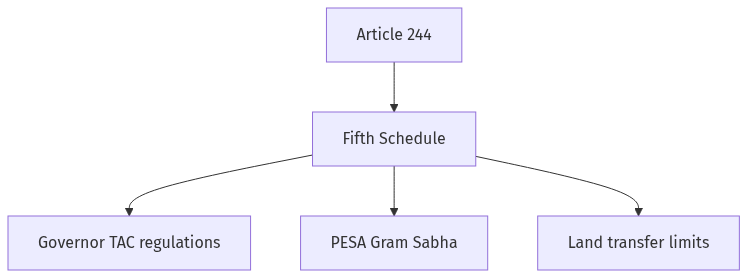
- Article 244(1) and the Fifth Schedule provide for Scheduled Areas in states other than the four Sixth Schedule states of Assam, Meghalaya, Tripura, and Mizoram.
- The President notifies and can re-schedule areas. A Tribes Advisory Council must be set up; the Governor may make regulations for peace and good government, including land transfer.
- PESA, 1996, after the Bhuria Committee, extends panchayats to these areas and names Gram Sabha powers over land, minor forest produce, and intoxicants.
Where they are
- Large blocks sit in Gujarat, Rajasthan, Maharashtra, Madhya Pradesh, Chhattisgarh, Jharkhand, Odisha, Andhra Pradesh, Telangana, Himachal Pradesh, and smaller pockets elsewhere as notified.
- They are not identical with every ST hamlet. Many tribal people live outside Scheduled Areas and lose this extra shield.
How they differ from the Sixth Schedule
- Sixth Schedule uses Autonomous District Councils in parts of the North-East.
- Fifth Schedule uses Governor, TAC, and now PESA Gram Sabha. Samata (1997) restricted transfer of tribal land in Scheduled Areas, including some mining leases.
Limit
- Notification lags settlement. Mining and dams often proceed while TAC advice is weak, as the Xaxa Committee recorded.
Flow diagram
Conclusion
Scheduled Areas are Fifth Schedule tribal territories with special land and governance rules. PESA and Samata are the living tests. They protect only the notified map, not every Adivasi household.
Quick related
Students also ask
-
Village as little republic
Next question on this syllabus topic (2023 · Q5(c)). View answer →
-
Is every ST village a Scheduled Area?
No. Only notified tracts. Many ST households live outside and do not get Fifth Schedule land rules.
-
Does Arunachal fall under the Fifth Schedule?
No. Arunachal is not a Fifth Schedule state. Protection there runs through Inner Line, custom, and state politics.
More from this topic
Q6(a) · UPSC Mains 2026 · Anthropology GS 2 · 20 marks · Solution
Make a critical appraisal of the mesolithic culture of Ganga basin with reference to artifacts, faunal and human skeletal remains excavated from different sites
Evolution of the Indian Culture and Civilization
• Ganga basin Mesolithic sites like Sarai Nahar Rai, Mahadaha, and Damd
Q5(e) · UPSC Mains 2026 · Anthropology GS 2 · 10 marks · Solution
Contribution of L. K. Ananthakrishna Iyer in Anthropology.
Evolution of the Indian Culture and Civilization
L. K. Ananthakrishna Iyer is a pioneering figure in Indian anthropology, known for his monumental ethnographic surveys like The Cochin Tribes and Castes and The Mysore Tribes and Castes. Working during the colonial era, he bridged western anthropological methods with indigenous scholarship. His documentation of social stratification, material culture, and folklore laid the empirical foundation for Indian sociology and anthropology. Iyer also established the first department of anthropology in India at the University of Calcutta, shaping institutional teaching and research.
Q5(c) · UPSC Mains 2026 · Anthropology GS 2 · 10 marks · Solution
Article 371A of the Indian Constitution.
Evolution of the Indian Culture and Civilization
Article 371A of the Indian Constitution grants special autonomous status to Nagaland, protecting its traditional socio-religious practices, customary laws, and land ownership rights. Enacted via the 13th Constitutional Amendment Act, 1962, following the 16-point Agreement, it reflects the asymmetrical federal framework of India. The article places a special responsibility on the Governor regarding law and order and regional financial allocations. It balances tribal autonomy with national integration, though it faces implementation challenges in modern governance.