
Revision summary
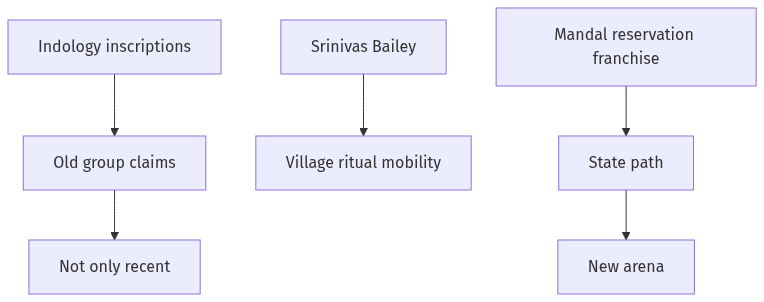
Caste mobility as group rank-claim is old: dynastic Kshatriya status, grants, and Puranic origin tales. Srinivas and Bailey show village and frontier mobility in the twentieth century. The colonial census froze names and made paper rank fights. Mandal, Indra Sawhney, and adult franchise made the state the main arena. Ambedkarite assertion is a recent path that refuses Sanskritisation as the only honourable move.
Model answer
Copper italics in this answer — like this — are the key facts. Each one is unpacked in the Facts & figures rail.
Introduction
Caste mobility is the movement of a person or a group in the rank order of jati and varna. It is not a product only of modern jobs and elections. Indology and ethnography both show older paths. What is recent is the scale, the state, and the language of rights.
Body
Indological context
- Dharmashastra presents varna as birth-based, yet it records apad dharma, mixed unions, and the vrata of groups seeking recognition.
- Kshatriya status was claimed by many regional dynasties. Rajput formation, discussed by Dirk Kolff and others, is a long military-and-marriage process, not a Vedic fossil.
- Temple inscriptions and copper plates show land grants that raise a group’s local rank. Kayastha and other scribal groups negotiated status across centuries.
- Bhakti saints criticised birth rank and opened devotion; they did not abolish jati, but they made a moral path around it.
- Sanskritisation in Srinivas’s sense has pre-modern analogues: claims to gotra, vegetarian style, and Puranic origin.
Empirical and historical context
- M. N. Srinivas showed twentieth-century village mobility through ritual copying after land and numbers rose.
- F. G. Bailey showed political and economic mobility on a tribe–caste frontier.
- Colonial census froze names and made rank a paper fight. That was new as a technology, not as a desire to rise.
- Non-Brahmin movements, Phule, Periyar, Ambedkar, and Mandal (1990) made mobility a claim on the state: education, jobs, and elected office.
- Indra Sawhney (1992) and later OBC lists turned empirical backwardness into a legal ladder. This is recent as constitutional machinery.
What is not recent
- Group climbing through land, war, sect, and origin tales is old.
- Individual escape through sainthood, army, or city trade is old.
What is recent
- Adult franchise, reservation, courts, and a national OBC/SC public.
- Urban jobs and English education as a mass path.
- Dalit assertion that rejects Sanskritisation as the only honourable climb.
Answer
- Caste mobility is not recent as a social fact.
- Recent tools have changed its speed, its arena, and who can refuse the old ritual path.
Flow diagram
Conclusion
Indology and inscriptions show groups claiming higher rank long before the census. Village studies show Sanskritisation in living memory. The Republic added reservation and parties. Mobility is old; the democratic state path is new.
Quick related
Students also ask
-
Is annihilation of caste possible? Discuss the future of caste system in the light of various proactive measures taken by the Indian State.
Next question on this syllabus topic (2023 · Q6(a)). View answer →
-
Did Manu freeze caste forever?
The text ranks birth strongly, but history shows claims, grants, and sects moving groups. Text is an ideal, not a full social film.
-
Is reservation the first caste mobility?
No. It is the first large constitutional machinery for it. Ritual and military claims are older.
Same topic · past papers
UPSC has asked this before
These previous-year questions sit on the same topic. Open one to practise the earlier ask.
-
2025 · Q4(a) · Anthropology GS 2 · 20 marks
What are the different types of caste mobility in India? Highlight the various factors responsible for it -
2015 · Q8(a) · Anthropology GS 2 · 20 marks
What do you understand by dynamics of caste mobility? How did the concept of Sanskritization contribute to its functionality?
More from this topic
Q8(c) · UPSC Mains 2026 · Anthropology GS 2 · 15 marks · Solution
What are the provisions given in the Constitution of India for the safeguard of the Scheduled Caste populations?
Caste system in India
The Constitution protects Scheduled Castes through equality and anti-discrimination (Articles 14–15), abolition of untouchability (Article 17), and affirmative action including reservation in legislatures (Articles 330, 332) and public employment (Article 16). Article 46 in the DPSPs directs the state to promote SC educational and economic interests and guard against exploitation. Article 338 creates the National Commission for Scheduled Castes to monitor safeguards. Statutes such as the Protection of Civil Rights Act, 1955, and the SC/ST (Prevention of Atrocities) Act give teeth to constitutional promises.
Q2(a) · UPSC Mains 2026 · Anthropology GS 2 · 20 marks · Solution
What are the major debates related to the concept of jajmani system?
Caste system in India
1. W.H. Wiser described the Jajmani system as a stable, reciprocal exchange network promoting rural solidarity. 2. Conflict theorists like Kathleen Gough and T. Scarlett Epstein criticized this as a romanticized, exploitative hierarchy. 3. Louis Dumont argued the system is driven by religious principles of purity, pollution, and ritual interdependence. 4. Conversely, institutional economists like Oscar Lewis emphasized material realities, land control, and surplus extraction. 5. Market forces, cash cropping, and monetisation have steadily eroded traditional grain-payment obligations in rural areas. 6. State interventions like land reforms, panchayats, and affirmative action provided alternative mobility, weakening dominant caste monopolies. 7. Ultimately, the system transitioned from classical ritual patronage to a dynamic structure where traditional inequalities adapt to modern politics.
Q4(a) · UPSC Mains 2025 · Anthropology GS 2 · 20 marks · Solution
What are the different types of caste mobility in India? Highlight the various factors responsible for it
Caste system in India
Types include Sanskritisation, Westernisation, dominant-caste politics, conversion, ethnicisation, passing and legal listing. Srinivas explained ritual copying; Mandal and Indra Sawhney explain political listing. Ambedkarite conversion exits Hindu rank but meets list-law limits for some religious groups. Economic, electoral, religious and judicial factors interact and can contradict. Tribe–caste continuum is a related gradient, not the same as Sanskritisation.