
Revision summary
Jajmani is hereditary service of artisan and serving castes for landed patrons, named by Wiser. Beidelman stressed coercion; Srinivas and Lewis described harvest shares and rites. Ritual calls to barber and priest continue in many villages. Cash wages, mills, land reform, and MGNREGA have broken daily dependence. Epstein’s Mysore villages show the market replacing customary shares.
Model answer
Copper italics in this answer — like this — are the key facts. Each one is unpacked in the Facts & figures rail.
Introduction
Jajmani is a village system of hereditary service in which artisan and serving castes work for landed patron households in return for grain, clothes, and ritual dues rather than a daily cash wage.
Body
The classic picture
- William Wiser named jajmani from a Uttar Pradesh village: the jajman is the patron, the kamin or purjan is the server.
- Thomas O. Beidelman stressed inequality and coercion inside the same exchange.
- Oscar Lewis in Rampur and M. N. Srinivas in Rampura recorded barber, washerman, carpenter, and priest tied to harvest shares and life-cycle rites.
- The system linked caste occupation, land, and ritual rank in one local economy.
Continuity
- Life-cycle rites still call the barber, priest, and drummer in many villages.
- Some grain shares and festival gifts survive beside cash.
- Dominant-caste patrons still organise labour at weddings and harvests, as André Béteille saw in Tanjore even when tenancy law had begun to bite.
Change
- Cash wages, mills, and urban jobs cut hereditary monopoly of the smith and weaver.
- Land reform, MGNREGA, and reserved panchayat seats reduce total dependence on one jajman.
- Scarlett Epstein in Wangala and Dalena showed irrigation and the market replacing customary shares.
- Migration and shop goods mean many kamins no longer live by one village’s grain.
Flow diagram
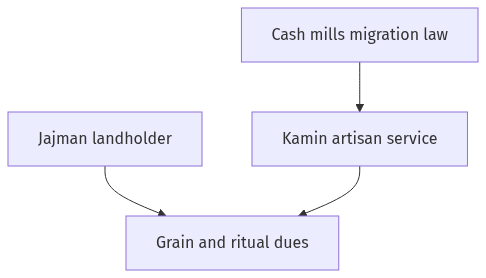
Conclusion
Jajmani was a hereditary service economy around land and ritual. Rites keep fragments of it. Cash, law, mills, and migration have ended it as the main village wage system.
Quick related
Students also ask
-
Is caste mobility a recent phenomenon? Discuss in the light of Indological and Empirical context.
Next question on this syllabus topic (2023 · Q4(c)). View answer →
-
Is jajmani the same as caste?
No. Caste is a wider rank and marriage system. Jajmani is one local labour and ritual contract that used caste occupations.
-
Has jajmani fully ended?
As a whole-village grain wage it has largely ended. Fragments remain in life-cycle ritual and some harvest gifts.
Same topic · past papers
UPSC has asked this before
These previous-year questions sit on the same topic. Open one to practise the earlier ask.
-
2026 · Q2(a) · Anthropology GS 2 · 20 marks
What are the major debates related to the concept of jajmani system?
More from this topic
Q8(c) · UPSC Mains 2026 · Anthropology GS 2 · 15 marks · Solution
What are the provisions given in the Constitution of India for the safeguard of the Scheduled Caste populations?
Caste system in India
The Constitution protects Scheduled Castes through equality and anti-discrimination (Articles 14–15), abolition of untouchability (Article 17), and affirmative action including reservation in legislatures (Articles 330, 332) and public employment (Article 16). Article 46 in the DPSPs directs the state to promote SC educational and economic interests and guard against exploitation. Article 338 creates the National Commission for Scheduled Castes to monitor safeguards. Statutes such as the Protection of Civil Rights Act, 1955, and the SC/ST (Prevention of Atrocities) Act give teeth to constitutional promises.
Q2(a) · UPSC Mains 2026 · Anthropology GS 2 · 20 marks · Solution
What are the major debates related to the concept of jajmani system?
Caste system in India
1. W.H. Wiser described the Jajmani system as a stable, reciprocal exchange network promoting rural solidarity. 2. Conflict theorists like Kathleen Gough and T. Scarlett Epstein criticized this as a romanticized, exploitative hierarchy. 3. Louis Dumont argued the system is driven by religious principles of purity, pollution, and ritual interdependence. 4. Conversely, institutional economists like Oscar Lewis emphasized material realities, land control, and surplus extraction. 5. Market forces, cash cropping, and monetisation have steadily eroded traditional grain-payment obligations in rural areas. 6. State interventions like land reforms, panchayats, and affirmative action provided alternative mobility, weakening dominant caste monopolies. 7. Ultimately, the system transitioned from classical ritual patronage to a dynamic structure where traditional inequalities adapt to modern politics.
Q4(a) · UPSC Mains 2025 · Anthropology GS 2 · 20 marks · Solution
What are the different types of caste mobility in India? Highlight the various factors responsible for it
Caste system in India
Types include Sanskritisation, Westernisation, dominant-caste politics, conversion, ethnicisation, passing and legal listing. Srinivas explained ritual copying; Mandal and Indra Sawhney explain political listing. Ambedkarite conversion exits Hindu rank but meets list-law limits for some religious groups. Economic, electoral, religious and judicial factors interact and can contradict. Tribe–caste continuum is a related gradient, not the same as Sanskritisation.