
Revision summary
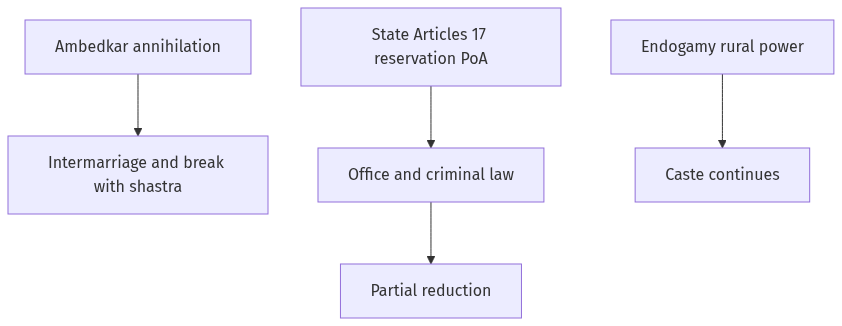
Ambedkar defined annihilation as ending graded inequality, not polishing it through Sanskritisation. The State used Article 17, atrocity law, reservation, Mandal, and panchayat quotas. A Dalit and OBC middle class and party system show real change. Endogamy, atrocities, and list-competition show caste surviving. Full annihilation is not present; partial civic equality is.
Model answer
Copper italics in this answer — like this — are the key facts. Each one is unpacked in the Facts & figures rail.
Introduction
B. R. Ambedkar’s Annihilation of Caste treated jati as a graded inequality that reform of custom could not end. He asked for a destruction of the religious basis of caste, intermarriage, and a new moral community. The Republic later used law, reservation, and development. The question is whether those measures can finish his programme.
Body
Ambedkar’s test
- Caste is not only division of labour but division of labourers, ranked and endogamous.
- Temple entry and Sanskritisation leave the ladder standing. Annihilation needs inter-caste marriage, a break with shastric authority, and equal citizenship.
- Conversion (1956) was a collective exit, not a private piety.
State measures
- Abolition of untouchability (Article 17), the Protection of Civil Rights Act, and the SC/ST (Prevention of Atrocities) Act, 1989 (amended 2015) criminalise caste humiliation.
- Articles 15(4), 16(4), 46, and reservation in legislatures, jobs, and education (with Indra Sawhney, creamy layer for OBC, and later EWS as a separate track) are proactive ranking tools.
- 73rd and 74th Amendments reserve panchayat and municipality seats for SC and ST, including women.
- Land reform, scholarships, and Stand-Up or similar enterprise schemes try to shift class. Mandal (1990) expanded the OBC public.
What has changed
- A Dalit and OBC middle class exists in offices, universities, and parties. Kanshi Ram and later Bahujan politics made caste a public claim, not only a stigma.
- Urban anonymity, courts, and campuses weaken everyday untouchability in some settings.
What has not
- Marriage remains largely endogamous. Honour violence and honour-coded families show the ladder in the household.
- Atrocities in rural land and love cases continue. Reservation created a new competitive politics of lists, not a casteless public.
- Ambedkar warned that political democracy without social democracy would keep caste. That warning still fits.
Is annihilation possible?
- As a total end of jati in one generation, no. Endogamy and ritual rank reproduce it.
- As a reduction of graded humiliation through law, numbers in office, and mixed work, yes, in part, already.
- Future caste is likely to be politicised, legally regulated, and still marital, unless intermarriage and local land power change at scale.
Flow diagram
Conclusion
Annihilation in Ambedkar’s full sense is not yet possible because marriage and rural power still reproduce jati. State measures have made caste a constitutional adversary and a political resource. The future is a weaker ritual ladder and a stronger caste-in-politics, unless social democracy catches up with the statute book.
Quick related
Students also ask
-
Critically describe Dr. B. R. Ambedkar's argument on the origin of Indian caste system
Next question on this syllabus topic (2022 · Q2(c)). View answer →
-
Did Ambedkar think the Constitution alone would annihilate caste?
No. He treated political democracy as incomplete without social democracy, intermarriage, and a new public ethic.
-
Does reservation annihilate caste?
It redistributes office and education. It does not by itself end endogamy. It can also freeze caste as a certificate identity.
Same topic · past papers
UPSC has asked this before
These previous-year questions sit on the same topic. Open one to practise the earlier ask.
-
2025 · Q7(b) · Anthropology GS 2 · 15 marks
Discuss the rising ethnic conflicts in India and propose their possible remedial measures
More from this topic
Q8(c) · UPSC Mains 2026 · Anthropology GS 2 · 15 marks · Solution
What are the provisions given in the Constitution of India for the safeguard of the Scheduled Caste populations?
Caste system in India
The Constitution protects Scheduled Castes through equality and anti-discrimination (Articles 14–15), abolition of untouchability (Article 17), and affirmative action including reservation in legislatures (Articles 330, 332) and public employment (Article 16). Article 46 in the DPSPs directs the state to promote SC educational and economic interests and guard against exploitation. Article 338 creates the National Commission for Scheduled Castes to monitor safeguards. Statutes such as the Protection of Civil Rights Act, 1955, and the SC/ST (Prevention of Atrocities) Act give teeth to constitutional promises.
Q2(a) · UPSC Mains 2026 · Anthropology GS 2 · 20 marks · Solution
What are the major debates related to the concept of jajmani system?
Caste system in India
1. W.H. Wiser described the Jajmani system as a stable, reciprocal exchange network promoting rural solidarity. 2. Conflict theorists like Kathleen Gough and T. Scarlett Epstein criticized this as a romanticized, exploitative hierarchy. 3. Louis Dumont argued the system is driven by religious principles of purity, pollution, and ritual interdependence. 4. Conversely, institutional economists like Oscar Lewis emphasized material realities, land control, and surplus extraction. 5. Market forces, cash cropping, and monetisation have steadily eroded traditional grain-payment obligations in rural areas. 6. State interventions like land reforms, panchayats, and affirmative action provided alternative mobility, weakening dominant caste monopolies. 7. Ultimately, the system transitioned from classical ritual patronage to a dynamic structure where traditional inequalities adapt to modern politics.
Q4(a) · UPSC Mains 2025 · Anthropology GS 2 · 20 marks · Solution
What are the different types of caste mobility in India? Highlight the various factors responsible for it
Caste system in India
Types include Sanskritisation, Westernisation, dominant-caste politics, conversion, ethnicisation, passing and legal listing. Srinivas explained ritual copying; Mandal and Indra Sawhney explain political listing. Ambedkarite conversion exits Hindu rank but meets list-law limits for some religious groups. Economic, electoral, religious and judicial factors interact and can contradict. Tribe–caste continuum is a related gradient, not the same as Sanskritisation.