
Revision summary
Varna is the four-fold Brahmanical rank by birth. Buddhism treated it as a social label, not a bar to nirvana. The sangha was open by conduct, as Ashokan dhamma also implied. Patronage still carried rank into Buddhist society. Ambedkar used that critique in the 1956 conversion.
Model answer
Copper italics in this answer — like this — are the key facts. Each one is unpacked in the Facts & figures rail.
Introduction
Varna is the four-fold ranking of Brahmana, Kshatriya, Vaishya, and Shudra in Brahmanical texts. Buddhism did not delete those names, but it denied that birth-varna decides release.
Body
The Buddhist claim
- Early suttas treat varna as a social label, not as a ritual essence. A person of any birth may join the sangha if conduct is sound.
- The Buddha used the language of Arya for the noble path, not for a closed birth estate.
- Ashoka’s edicts praise dhamma and gifts to all sects. They do not rest the empire on varna purity.
Limit and afterlife
- Monasteries still drew patronage from kings and merchants, so rank did not vanish from Buddhist society.
- B. R. Ambedkar later read Buddhism as a public exit from caste, which is why Navayana conversion in 1956 used the older critique of birth-varna.
- Irawati Karve and Indological kinship work still show varna as a textual map that villages mix with jati. Buddhism attacked the map’s soteriology more than it erased jati on the ground.
Flow diagram
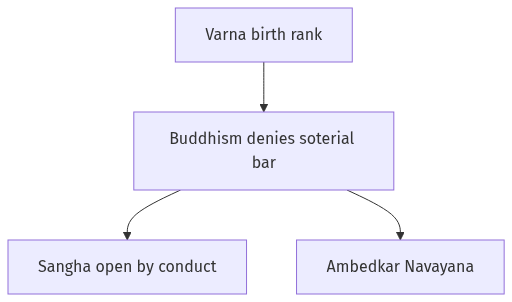
Conclusion
Buddhism kept the word varna but broke its monopoly over salvation. The sangha was open in principle; caste practice around the monastery was never fully abolished.
Quick related
Students also ask
-
Dharma versus Religion
Next question on this syllabus topic (2022 · Q1(c)). View answer →
-
Did Buddhism abolish caste in India?
No. It denied birth as the key to release. Jati and patronage continued around many monasteries.
-
Is Ambedkar’s Buddhism the same as early Buddhism?
It uses the early critique of birth-varna for a modern political ethics. It is not a replica of every Pali rule.
More from this topic
Q6(a) · UPSC Mains 2026 · Anthropology GS 2 · 20 marks · Solution
Make a critical appraisal of the mesolithic culture of Ganga basin with reference to artifacts, faunal and human skeletal remains excavated from different sites
Evolution of the Indian Culture and Civilization
• Ganga basin Mesolithic sites like Sarai Nahar Rai, Mahadaha, and Damd
Q5(e) · UPSC Mains 2026 · Anthropology GS 2 · 10 marks · Solution
Contribution of L. K. Ananthakrishna Iyer in Anthropology.
Evolution of the Indian Culture and Civilization
L. K. Ananthakrishna Iyer is a pioneering figure in Indian anthropology, known for his monumental ethnographic surveys like The Cochin Tribes and Castes and The Mysore Tribes and Castes. Working during the colonial era, he bridged western anthropological methods with indigenous scholarship. His documentation of social stratification, material culture, and folklore laid the empirical foundation for Indian sociology and anthropology. Iyer also established the first department of anthropology in India at the University of Calcutta, shaping institutional teaching and research.
Q5(c) · UPSC Mains 2026 · Anthropology GS 2 · 10 marks · Solution
Article 371A of the Indian Constitution.
Evolution of the Indian Culture and Civilization
Article 371A of the Indian Constitution grants special autonomous status to Nagaland, protecting its traditional socio-religious practices, customary laws, and land ownership rights. Enacted via the 13th Constitutional Amendment Act, 1962, following the 16-point Agreement, it reflects the asymmetrical federal framework of India. The article places a special responsibility on the Governor regarding law and order and regional financial allocations. It balances tribal autonomy with national integration, though it faces implementation challenges in modern governance.