
Revision summary
Pit-dwellers of Kashmir lived in sunken Neolithic floors at Burzahom, Gufkral, and Kanispur. Houses later rose on filled pits as mud-and-rubble rectangles. Bone tools, cereals, and dog burials mark mixed subsistence. Sankalia set the valley Neolithic beside other Indian food-producing cultures. The tradition is highland and local, not an Indus copy.
Model answer
Copper italics in this answer — like this — are the key facts. Each one is unpacked in the Facts & figures rail.
Introduction
Pit-dwellers of Kashmir are the Neolithic households who lived in sunken floors at Burzahom and related valley sites. They show a highland farming and hunting life that is not a copy of the Indus city.
Body
Sites and house form
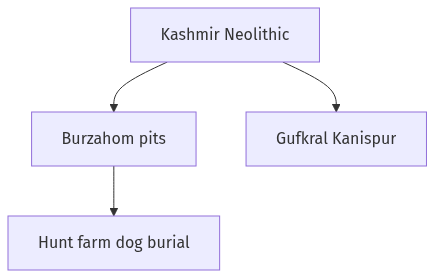
- Burzahom, excavated under T. N. Khazanchi and later teams of the Archaeological Survey, is the type site of Kashmir Neolithic pit-dwellings.
- Gufkral and Kanispur repeat the same sunken floors, storage pits, and later mud-and-rubble houses on the old pits.
- Early floors are circular or oval, cut into loess, with steps, post-holes, and hearths. Later levels fill the pits and raise rectangular houses.
Economy and burial
- Bone tools, harpoons, and dog burials sit with wheat, barley, and lentil, so the pit-dwellers mixed hunt, fish, and early farm.
- H. D. Sankalia placed this Kashmir Neolithic beside other Indian food-producing cultures, but the pit house and the dog grave remain a valley signature.
- Human burials in house pits, sometimes with dogs, mark a domestic rite, not a Harappan cemetery pattern.
Flow diagram
Conclusion
Kashmir pit-dwellers are a dated Neolithic house tradition centred on Burzahom. They record highland mixed subsistence, not an Indus suburb.
Quick related
Students also ask
-
Varna and Buddhism
Next question on this syllabus topic (2022 · Q1(b)). View answer →
-
Are pit-dwellings unique to Kashmir in India?
They are the clearest published cluster. Similar sunken floors appear elsewhere, but Burzahom remains the teaching type site.
-
Did these people know the Harappans?
Some later contacts are argued from finds, but the pit-house village is not a Harappan colony.
More from this topic
Q6(a) · UPSC Mains 2026 · Anthropology GS 2 · 20 marks · Solution
Make a critical appraisal of the mesolithic culture of Ganga basin with reference to artifacts, faunal and human skeletal remains excavated from different sites
Evolution of the Indian Culture and Civilization
• Ganga basin Mesolithic sites like Sarai Nahar Rai, Mahadaha, and Damd
Q5(e) · UPSC Mains 2026 · Anthropology GS 2 · 10 marks · Solution
Contribution of L. K. Ananthakrishna Iyer in Anthropology.
Evolution of the Indian Culture and Civilization
L. K. Ananthakrishna Iyer is a pioneering figure in Indian anthropology, known for his monumental ethnographic surveys like The Cochin Tribes and Castes and The Mysore Tribes and Castes. Working during the colonial era, he bridged western anthropological methods with indigenous scholarship. His documentation of social stratification, material culture, and folklore laid the empirical foundation for Indian sociology and anthropology. Iyer also established the first department of anthropology in India at the University of Calcutta, shaping institutional teaching and research.
Q5(c) · UPSC Mains 2026 · Anthropology GS 2 · 10 marks · Solution
Article 371A of the Indian Constitution.
Evolution of the Indian Culture and Civilization
Article 371A of the Indian Constitution grants special autonomous status to Nagaland, protecting its traditional socio-religious practices, customary laws, and land ownership rights. Enacted via the 13th Constitutional Amendment Act, 1962, following the 16-point Agreement, it reflects the asymmetrical federal framework of India. The article places a special responsibility on the Governor regarding law and order and regional financial allocations. It balances tribal autonomy with national integration, though it faces implementation challenges in modern governance.