
Revision summary
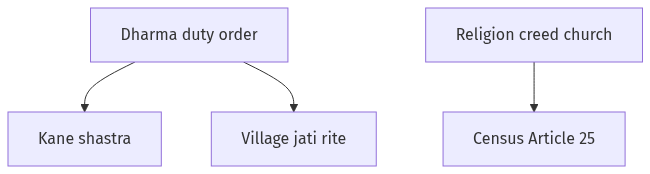
Dharma means duty and order tied to role and group. Religion names a congregational faith with creed and conversion. Kane and Dumont keep dharma as law and hierarchy, not a church. Article 25 forces Indian practice into the legal word religion. Colonial translation flattened duty, sect, and civil law into one noun.
Model answer
Copper italics in this answer — like this — are the key facts. Each one is unpacked in the Facts & figures rail.
Introduction
Dharma in Indian usage is duty, order, and right conduct tied to person, stage, and group. Religion, in the Latin-Christian sense, is a named faith with creed, church, and conversion.
Body
Two vocabularies
- P. V. Kane treated dharma as a legal-ethical field covering kingship, caste duty, and rite, not as a single church.
- Louis Dumont contrasted homo hierarchicus, ordered by dharma, with the Western individual of a congregational religion.
- M. N. Srinivas showed that village practice mixes purity, festival, and jati duty. That mix is dharma on the ground, not a Sunday congregation.
Why the contrast matters
- Article 25 of the Constitution uses the word religion for freedom of conscience. Courts then have to decide whether a practice is essential religion or social dharma.
- Colonial census and mission schools translated dharma as religion, which flattened jati duty, sect, and civil law into one English noun.
- The anthropological task is to keep both words. Dharma is relational duty. Religion is a modern legal box for faith.
Flow diagram
Conclusion
Dharma is an Indian order of duties. Religion is a later administrative name for faith. Using one word for both hides caste, kingship, and law.
Quick related
Students also ask
-
Westernisation and Modernisation.
Next question on this syllabus topic (2022 · Q1(e)). View answer →
-
Can dharma be translated as religion?
Only loosely. Duty, law, and rank leak out of the English word.
-
Is Hinduism a religion in the constitutional sense?
The courts treat it as one for Article 25. Anthropologists still split shastric dharma from congregational faith.
More from this topic
Q6(a) · UPSC Mains 2026 · Anthropology GS 2 · 20 marks · Solution
Make a critical appraisal of the mesolithic culture of Ganga basin with reference to artifacts, faunal and human skeletal remains excavated from different sites
Evolution of the Indian Culture and Civilization
• Ganga basin Mesolithic sites like Sarai Nahar Rai, Mahadaha, and Damd
Q5(e) · UPSC Mains 2026 · Anthropology GS 2 · 10 marks · Solution
Contribution of L. K. Ananthakrishna Iyer in Anthropology.
Evolution of the Indian Culture and Civilization
L. K. Ananthakrishna Iyer is a pioneering figure in Indian anthropology, known for his monumental ethnographic surveys like The Cochin Tribes and Castes and The Mysore Tribes and Castes. Working during the colonial era, he bridged western anthropological methods with indigenous scholarship. His documentation of social stratification, material culture, and folklore laid the empirical foundation for Indian sociology and anthropology. Iyer also established the first department of anthropology in India at the University of Calcutta, shaping institutional teaching and research.
Q5(c) · UPSC Mains 2026 · Anthropology GS 2 · 10 marks · Solution
Article 371A of the Indian Constitution.
Evolution of the Indian Culture and Civilization
Article 371A of the Indian Constitution grants special autonomous status to Nagaland, protecting its traditional socio-religious practices, customary laws, and land ownership rights. Enacted via the 13th Constitutional Amendment Act, 1962, following the 16-point Agreement, it reflects the asymmetrical federal framework of India. The article places a special responsibility on the Governor regarding law and order and regional financial allocations. It balances tribal autonomy with national integration, though it faces implementation challenges in modern governance.