
Revision summary
• Ethnoarchaeology studies living societies to build analogies for interpreting static archaeological
Model answer
Copper italics in this answer — like this — are the key facts. Each one is unpacked in the Facts & figures rail.
Introduction
Archaeological interpretation relies on diverse methodological frameworks to decode material culture. While ethnoarchaeology bridges living human behavior with static artifact patterns, classical archaeology investigates monumental civilizations through a synthesis of art, text, and excavation.
Body
Ethnoarchaeology and Living Traditions
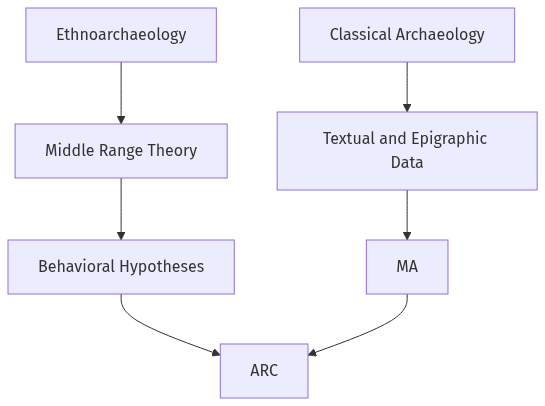
- Middle-Range Theory: Formulated by Lewis Binford to link static material remains with dynamic human behaviors through living ethnographic analogues.
- Behavioral Focus: Studies contemporary discard patterns, tool manufacture, and subsistence strategies to generate testable hypotheses for prehistoric contexts.
Classical Archaeology and Literate Antiquity
- Civilizational Scope: Centers on the Mediterranean and Near Eastern worlds, notably Greece, Rome, and Mesopotamia, spanning classical antiquity.
- Text-Aided Approach: Relies heavily on historical texts, epigraphy, numismatics, and monumental architecture alongside stratigraphic excavation.
Comparative Methodological Matrix
- Data Sources: Ethnoarchaeology uses living informants and material correlates; classical archaeology combines philology with art history and artifact typology.
- Analytical Goal: Ethnoarchaeology seeks universal principles of human adaptation, whereas classical archaeology emphasizes historical particularism and aesthetic evolution.
Flow diagram
Conclusion
Ethnoarchaeology and classical archaeology represent complementary pillars of archaeological science. Integrating ethnoarchaeological middle-range theory with classical historical texts enriches our understanding of both prehistoric adaptations and complex ancient civilizations.
Quick related
Students also ask
-
Should we still distinguish between 'classic' and 'progressive' Neanderthals? Discuss the controversy surrounding Neanderthal's position in human evolution
Next question on this syllabus topic (2022 · Q3(c)). View answer →
-
What is the difference between ethnoarchaeology and classical archaeology?
Ethnoarchaeology studies living societies to understand material culture formation, whereas classical archaeology studies ancient literate civilizations using art and texts.
-
How does ethnoarchaeology help in archaeological interpretation?
It provides middle-range theory and ethnographic analogies to link static archaeological artifacts with dynamic human behaviors.
Same topic · past papers
UPSC has asked this before
These previous-year questions sit on the same topic. Open one to practise the earlier ask.
-
2024 · Q2(a) · Anthropology GS 1 · 20 marks
Discuss historical particularism as a critical development to the classical evolutionism.
More from this topic
Q3(c) · UPSC Mains 2022 · Anthropology GS 1 · 15 marks · Solution
Should we still distinguish between 'classic' and 'progressive' Neanderthals? Discuss the controversy surrounding Neanderthal's position in human evolution
Neanderthal man
Classic versus progressive was a European-versus-Levant type split. Boule’s La Chapelle cartoon inflated classic robustness. Many Levant ‘progressives’ are early moderns plus contact. Ancient DNA shows mixing, not a clean replacement without genes. Denisovans break any two-box scheme.