
Revision summary
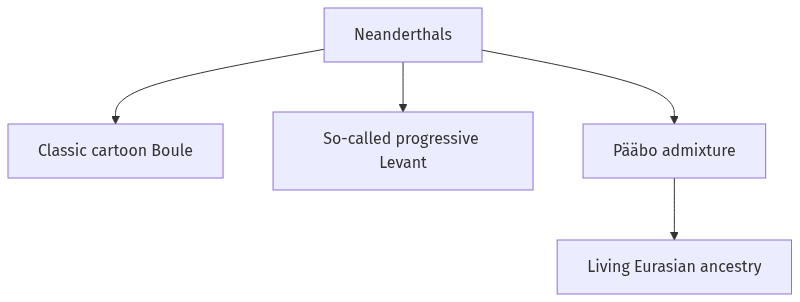
Classic versus progressive was a European-versus-Levant type split. Boule’s La Chapelle cartoon inflated classic robustness. Many Levant ‘progressives’ are early moderns plus contact. Ancient DNA shows mixing, not a clean replacement without genes. Denisovans break any two-box scheme.
Model answer
Copper italics in this answer — like this — are the key facts. Each one is unpacked in the Facts & figures rail.
Introduction
Older textbooks split Neanderthals into a robust ‘classic’ European type and a lighter ‘progressive’ Near Eastern type. Genetics and new fossils have made that split a poor evolutionary map.
Body
The old distinction
- Classic labels, built on La Chapelle-aux-Saints after Boule, pictured a bent, separate species.
- Progressive labels for Tabun, Skhul, and Qafzeh mixed Neanderthal and early modern traits and fed a story of evolution toward Homo sapiens.
- Howell and others used climate: cold Europe made the classic body; the Levant stayed gracile.
Why the split fails
- La Chapelle was arthritic. Straus and later workers unbent the cartoon.
- Levantine ‘progressives’ are now often early moderns with some Neanderthal contact, not a halfway species.
- Svante Pääbo’s genomes show Neanderthals as a sister population that mixed with out-of-Africa moderns. Indian and Eurasian people still carry that ancestry.
- Denisova and Jebel Irhoud add more branches. A two-box classic/progressive scheme cannot hold them.
Position today
- Neanderthals are Homo neanderthalensis or a closely related form of Homo sapiens in a lumper’s language. The live question is admixture and culture, including Shanidar burial and Châtelperronian debate, not a racial grade inside Neanderthals.
Flow diagram
Conclusion
The classic–progressive split was a typological comfort. Neanderthals sit as a sister population that mixed with modern humans. Keep the fossils and the genomes; drop the two-type ladder.
Quick related
Students also ask
-
Are Neanderthals our ancestors?
They are sister populations. Many non-African humans inherited some Neanderthal DNA, so they are partial ancestors, not the sole stem.
-
Should exams still use classic and progressive?
Use the words only to criticise them. Current argument is admixture and behaviour, not two Neanderthal races.
Same topic · past papers
UPSC has asked this before
These previous-year questions sit on the same topic. Open one to practise the earlier ask.
-
2026 · Q1(e) · Anthropology GS 1 · 10 marks
Ethnoarchaeology and classical archaeology. -
2026 · Q1(b) · Anthropology GS 1 · 10 marks
Canalization and catch-up growth. -
2026 · Q1(d) · Anthropology GS 1 · 10 marks
Genetic polymorphism and natural selection. -
2026 · Q2(c) · Anthropology GS 1 · 15 marks
How is the theory of structuralism helpful in understanding the concepts of caste and gender? -
2026 · Q3(a) · Anthropology GS 1 · 20 marks
How do the concepts of power, authority, legitimacy and social control change with changing political organization? Discuss in detail giving suitable examples
More from this topic
Q1(e) · UPSC Mains 2026 · Anthropology GS 1 · 10 marks · Solution
Ethnoarchaeology and classical archaeology.
Neanderthal man
• Ethnoarchaeology studies living societies to build analogies for interpreting static archaeological