
Revision summary
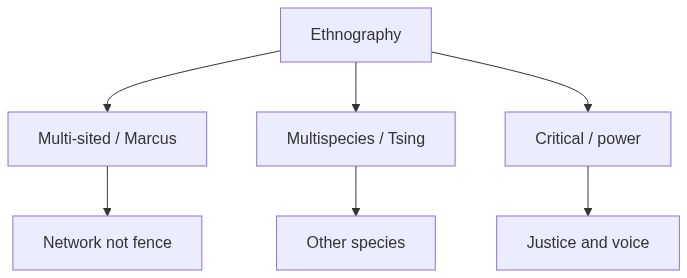
Multi-sited ethnography, associated with George Marcus, follows people, things and conflicts across more than one site. Multispecies ethnography, as in Kirksey, Helmreich and Tsing, treats animals, plants and fungi as part of social life. Critical ethnography describes a scene and also asks how power works, whose voice is heard, and what change is possible. The three answer the limits of one-village, human-only, harmony-seeking fieldwork. A migrant chain, a human–animal conflict, and a caste or gender justice case illustrate the three methods.
Model answer
Copper italics in this answer — like this — are the key facts. Each one is unpacked in the Facts & figures rail.
Introduction
Classical ethnography often sat in one village and wrote about one people. Multi-sited, multispecies and critical ethnography open that frame. They follow connections across places, they take other living beings as part of social life, and they ask whose voice the ethnography serves.
Body
Multi-sited ethnography
George Marcus, in his essay on multi-sited ethnography, argued that many contemporary objects cannot be known from one site. The ethnographer follows people, things, metaphors, plots or conflicts across locations. A Gulf migrant is not only a Kerala household and not only a Dubai camp. A commodity chain, a court case, or a rumour on WhatsApp is the same kind of object.
Arjun Appadurai’s work on global flows sits beside Marcus: the “field” is a network, not a fence. The method still uses participant observation. It simply refuses to treat the village boundary as the edge of society.
Multispecies ethnography
Eben Kirksey, Stefan Helmreich and Anna Tsing asked anthropology to take animals, plants, fungi and microbes as companions in social life, not as a silent background. Tsing’s The Mushroom at the End of the World follows matsutake fungi, pickers and markets. Donna Haraway’s companion-species work and Eduardo Kohn’s How Forests Think push the same point.
A current example is One Health after COVID-19, or human–elephant conflict on a forest fringe, or street dogs and sanitation in an Indian city. Culture is made with other species, not only about them.
Critical ethnography
Critical ethnography, as D. Soyini Madison and earlier Marxist, feminist and postcolonial fieldworkers framed it, does not stop at describing a culture. It asks how power, race, caste, gender and the state produce the scene, and it sides with the possibility of change. Nancy Scheper-Hughes on hunger and Paul Farmer on structural violence are medical-anthropological cousins of this stance.
The ethnographer’s own position is part of the data. The aim is not a pretty whole, but an account that the marginalised could recognise.
Why the three are asked together
One-site holism is too small for migrants, too human-only for ecology, and too polite for injustice. The three methods are a toolkit: follow the connection, include other species, and name power.
Flow diagram
Conclusion
Multi-sited work follows the object across places. Multispecies work puts other living beings inside the social. Critical ethnography asks who benefits from the story. Together they keep fieldwork, but they drop the fiction of one closed village.
Quick related
Students also ask
-
Harappan maritime trade
Next question on this syllabus topic (2024 · Q1(b)). View answer →
-
Is multi-sited work just travel journalism?
No. It still uses long-term observation and interviews. The difference is the object: a chain or conflict, not a single community fence.
-
Which thinkers belong with each method?
Marcus with multi-sited work; Tsing, Kirksey or Helmreich with multispecies work; Scheper-Hughes or Farmer with a critical stance.
Same topic · past papers
UPSC has asked this before
These previous-year questions sit on the same topic. Open one to practise the earlier ask.
-
2024 · Q1(c) · Anthropology GS 1 · 10 marks
Critical perspective on avoidance and joking relationship -
2024 · Q2(a) · Anthropology GS 1 · 20 marks
Discuss historical particularism as a critical development to the classical evolutionism.
More from this topic
Q5(d) · UPSC Mains 2026 · Anthropology GS 1 · 10 marks · Solution
Anthropometry in ergonomics.
Meaning, Scope and development of Anthropology.
This short note explores the application of anthropometry in ergonomics, bridging human physical dimensions with product and workspace design. It defines anthropometry as the measurement of human body variations and highlights its utility in tool design, workstation layouts, and safety compliance. Accounting for population variability ensures inclusivity and reduces occupational injuries. The note emphasizes the synthesis of biological anthropology with industrial design to optimize human-machine interfaces.
Q1(b) · UPSC Mains 2024 · Anthropology GS 1 · 10 marks · Solution
Harappan maritime trade
Meaning, Scope and development of Anthropology.
Harappan maritime trade joined Indus rivers and coastal sites to Oman, Bahrain and Mesopotamia. Lothal, Dholavira, Kuntasi, Balakot and Sutkagen-dor were important nodes. Meluhha texts, Indus seals, Gulf materials and etched carnelian beads provide converging evidence. Exports included crafted beads, shell, ivory, timber and probably textiles; metals moved inward. Lothal’s basin may be a dock or reservoir, so do not make the whole case depend on it. Trade supported craft specialisation and urban integration but was not the sole cause of Harappan civilisation.
Q3(b) · UPSC Mains 2022 · Anthropology GS 1 · 15 marks · Solution
Enumerate the evidence of animal domestication in Indian microlithic industry
Meaning, Scope and development of Anthropology.
Microliths are tools; domestication is a faunal and dung argument. Bagor shows sheep and goat with a microlithic camp. Adamgarh and Bhimbetka mix hunt with later stock. Ganga Mesolithic bone is still largely wild. Harappan villages complete the domestication story.