
Revision summary
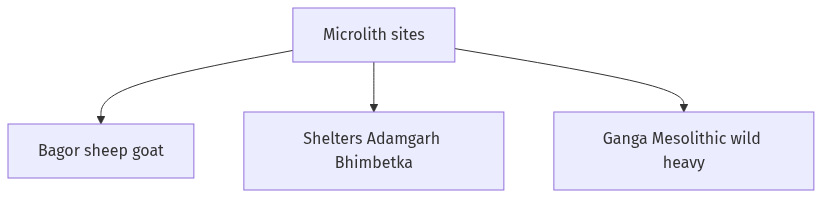
Microliths are tools; domestication is a faunal and dung argument. Bagor shows sheep and goat with a microlithic camp. Adamgarh and Bhimbetka mix hunt with later stock. Ganga Mesolithic bone is still largely wild. Harappan villages complete the domestication story.
Model answer
Copper italics in this answer — like this — are the key facts. Each one is unpacked in the Facts & figures rail.
Introduction
Indian microlithic sites are mainly Mesolithic. Some of them already show managed animals beside hunt. The evidence is bone, dung, and settlement, not the bladelet alone.
Body
What counts as evidence
- A microlith is a small backed tool. Domestication needs age-sex profiles of fauna, pathology, dung, and a shift from wild size-ranges.
- Bagor (Rajasthan), excavated by V. N. Misra, yielded sheep and goat with microliths and copper in later levels, a pastoral overlay on a hunting camp.
- Adamgarh and Bhimbetka shelters mix hunted deer and boar with later herded stock in the sequence.
- Sarai Nahar Rai, Mahadaha, and Damdama in the Ganga plains show wild cattle, hog deer, and turtle. Claims of early cattle must stay cautious where bones are wild aurochs-size.
- Langhnaj in Gujarat and Birbhanpur add microliths with fauna that later Holocene villages clearly herd.
Reading the phase
- Meadow and Harappan work show full domestication in the Indus tradition. Microlithic India is a mosaic: foragers, herder-foragers, and contact with village stock.
- Rock art of herding at Bhimbetka supports the bone, but art alone is not a domestication date.
Flow diagram
Conclusion
Animal domestication in the Indian microlithic is patchy. Bagor sheep-goat and shelter sequences are the strongest field files. The bladelet industry does not by itself prove a herd.
Quick related
Students also ask
-
Modes of Subsistence.
Next question on this syllabus topic (2021 · Q5(e)). View answer →
-
Did all Mesolithic Indians herd?
No. Many sites remain hunter-gatherer. Domestication is regional and late in the microlithic span.
-
Is a small bovid bone enough?
No. Size overlap with wild sheep and goat needs measurements, age profiles, and context.
Same topic · past papers
UPSC has asked this before
These previous-year questions sit on the same topic. Open one to practise the earlier ask.
-
2024 · Q2(b) · Anthropology GS 1 · 15 marks
Describe the evidences of food production and domestication of animals with special reference to Mehrgarh. Throw light on its significance.
More from this topic
Q5(d) · UPSC Mains 2026 · Anthropology GS 1 · 10 marks · Solution
Anthropometry in ergonomics.
Meaning, Scope and development of Anthropology.
This short note explores the application of anthropometry in ergonomics, bridging human physical dimensions with product and workspace design. It defines anthropometry as the measurement of human body variations and highlights its utility in tool design, workstation layouts, and safety compliance. Accounting for population variability ensures inclusivity and reduces occupational injuries. The note emphasizes the synthesis of biological anthropology with industrial design to optimize human-machine interfaces.
Q5(a) · UPSC Mains 2025 · Anthropology GS 1 · 10 marks · Solution
Multispecies, Multi-sited and Critical Ethnography.
Meaning, Scope and development of Anthropology.
Multi-sited ethnography, associated with George Marcus, follows people, things and conflicts across more than one site. Multispecies ethnography, as in Kirksey, Helmreich and Tsing, treats animals, plants and fungi as part of social life. Critical ethnography describes a scene and also asks how power works, whose voice is heard, and what change is possible. The three answer the limits of one-village, human-only, harmony-seeking fieldwork. A migrant chain, a human–animal conflict, and a caste or gender justice case illustrate the three methods.
Q1(b) · UPSC Mains 2024 · Anthropology GS 1 · 10 marks · Solution
Harappan maritime trade
Meaning, Scope and development of Anthropology.
Harappan maritime trade joined Indus rivers and coastal sites to Oman, Bahrain and Mesopotamia. Lothal, Dholavira, Kuntasi, Balakot and Sutkagen-dor were important nodes. Meluhha texts, Indus seals, Gulf materials and etched carnelian beads provide converging evidence. Exports included crafted beads, shell, ivory, timber and probably textiles; metals moved inward. Lothal’s basin may be a dock or reservoir, so do not make the whole case depend on it. Trade supported craft specialisation and urban integration but was not the sole cause of Harappan civilisation.