
Revision summary
Mendelian traits follow one-locus segregation and can be read in a pedigree. ABO, PTC tasting, albinism, haemophilia A and Huntington disease are standard examples. Multiple alleles and sex-linkage extend Mendelism; they do not cancel it. Non-Mendelian traits include polygenic stature and skin colour, linkage, maternal mtDNA and imprinting. Environment plus many genes gives a curve, not a 3:1 ratio. Use family study for Mendelian markers and quantitative genetics for everyday variation. Single-factor, multifactor, lethal and polygenic inheritance is this same distinction.
Model answer
Copper italics in this answer — like this — are the key facts. Each one is unpacked in the Facts & figures rail.
Introduction
Mendelian traits are characters that pass from parents to children according to Mendel’s two basic laws: segregation and independent assortment. Non-Mendelian traits do not follow those simple one-gene rules. Biological anthropology needs both ideas, because some human markers behave like garden peas, while height, skin colour and many diseases do not.
Body
Mendelian traits
- Definition: Mendelian traits are hereditary characteristics controlled mainly by a single gene or locus and inherited according to the basic principles established by Gregor Mendel.
- Mendel’s laws: The classical framework includes the Law of Segregation and Law of Independent Assortment, along with the concepts of paired alleles and dominance. These principles explain how alleles are transmitted from parents to offspring.
- Simple inheritance: Such traits are often called simple or monogenic traits because their phenotype is primarily determined by one gene, although the actual expression of some traits may be influenced by other genetic or environmental factors.
- Discrete variation: Mendelian traits often show distinct phenotypic categories, making their inheritance relatively easy to trace through family pedigrees.
- Dominance: In a heterozygous individual, a dominant allele can determine the observable phenotype, while a recessive allele may remain unexpressed.
- PTC tasting: The ability to taste the bitter compound Phenylthiocarbamide (PTC) has traditionally been used as an example of a Mendelian polymorphism in family and population studies.
- Achondroplasia: Achondroplasia is an autosomal dominant skeletal disorder caused by pathogenic variants in the FGFR3 gene. Heterozygous individuals show the characteristic phenotype, while homozygosity is usually lethal.
- Pedigree analysis: Mendelian traits are particularly useful for studying family inheritance, carrier status, recurrence risk, and genetic counselling.
- Caution: Some traditionally taught examples, such as earlobe attachment, cleft chin, and simple eye-colour categories, are not reliably controlled by a single dominant–recessive gene in humans. Modern genetics shows that many such traits have polygenic or multifactorial influences.
Non-Mendelian traits
- Definition: Non-Mendelian inheritance refers to patterns in which phenotype or transmission cannot be explained adequately by a simple single-gene dominant–recessive model.
- Basis: These patterns may result from multiple genes, interactions between genes, linkage, cytoplasmic inheritance, genomic imprinting, or environmental influences.
1. Codominance
- Definition: In codominance, both alleles are expressed simultaneously in a heterozygous individual rather than one completely masking the other.
- ABO blood groups: The ABO system is the classic example. I^A and I^B are codominant, so an individual with the I^A I^B genotype expresses both A and B antigens and has blood group AB.
- Anthropological significance: ABO variation is a classical population genetic marker used to study inheritance and genetic variation among human populations.
2. Incomplete dominance
- Definition: In incomplete dominance, the heterozygous phenotype is different from and often intermediate between the two homozygous phenotypes.
- Important correction: Sickle-cell trait is not a straightforward example of incomplete dominance. The HbS locus follows Mendelian inheritance, while the heterozygote produces both normal and abnormal haemoglobin and has a distinct physiological phenotype.
- Sickle-cell trait: Individuals with HbAS produce both HbA and HbS and generally show increased protection against severe Plasmodium falciparum malaria. This is better understood through codominant expression at the molecular level and heterozygote advantage at the population level, rather than simple incomplete dominance.
3. Polygenic or multifactorial inheritance
- Definition: Polygenic traits are influenced by multiple genes, often with each gene contributing a relatively small effect. Environmental factors may further modify the phenotype.
- Continuous variation: Such traits usually show a continuous range of phenotypes rather than two sharply separated categories, often producing an approximately bell-shaped distribution in populations.
- Height: Human stature is a classic polygenic and multifactorial trait, influenced by many genetic variants as well as nutrition, health, and other environmental factors.
- Skin colour: Human skin pigmentation is influenced by multiple genes involved in melanin production and distribution, along with environmental exposure such as ultraviolet radiation.
- Eye colour: Eye colour is also influenced by multiple genes, rather than being adequately explained by a simple dominant–recessive model.
- R. A. Fisher: Fisher demonstrated how the combined effects of many Mendelian genes can produce continuous quantitative variation, linking Mendelian genetics with quantitative genetics.
4. Pleiotropy
- Definition: Pleiotropy occurs when a single gene influences multiple phenotypic traits that may appear unrelated.
- Phenylketonuria: Phenylketonuria (PKU) is a classic example. Mutations affecting phenylalanine metabolism can produce multiple consequences, including neurological impairment, developmental problems, and altered pigmentation when untreated.
- Anthropological significance: Pleiotropy demonstrates that the effect of a single gene can extend across multiple physiological and phenotypic systems.
5. Genetic linkage
- Definition: Genetic linkage occurs when genes are located close together on the same chromosome and therefore tend to be inherited together.
- Violation of independent assortment: Linked genes do not assort independently in the same manner as genes located on different chromosomes. However, crossing over and recombination can separate linked alleles.
- HLA system: The HLA genes on chromosome 6 provide an important example of a dense genomic region containing multiple closely related loci. Particular HLA alleles can therefore show non-random associations within populations.
- Anthropological significance: Linkage analysis helps study inheritance, genetic relationships, disease susceptibility, and population structure.
6. Genomic imprinting
- Definition: Genomic imprinting is an epigenetic phenomenon in which the expression of a gene depends on whether the allele was inherited from the mother or father.
- Mechanism: During gamete formation, certain genomic regions acquire parent-specific epigenetic marks, including DNA methylation, which can cause one parental copy to be preferentially silenced.
- Prader–Willi syndrome: Loss of expression of paternally derived genes in a specific region of chromosome 15 can cause Prader–Willi syndrome.
- Angelman syndrome: Loss of maternal gene expression in the corresponding imprinted region can cause Angelman syndrome.
- Significance: These disorders demonstrate that the parental origin of an allele can influence phenotype, something that cannot be explained by a simple dominant–recessive model.
Why the distinction matters
- Mendelian inheritance: Useful for understanding single-gene disorders, blood groups, pedigrees, carrier status, and genetic counselling.
- Non-Mendelian inheritance: Explains many cases where phenotype depends on multiple genes, gene interactions, linkage, parental origin, or environmental factors.
- Anthropological significance: Most measurable human characteristics, such as height, skin pigmentation, and many physiological traits, show complex genetic architecture rather than simple dominant–recessive inheritance.
- Key principle: Non-Mendelian inheritance does not mean that Mendel’s laws are incorrect. Rather, it shows that human genetic inheritance involves additional mechanisms and interactions beyond the simplest single-locus model.
Flow diagram
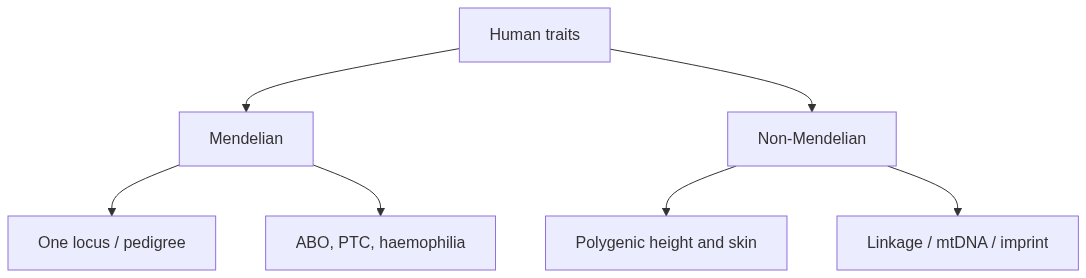
Conclusion
Multiple alleles and sex-linkage still obey segregation, so they remain Mendelian. The non-Mendelian label belongs to polygenic, linked, cytoplasmic and imprinted systems. Anthropology needs pedigrees for discrete markers and quantitative genetics for the living body.
Quick related
Students also ask
-
Lethal and sublethal genes
Next question on this syllabus topic (2024 · Q1(d)). View answer →
-
Is ABO Mendelian or non-Mendelian?
Mendelian. Multiple alleles and A/B codominance change the dominance rule, but transmission is still one-locus segregation.
-
How should Mendelian and non-Mendelian traits be distinguished in method?
Mendelian traits are read through pedigree ratios. Non-Mendelian traits such as stature or skin colour are read through quantitative genetics.
Same topic · past papers
UPSC has asked this before
These previous-year questions sit on the same topic. Open one to practise the earlier ask.
-
2016 · Q7(a) · Anthropology GS 1 · 20 marks
Critically discuss the Mendelian principles and their application to human populations.
More from this topic
Q8(b) · UPSC Mains 2024 · Anthropology GS 1 · 15 marks · Solution
Describe the genetics and inheritance patterns of the ABO and Rh blood groups in man.
Mendelian genetics in man-family study, single factor, multifactor, lethal, sub-lethal and polygenic inheritance in man.
ABO lies on chromosome 9 and encodes glycosyltransferases acting on H antigen. Iᴬ and Iᴮ are codominant; both dominate common O. Bombay phenotype hh lacks H antigen and demonstrates epistasis. Rh is a chromosome-1 complex centred on RHD and RHCE, not literally one allele pair. Maternal IgG anti-D can cause haemolytic disease after sensitisation; prophylaxis prevents most cases. Blood-group frequencies trace populations but cannot define races or prove unique paternity.
Q7(b) · UPSC Mains 2024 · Anthropology GS 1 · 15 marks · Solution
What is a multifactorial trait? Illustrate your answer with suitable human examples.
Mendelian genetics in man-family study, single factor, multifactor, lethal, sub-lethal and polygenic inheritance in man.
A multifactorial trait combines many genetic variants with environment and development. Fisher explained continuous variation through many small Mendelian effects. Height, pigmentation, BMI and blood pressure are continuous examples. Cleft lip, neural-tube defects, diabetes and hypertension can use a liability-threshold model. Twin, family and GWAS designs estimate components but depend on population and environment. Yajnik's thin-fat phenotype illustrates developmental and nutritional interaction in India.
Q5(e) · UPSC Mains 2024 · Anthropology GS 1 · 10 marks · Solution
Single-gene mutation disorders in man.
Mendelian genetics in man-family study, single factor, multifactor, lethal, sub-lethal and polygenic inheritance in man.
Single-gene disorders chiefly arise from a pathogenic variant at one locus. Autosomal recessive examples include sickle-cell disease, PKU and cystic fibrosis. Autosomal dominant examples include Huntington disease and achondroplasia. Haemophilia A and Duchenne muscular dystrophy are X-linked recessive. Allison linked sickle-cell carrier advantage with malaria. Penetrance, expressivity, new mutations and environment prevent simplistic genetic determinism.