
Revision summary
ABO lies on chromosome 9 and encodes glycosyltransferases acting on H antigen. Iᴬ and Iᴮ are codominant; both dominate common O. Bombay phenotype hh lacks H antigen and demonstrates epistasis. Rh is a chromosome-1 complex centred on RHD and RHCE, not literally one allele pair. Maternal IgG anti-D can cause haemolytic disease after sensitisation; prophylaxis prevents most cases. Blood-group frequencies trace populations but cannot define races or prove unique paternity.
Model answer
Copper italics in this answer — like this — are the key facts. Each one is unpacked in the Facts & figures rail.
Introduction
ABO and Rh are inherited red-cell antigen systems and classic markers of human variation. ABO illustrates multiple alleles and codominance; Rh, especially the D antigen, illustrates a genetically complex system with major maternal–foetal significance.
Body
ABO system
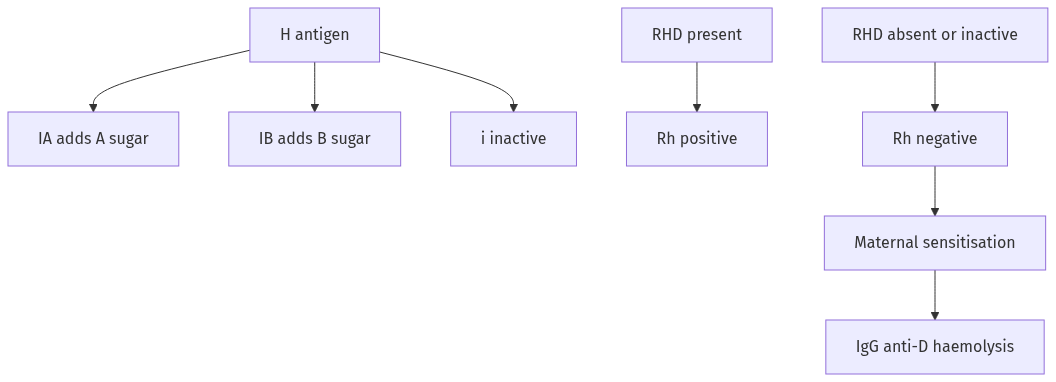
Karl Landsteiner discovered ABO agglutination. The ABO locus on chromosome 9 encodes glycosyltransferases. Iᴬ adds N-acetylgalactosamine to the H antigen; Iᴮ adds galactose; common i/O alleles produce inactive enzyme. Iᴬ and Iᴮ are codominant and both dominate O:
- A phenotype: IᴬIᴬ or Iᴬi; anti-B in plasma.
- B: IᴮIᴮ or Iᴮi; anti-A.
- AB: IᴬIᴮ; both antigens and neither antibody.
- O: ii; neither A nor B antigen and both antibodies.
A and B parents can therefore have an O child only if both are heterozygous; paternity can sometimes be excluded, never uniquely proved, by ABO alone. Bombay phenotype (hh), first reported in Mumbai, lacks H antigen and can type deceptively as O—an important epistatic exception.
Rh system
The Rh complex lies on chromosome 1, principally RHD and RHCE. Presence of D usually defines Rh-positive; absence or inactivation defines Rh-negative. “Positive dominant over negative” is a useful pedigree shorthand, but C/c and E/e antigens, variant D alleles and gene structure make Rh more complex than one two-allele locus.
Unlike naturally occurring ABO antibodies, anti-D usually follows sensitisation. An Rh-negative mother carrying an Rh-positive foetus may form IgG anti-D; in a later incompatible pregnancy it can cross the placenta and cause haemolytic disease of the foetus/newborn. Anti-D immunoglobulin prophylaxis greatly reduces this risk.
ABO and Rh frequencies helped early population anthropology map clines and affinity, including Indian caste and tribal samples. Drift, founder effect, selection and gene flow shape frequencies, but no blood group defines a race. DNA markers now provide finer histories.
Flow diagram
Conclusion
ABO is a clean example of multiple allelism, codominance and epistasis; Rh is a multi-antigen system whose D incompatibility matters in pregnancy. Both remain valuable teaching and clinical markers, but population frequencies are not racial essences.
Quick related
Students also ask
-
Polygenic Inheritance
Next question on this syllabus topic (2023 · Q5(a)). View answer →
-
Is Rh inheritance simply D dominant and d recessive?
That shorthand predicts many pedigrees, but the real RHD/RHCE system includes several antigens and variant alleles.
-
Can ABO prove paternity?
It can exclude some alleged fathers but is far too common to establish unique paternity; STR DNA is required.
Same topic · past papers
UPSC has asked this before
These previous-year questions sit on the same topic. Open one to practise the earlier ask.
-
2023 · Q5(a) · Anthropology GS 1 · 10 marks
Polygenic Inheritance
More from this topic
Q1(a) · UPSC Mains 2025 · Anthropology GS 1 · 10 marks · Solution
Mendelian and non-Mendelian traits.
Mendelian genetics in man-family study, single factor, multifactor, lethal, sub-lethal and polygenic inheritance in man.
Mendelian traits follow one-locus segregation and can be read in a pedigree. ABO, PTC tasting, albinism, haemophilia A and Huntington disease are standard examples. Multiple alleles and sex-linkage extend Mendelism; they do not cancel it. Non-Mendelian traits include polygenic stature and skin colour, linkage, maternal mtDNA and imprinting. Environment plus many genes gives a curve, not a 3:1 ratio. Use family study for Mendelian markers and quantitative genetics for everyday variation. Single-factor, multifactor, lethal and polygenic inheritance is this same distinction.
Q7(b) · UPSC Mains 2024 · Anthropology GS 1 · 15 marks · Solution
What is a multifactorial trait? Illustrate your answer with suitable human examples.
Mendelian genetics in man-family study, single factor, multifactor, lethal, sub-lethal and polygenic inheritance in man.
A multifactorial trait combines many genetic variants with environment and development. Fisher explained continuous variation through many small Mendelian effects. Height, pigmentation, BMI and blood pressure are continuous examples. Cleft lip, neural-tube defects, diabetes and hypertension can use a liability-threshold model. Twin, family and GWAS designs estimate components but depend on population and environment. Yajnik's thin-fat phenotype illustrates developmental and nutritional interaction in India.
Q5(e) · UPSC Mains 2024 · Anthropology GS 1 · 10 marks · Solution
Single-gene mutation disorders in man.
Mendelian genetics in man-family study, single factor, multifactor, lethal, sub-lethal and polygenic inheritance in man.
Single-gene disorders chiefly arise from a pathogenic variant at one locus. Autosomal recessive examples include sickle-cell disease, PKU and cystic fibrosis. Autosomal dominant examples include Huntington disease and achondroplasia. Haemophilia A and Duchenne muscular dystrophy are X-linked recessive. Allison linked sickle-cell carrier advantage with malaria. Penetrance, expressivity, new mutations and environment prevent simplistic genetic determinism.