
Revision summary
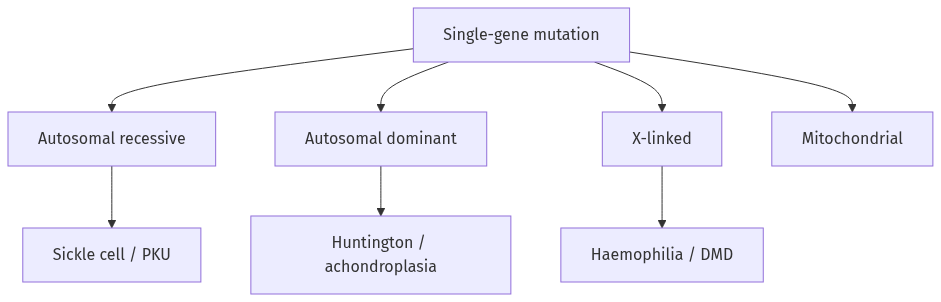
Single-gene disorders chiefly arise from a pathogenic variant at one locus. Autosomal recessive examples include sickle-cell disease, PKU and cystic fibrosis. Autosomal dominant examples include Huntington disease and achondroplasia. Haemophilia A and Duchenne muscular dystrophy are X-linked recessive. Allison linked sickle-cell carrier advantage with malaria. Penetrance, expressivity, new mutations and environment prevent simplistic genetic determinism.
Model answer
Copper italics in this answer — like this — are the key facts. Each one is unpacked in the Facts & figures rail.
Introduction
A single-gene disorder arises mainly from a pathogenic variant at one locus and therefore tends to show a recognisable Mendelian pedigree. Its expression can still vary with penetrance, modifier genes, environment and reproductive fitness.
Body
Major inheritance patterns
- Autosomal recessive: disease usually appears in homozygotes while heterozygotes are carriers. Sickle-cell disease results from a missense variant in HBB; phenylketonuria commonly involves PAH; cystic fibrosis involves CFTR. Sickle-cell heterozygote advantage in malarial regions, identified by A. C. Allison, connects mutation to natural selection.
- Autosomal dominant: one altered allele can suffice. Huntington disease is caused by a CAG-repeat expansion in HTT and often appears after reproduction; achondroplasia commonly involves FGFR3 and many cases are new mutations.
- X-linked recessive: males are more often affected because they have one X chromosome. Haemophilia A involves F8, and Duchenne muscular dystrophy involves DMD. Carrier mothers transmit risk; fathers do not pass X-linked traits to sons.
- X-linked dominant and mitochondrial: these are single-locus patterns too, though the latter is cytoplasmic. Mitochondrial disorders pass through mothers, not affected fathers.
Founder effect and endogamy can raise particular alleles in small populations, making community-sensitive screening useful in India. Yet “one gene” does not mean one fixed outcome: variable expressivity, incomplete penetrance and allelic heterogeneity complicate counselling. Chromosomal syndromes such as Down syndrome are not single-gene disorders.
Flow diagram
Conclusion
Single-gene disorders make Mendelian rules visible in human pedigrees, while sickle cell demonstrates their evolutionary ecology. Diagnosis should combine pedigree and molecular evidence without converting communities into genetic stereotypes.
Quick related
Students also ask
-
What is a multifactorial trait? Illustrate your answer with suitable human examples.
Next question on this syllabus topic (2024 · Q7(b)). View answer →
-
Is Down syndrome a single-gene mutation disorder?
No. It usually results from trisomy 21, a chromosomal-number abnormality.
-
Does one mutated gene guarantee disease?
Not always. Penetrance, expressivity, allele type, modifiers and environment can alter the phenotype.
More from this topic
Q1(a) · UPSC Mains 2025 · Anthropology GS 1 · 10 marks · Solution
Mendelian and non-Mendelian traits.
Mendelian genetics in man-family study, single factor, multifactor, lethal, sub-lethal and polygenic inheritance in man.
Mendelian traits follow one-locus segregation and can be read in a pedigree. ABO, PTC tasting, albinism, haemophilia A and Huntington disease are standard examples. Multiple alleles and sex-linkage extend Mendelism; they do not cancel it. Non-Mendelian traits include polygenic stature and skin colour, linkage, maternal mtDNA and imprinting. Environment plus many genes gives a curve, not a 3:1 ratio. Use family study for Mendelian markers and quantitative genetics for everyday variation. Single-factor, multifactor, lethal and polygenic inheritance is this same distinction.
Q8(b) · UPSC Mains 2024 · Anthropology GS 1 · 15 marks · Solution
Describe the genetics and inheritance patterns of the ABO and Rh blood groups in man.
Mendelian genetics in man-family study, single factor, multifactor, lethal, sub-lethal and polygenic inheritance in man.
ABO lies on chromosome 9 and encodes glycosyltransferases acting on H antigen. Iᴬ and Iᴮ are codominant; both dominate common O. Bombay phenotype hh lacks H antigen and demonstrates epistasis. Rh is a chromosome-1 complex centred on RHD and RHCE, not literally one allele pair. Maternal IgG anti-D can cause haemolytic disease after sensitisation; prophylaxis prevents most cases. Blood-group frequencies trace populations but cannot define races or prove unique paternity.
Q7(b) · UPSC Mains 2024 · Anthropology GS 1 · 15 marks · Solution
What is a multifactorial trait? Illustrate your answer with suitable human examples.
Mendelian genetics in man-family study, single factor, multifactor, lethal, sub-lethal and polygenic inheritance in man.
A multifactorial trait combines many genetic variants with environment and development. Fisher explained continuous variation through many small Mendelian effects. Height, pigmentation, BMI and blood pressure are continuous examples. Cleft lip, neural-tube defects, diabetes and hypertension can use a liability-threshold model. Twin, family and GWAS designs estimate components but depend on population and environment. Yajnik's thin-fat phenotype illustrates developmental and nutritional interaction in India.