
Revision summary
A multifactorial trait combines many genetic variants with environment and development. Fisher explained continuous variation through many small Mendelian effects. Height, pigmentation, BMI and blood pressure are continuous examples. Cleft lip, neural-tube defects, diabetes and hypertension can use a liability-threshold model. Twin, family and GWAS designs estimate components but depend on population and environment. Yajnik's thin-fat phenotype illustrates developmental and nutritional interaction in India.
Model answer
Copper italics in this answer — like this — are the key facts. Each one is unpacked in the Facts & figures rail.
Introduction
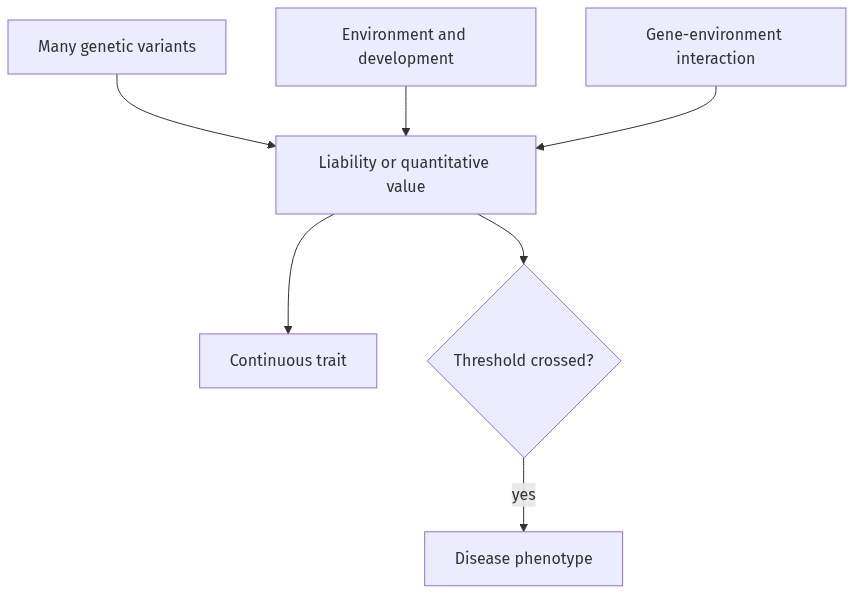
A multifactorial trait results from many genetic variants acting with environmental and developmental factors. It usually lacks a simple Mendelian pedigree: the phenotype may be continuously distributed, like stature, or cross a liability threshold, like cleft lip.
Body
Architecture and examples
R. A. Fisher's quantitative genetics showed how many Mendelian loci of small additive effect can generate a continuous curve. Phenotypic variance includes genetic, environmental and interaction terms. Height, body mass, skin pigmentation and blood pressure are continuous multifactorial traits. Height reflects polygenic potential plus childhood nutrition and infection; pigmentation combines variants including SLC24A5 and MC1R with UV-related selection and tanning.
For dichotomous conditions, the liability-threshold model proposes an unobserved continuous liability. Disease appears when genetic and environmental load crosses a threshold. Cleft lip/palate, neural-tube defects, type 2 diabetes and essential hypertension are standard examples. Recurrence is higher among close relatives and after a severe or multiple case, but no 3:1 ratio follows.
Twin, adoption and family studies estimate recurrence and heritability; genome-wide association studies identify many loci, usually of small effect. C. S. Yajnik's Indian “thin-fat” phenotype research illustrates developmental mismatch: constrained foetal growth combined with later calorie abundance raises metabolic risk. Lactase persistence and dairying offer a longer-term gene–culture interaction, though the phenotype has major-locus effects and should not be confused with a purely polygenic trait.
Multifactorial does not mean vaguely “many causes”. Models must specify exposure and population. Heritability changes with environment, polygenic scores transfer poorly across ancestries, and social inequality can be mislabelled genetic risk.
Flow diagram
Conclusion
- Multifactorial traits are the normal terrain of human biological variation: many alleles, development and lived environment jointly make the phenotype. Their study requires quantitative and biocultural models, not Mendelian determinism or a genes-versus-culture choice.
Quick related
Students also ask
-
Describe the genetics and inheritance patterns of the ABO and Rh blood groups in man.
Next question on this syllabus topic (2024 · Q8(b)). View answer →
-
Are polygenic and multifactorial synonymous?
Polygenic specifies many loci; multifactorial additionally stresses environmental and developmental causes.
-
Why can a binary disease be multifactorial?
An underlying continuous liability can cross a threshold, producing an affected/unaffected outcome.
More from this topic
Q1(a) · UPSC Mains 2025 · Anthropology GS 1 · 10 marks · Solution
Mendelian and non-Mendelian traits.
Mendelian genetics in man-family study, single factor, multifactor, lethal, sub-lethal and polygenic inheritance in man.
Mendelian traits follow one-locus segregation and can be read in a pedigree. ABO, PTC tasting, albinism, haemophilia A and Huntington disease are standard examples. Multiple alleles and sex-linkage extend Mendelism; they do not cancel it. Non-Mendelian traits include polygenic stature and skin colour, linkage, maternal mtDNA and imprinting. Environment plus many genes gives a curve, not a 3:1 ratio. Use family study for Mendelian markers and quantitative genetics for everyday variation. Single-factor, multifactor, lethal and polygenic inheritance is this same distinction.
Q8(b) · UPSC Mains 2024 · Anthropology GS 1 · 15 marks · Solution
Describe the genetics and inheritance patterns of the ABO and Rh blood groups in man.
Mendelian genetics in man-family study, single factor, multifactor, lethal, sub-lethal and polygenic inheritance in man.
ABO lies on chromosome 9 and encodes glycosyltransferases acting on H antigen. Iᴬ and Iᴮ are codominant; both dominate common O. Bombay phenotype hh lacks H antigen and demonstrates epistasis. Rh is a chromosome-1 complex centred on RHD and RHCE, not literally one allele pair. Maternal IgG anti-D can cause haemolytic disease after sensitisation; prophylaxis prevents most cases. Blood-group frequencies trace populations but cannot define races or prove unique paternity.
Q5(e) · UPSC Mains 2024 · Anthropology GS 1 · 10 marks · Solution
Single-gene mutation disorders in man.
Mendelian genetics in man-family study, single factor, multifactor, lethal, sub-lethal and polygenic inheritance in man.
Single-gene disorders chiefly arise from a pathogenic variant at one locus. Autosomal recessive examples include sickle-cell disease, PKU and cystic fibrosis. Autosomal dominant examples include Huntington disease and achondroplasia. Haemophilia A and Duchenne muscular dystrophy are X-linked recessive. Allison linked sickle-cell carrier advantage with malaria. Penetrance, expressivity, new mutations and environment prevent simplistic genetic determinism.