
Revision summary
Heritability is a population-and-environment-specific share of phenotypic variance. Broad H² includes all genetic variance; narrow h² includes additive variance. Fisher's variance partition underlies the concept. Twin, adoption, pedigree and parent–offspring designs estimate familial resemblance. Equal-environment assumptions and gene–environment correlation limit twin estimates. High heritability does not mean immutability or explain group differences.
Model answer
Copper italics in this answer — like this — are the key facts. Each one is unpacked in the Facts & figures rail.
Introduction
Heritability is the proportion of observed phenotypic variance in a specified population and environment attributable to genetic variance. It does not measure how genetic an individual's trait is, nor does a high value make a trait unchangeable.
Body
Concept and estimation
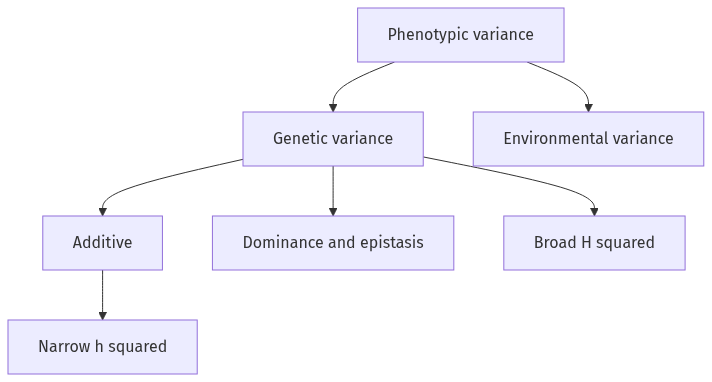
Quantitative genetics partitions phenotypic variance as V(P) = V(G) + V(E) + interactions. Broad-sense heritability, H² = V(G)/V(P), includes additive, dominance and epistatic variance. Narrow-sense heritability, h² = V(A)/V(P), retains additive variance and best predicts response to selection; R. A. Fisher supplied the variance framework.
Estimation uses resemblance among relatives:
- parent–offspring regression and sibling correlations estimate additive familial resemblance;
- classical twin studies compare monozygotic with dizygotic twins, often using h² ≈ 2(rMZ − rDZ) under restrictive assumptions;
- adoption studies separate resemblance to biological and rearing relatives;
- pedigrees and modern genomic relatedness methods estimate variance components in large samples.
Height is highly heritable in many well-nourished populations, yet mean stature can rise rapidly with nutrition. IQ estimates similarly vary by age, class and environment. Twin estimates assume comparable environments and may be inflated by gene–environment correlation, assortative mating or shared prenatal conditions. Population stratification can also distort genomic estimates.
Thus heritability is local to population, age, environment and measurement. It says nothing directly about between-population causes.
Flow diagram
Conclusion
Heritability converts family resemblance into a variance estimate. Used carefully, it clarifies polygenic variation; used as destiny, it revives biological determinism. The anthropological answer must always specify whose population and which environment.
Quick related
Students also ask
-
Single-gene mutation disorders in man.
Next question on this syllabus topic (2024 · Q5(e)). View answer →
-
Does 80% heritability mean 80% of a person's height is genetic?
No. It describes variance among people in one sampled environment, not fractions of an individual.
-
Can heritability change?
Yes. Alter the environment, age range, population or measurement and the variance ratio can change.
More from this topic
Q1(a) · UPSC Mains 2025 · Anthropology GS 1 · 10 marks · Solution
Mendelian and non-Mendelian traits.
Mendelian genetics in man-family study, single factor, multifactor, lethal, sub-lethal and polygenic inheritance in man.
Mendelian traits follow one-locus segregation and can be read in a pedigree. ABO, PTC tasting, albinism, haemophilia A and Huntington disease are standard examples. Multiple alleles and sex-linkage extend Mendelism; they do not cancel it. Non-Mendelian traits include polygenic stature and skin colour, linkage, maternal mtDNA and imprinting. Environment plus many genes gives a curve, not a 3:1 ratio. Use family study for Mendelian markers and quantitative genetics for everyday variation. Single-factor, multifactor, lethal and polygenic inheritance is this same distinction.
Q8(b) · UPSC Mains 2024 · Anthropology GS 1 · 15 marks · Solution
Describe the genetics and inheritance patterns of the ABO and Rh blood groups in man.
Mendelian genetics in man-family study, single factor, multifactor, lethal, sub-lethal and polygenic inheritance in man.
ABO lies on chromosome 9 and encodes glycosyltransferases acting on H antigen. Iᴬ and Iᴮ are codominant; both dominate common O. Bombay phenotype hh lacks H antigen and demonstrates epistasis. Rh is a chromosome-1 complex centred on RHD and RHCE, not literally one allele pair. Maternal IgG anti-D can cause haemolytic disease after sensitisation; prophylaxis prevents most cases. Blood-group frequencies trace populations but cannot define races or prove unique paternity.
Q7(b) · UPSC Mains 2024 · Anthropology GS 1 · 15 marks · Solution
What is a multifactorial trait? Illustrate your answer with suitable human examples.
Mendelian genetics in man-family study, single factor, multifactor, lethal, sub-lethal and polygenic inheritance in man.
A multifactorial trait combines many genetic variants with environment and development. Fisher explained continuous variation through many small Mendelian effects. Height, pigmentation, BMI and blood pressure are continuous examples. Cleft lip, neural-tube defects, diabetes and hypertension can use a liability-threshold model. Twin, family and GWAS designs estimate components but depend on population and environment. Yajnik's thin-fat phenotype illustrates developmental and nutritional interaction in India.