
Revision summary
A lethal genotype causes death before reproduction; a sublethal genotype substantially lowers viability or fertility. Recessive lethals hidden in carriers can produce a 2:1 ratio among survivors. Tay–Sachs illustrates a recessive lethal; homozygous FGFR3 achondroplasia is lethal while heterozygotes live. Huntington persists partly because onset is often after reproduction. HbSS is severely deleterious, while HbAS can be favoured in falciparum-malaria regions. Endogamy changes homozygosity and health care changes the fitness effect.
Model answer
Copper italics in this answer — like this — are the key facts. Each one is unpacked in the Facts & figures rail.
Introduction
A lethal allele causes death in a particular genotype, usually before reproduction; a sublethal allele markedly lowers survival or reproductive fitness without invariably causing death. The allele itself is not lethal in every carrier: dominance, age of onset, penetrance, environment and medical care determine its effect.
Body
Genetic patterns
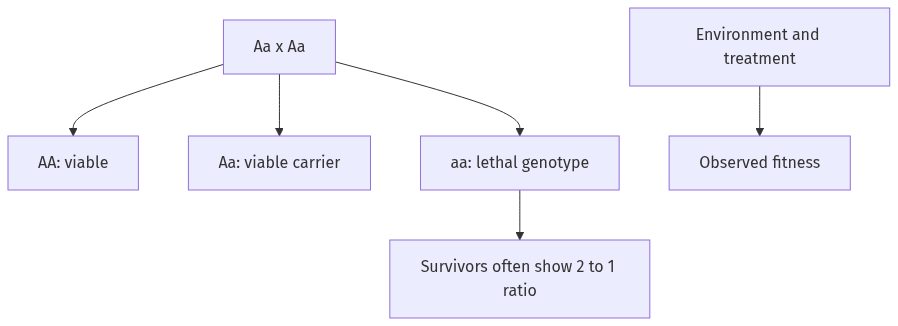
Most lethal alleles are recessive because a normal heterozygote can transmit them. When two heterozygotes mate, the lethal homozygote may disappear before observation, changing the surviving Mendelian ratio from 3:1 to 2:1. Tay–Sachs disease is an autosomal-recessive example historically lethal in early childhood without effective supportive care.
Some alleles are dominant for a visible trait but homozygous lethal. In achondroplasia, one altered FGFR3 allele causes short-limbed dwarfism, while two altered copies usually cause lethal skeletal dysplasia. Two affected heterozygous parents therefore face a 1/4 homozygous-lethal conception risk.
Dominant lethals can persist when expression follows reproduction. Huntington disease, caused by a HTT CAG expansion, reduces survival but often has adult onset; it is better described as a late-acting deleterious dominant than as an invariably pre-reproductive lethal.
Sublethal effects form a continuum. Untreated beta-thalassaemia major, cystic fibrosis and HbSS sickle-cell disease sharply reduce viability, but outcome varies with environment and treatment. Their persistence cannot be explained by lethality alone. HbS and some thalassaemia alleles are maintained in malarial regions because heterozygotes receive protection against severe Plasmodium falciparum malaria—balanced polymorphism, demonstrated for sickle-cell trait by A. C. Allison.
Anthropological significance
Small populations, endogamy and consanguinity can increase homozygosity of rare recessives. Pedigree analysis and population screening inform non-directive counselling, while modern treatment changes selection coefficients. Labels must not stigmatise communities or imply that carriers are diseased.
Flow diagram
Conclusion
Lethal and sublethal describe genotype-specific fitness effects, not morally defective people or permanently fixed outcomes. Altered ratios reveal the genetics; age, malaria, endogamy and health care reveal the population-anthropological context.
Quick related
Students also ask
-
Heritability and its estimation
Next question on this syllabus topic (2024 · Q5(c)). View answer →
-
Is a lethal allele always dominant?
No. Most persist as recessives in unaffected carriers. Some are dominant but act late, and some traits such as achondroplasia are viable in heterozygotes but lethal in homozygotes.
-
Is sickle-cell trait sublethal?
HbAS usually has near-normal viability and can be advantageous in malarial settings. HbSS disease is the strongly deleterious genotype.
More from this topic
Q1(a) · UPSC Mains 2025 · Anthropology GS 1 · 10 marks · Solution
Mendelian and non-Mendelian traits.
Mendelian genetics in man-family study, single factor, multifactor, lethal, sub-lethal and polygenic inheritance in man.
Mendelian traits follow one-locus segregation and can be read in a pedigree. ABO, PTC tasting, albinism, haemophilia A and Huntington disease are standard examples. Multiple alleles and sex-linkage extend Mendelism; they do not cancel it. Non-Mendelian traits include polygenic stature and skin colour, linkage, maternal mtDNA and imprinting. Environment plus many genes gives a curve, not a 3:1 ratio. Use family study for Mendelian markers and quantitative genetics for everyday variation. Single-factor, multifactor, lethal and polygenic inheritance is this same distinction.
Q8(b) · UPSC Mains 2024 · Anthropology GS 1 · 15 marks · Solution
Describe the genetics and inheritance patterns of the ABO and Rh blood groups in man.
Mendelian genetics in man-family study, single factor, multifactor, lethal, sub-lethal and polygenic inheritance in man.
ABO lies on chromosome 9 and encodes glycosyltransferases acting on H antigen. Iᴬ and Iᴮ are codominant; both dominate common O. Bombay phenotype hh lacks H antigen and demonstrates epistasis. Rh is a chromosome-1 complex centred on RHD and RHCE, not literally one allele pair. Maternal IgG anti-D can cause haemolytic disease after sensitisation; prophylaxis prevents most cases. Blood-group frequencies trace populations but cannot define races or prove unique paternity.
Q7(b) · UPSC Mains 2024 · Anthropology GS 1 · 15 marks · Solution
What is a multifactorial trait? Illustrate your answer with suitable human examples.
Mendelian genetics in man-family study, single factor, multifactor, lethal, sub-lethal and polygenic inheritance in man.
A multifactorial trait combines many genetic variants with environment and development. Fisher explained continuous variation through many small Mendelian effects. Height, pigmentation, BMI and blood pressure are continuous examples. Cleft lip, neural-tube defects, diabetes and hypertension can use a liability-threshold model. Twin, family and GWAS designs estimate components but depend on population and environment. Yajnik's thin-fat phenotype illustrates developmental and nutritional interaction in India.