
Revision summary
Classical fieldwork assumed a bounded site; present fields are mobile, institutional and digital. Marcus offers multi-sited ethnography, but breadth can cost immersive depth. Consent must be ongoing; genomic, visual and online data create re-identification risks. Writing Culture made textual authority and representation explicit. Positionality, researcher safety and unequal risk to local assistants require planning. Collaborative design, data minimisation, language competence and return of findings strengthen—not dilute—participant observation.
Model answer
Copper italics in this answer — like this — are the key facts. Each one is unpacked in the Facts & figures rail.
Introduction
Classical fieldwork imagined one ethnographer, one bounded community and prolonged co-residence, canonised by Malinowski in the Trobriands. Contemporary fields are mobile, digital, regulated and politically unequal. The challenge is not that fieldwork has become impossible, but that presence, consent and representation require redesign.
Body
Contemporary challenges
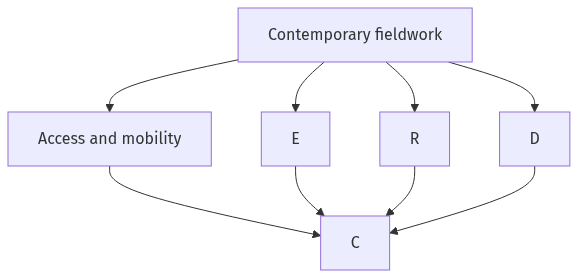
Access and scale: States, corporations, hospitals, conflict zones and online platforms restrict access. Migrants and supply chains exceed a village boundary. George Marcus’s multi-sited ethnography follows people, objects and metaphors, but breadth can reduce the depth that gives ethnography its force.
Consent and data: Consent is a continuing relationship, not a one-time signature. Visual media, GPS, genomic samples and searchable quotations can re-identify people. Cloud storage and AI-assisted transcription create new privacy and ownership risks. Community consent cannot erase individual dissent, and a gatekeeper cannot consent for everyone.
Power and representation: Writing Culture by James Clifford and George Marcus exposed how ethnographers construct authoritative texts. Feminist, Dalit, Indigenous and decolonial scholars ask who defines the question, receives the archive and benefits. Translation can flatten local categories; “giving voice” can still leave editorial control with the researcher.
Positionality and emotion: Caste, race, gender, nationality and institutional affiliation affect rapport and danger. Researchers may face harassment, surveillance, moral distress or vicarious trauma; local assistants often bear greater risk but receive less credit.
Digital and hybrid fields: Online identities are multiple, bots and algorithms mediate interaction, and public posts are not automatically ethically free data. Platform terms and deleted content also destabilise reproducibility.
Time and audit pressure: Short grants, ethics deadlines and publication incentives conflict with language learning and reciprocity. The observer effect, strategic answers and “research fatigue” intensify in over-studied communities.
Indian fieldwork among PVTGs, in border/conflict regions, hospitals or caste-sensitive settings requires special attention to administrative brokerage, stigma and return of findings.
Responses
Reflexive diaries, local-language competence, collaborative design, fair payment and authorship, secure data minimisation, staged consent and member discussion improve accountability. Mixed methods and multi-sited work should retain sustained observation. Open science must yield to confidentiality where disclosure harms participants.
Flow diagram
Conclusion
The contemporary field is neither bounded nor innocent. Rigorous fieldwork now means long-term relational evidence plus reflexivity, data protection, collaboration and care. These safeguards deepen participant observation; they do not replace it with remote extraction.
Quick related
Students also ask
-
Write the historical development of field work tradition in anthropology till recent times
Next question on this syllabus topic (2022 · Q7(b)). View answer →
-
Does reflexivity make ethnography merely subjective?
No. It documents how evidence was produced and allows readers to assess limitations; it supplements observation and triangulation.
-
Can community consent replace individual consent?
It may be necessary for legitimate entry, but it cannot authorise participation or disclosure against an individual’s wishes.
Same topic · past papers
UPSC has asked this before
These previous-year questions sit on the same topic. Open one to practise the earlier ask.
-
2026 · Q7(a) · Anthropology GS 1 · 20 marks
Discuss the mixed method approach in anthropological research -
2021 · Q8(a) · Anthropology GS 1 · 20 marks
Discuss various tools of data collection in conducting anthropological research
More from this topic
Q5(a) · UPSC Mains 2026 · Anthropology GS 1 · 10 marks · Solution
Ethics in anthropological fieldwork.
Fieldwork tradition in anthropology
Anthropological fieldwork ethics demand rigorous protection of human subjects and preservation of cultural integrity. Historically evolving from colonial encounters to modern collaborative paradigms, the discipline prioritizes informed consent and harm mitigation. Key dilemmas include balancing objectivity with advocacy, anonymizing vulnerable populations, and navigating power asymmetries between researcher and host. Contemporary practice is regulated by institutional review boards and professional codes such as those by the AAA, ensuring reciprocity and respect for indigenous knowledge systems.
Q7(b) · UPSC Mains 2022 · Anthropology GS 1 · 15 marks · Solution
Write the historical development of field work tradition in anthropology till recent times
Fieldwork tradition in anthropology
Torres Strait and Boas ended armchair evolution as the only method. Malinowski made long residence the classic. African and Indian village studies expanded the map. Reflexivity and multi-sited work named power and movement. Digital and urban fields still owe the ethic of presence.
Q4(c) · UPSC Mains 2016 · Anthropology GS 1 · 15 marks · Solution
Describe the evolution of Fieldwork tradition in Anthropology.
Fieldwork tradition in anthropology
Early anthropology used travellers, missions, and questionnaires. Torres Strait and Boas professionalised field collecting. Malinowski’s Trobriand stay became the charter of immersion. Indian village studies localised the tradition. Reflexivity and multi-sited work are the late evolution.