
Revision summary
Torres Strait and Boas ended armchair evolution as the only method. Malinowski made long residence the classic. African and Indian village studies expanded the map. Reflexivity and multi-sited work named power and movement. Digital and urban fields still owe the ethic of presence.
Model answer
Copper italics in this answer — like this — are the key facts. Each one is unpacked in the Facts & figures rail.
Introduction
Fieldwork became anthropology’s mark of honour. The path runs from travellers and missionaries to year-long residence, teams, multi-sited work, and digital fields.
Body
Beginnings
- Rivers on the Torres Strait expedition (1898) and genealogical method made intensive field science possible.
- Boas on the Northwest Coast demanded language and texts. Armchair Tylor was left behind.
The classic year
- Malinowski in the Trobriands set tent, vernacular, and the native’s point of view. Radcliffe-Brown in the Andamans added structural questions.
- Mead, Benedict, and Evans-Pritchard (Nuer, Azande) normalised long stays. Indian village work by Srinivas, Dube, and Marriott brought the method home.
Critique and after
- Reflexivity after the 1980s, Clifford and Marcus, showed the ethnographer in the text. Colonial archives were reread.
- Applied, medical, and development fieldwork used PRA beside the notebook.
- Recent work is multi-sited (Marcus), urban, laboratory, and online. The ethic of consent and the long stay remain the core, even when the ‘village’ is a chat group.
Flow diagram
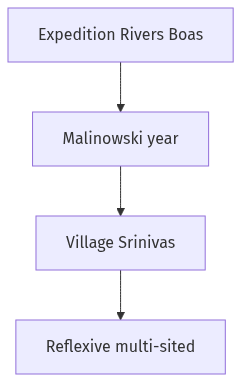
Conclusion
Fieldwork grew from expedition lists to Malinowskian residence, then to reflexive and multi-sited practice. The tradition is still presence plus method, not a postcard.
Quick related
Students also ask
-
Describe the evolution of Fieldwork tradition in Anthropology.
Next question on this syllabus topic (2016 · Q4(c)). View answer →
-
Is a two-week PRA fieldwork?
It is a field method. It is not a substitute for the ethnographic year when the question needs depth.
-
Did women enter the tradition late?
Mead and Benedict were early. Later feminist ethnography changed what counted as a field, including the house.
Same topic · past papers
UPSC has asked this before
These previous-year questions sit on the same topic. Open one to practise the earlier ask.
-
2022 · Q2(a) · Anthropology GS 1 · 20 marks
"Anthropology is the systematic, objective and holistic study of human kind in all times and places." Elaborate the argument
More from this topic
Q5(a) · UPSC Mains 2026 · Anthropology GS 1 · 10 marks · Solution
Ethics in anthropological fieldwork.
Fieldwork tradition in anthropology
Anthropological fieldwork ethics demand rigorous protection of human subjects and preservation of cultural integrity. Historically evolving from colonial encounters to modern collaborative paradigms, the discipline prioritizes informed consent and harm mitigation. Key dilemmas include balancing objectivity with advocacy, anonymizing vulnerable populations, and navigating power asymmetries between researcher and host. Contemporary practice is regulated by institutional review boards and professional codes such as those by the AAA, ensuring reciprocity and respect for indigenous knowledge systems.
Q3(c) · UPSC Mains 2024 · Anthropology GS 1 · 15 marks · Solution
Discuss the contemporary challenges in fieldwork method in anthropological research.
Fieldwork tradition in anthropology
Classical fieldwork assumed a bounded site; present fields are mobile, institutional and digital. Marcus offers multi-sited ethnography, but breadth can cost immersive depth. Consent must be ongoing; genomic, visual and online data create re-identification risks. Writing Culture made textual authority and representation explicit. Positionality, researcher safety and unequal risk to local assistants require planning. Collaborative design, data minimisation, language competence and return of findings strengthen—not dilute—participant observation.
Q4(c) · UPSC Mains 2016 · Anthropology GS 1 · 15 marks · Solution
Describe the evolution of Fieldwork tradition in Anthropology.
Fieldwork tradition in anthropology
Early anthropology used travellers, missions, and questionnaires. Torres Strait and Boas professionalised field collecting. Malinowski’s Trobriand stay became the charter of immersion. Indian village studies localised the tradition. Reflexivity and multi-sited work are the late evolution.