
Revision summary
Polygenic traits are built by many loci of small effect. Fisher joined Mendelism to Galton’s continuous curves. Nilsson-Ehle’s wheat colour is the classic additive model. Human stature and skin colour are standard anthropological examples. GWAS still finds many tiny effects, not a racial master gene.
Model answer
Copper italics in this answer — like this — are the key facts. Each one is unpacked in the Facts & figures rail.
Introduction
Polygenic inheritance is the passing of a trait that many loci of small effect build together. The result is a curve of people, not a 3:1 garden of peas.
Body
The genetic idea
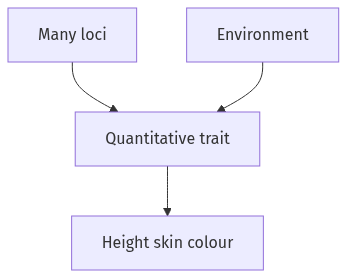
- R. A. Fisher showed that many Mendelian loci plus environment can produce the continuous distributions that Francis Galton had measured for stature.
- Nilsson-Ehle’s wheat-kernel colour is the teaching plant model: add more contributing alleles and the colour darkens by steps that look smooth in a large sample.
- Human stature, skin colour, blood pressure, and many disease risks sit in this architecture, which is why they are also called multifactorial when environment is counted.
Anthropological use
- Skin colour is a polygenic cline with latitude and ultraviolet light, not a three-race switch, which is why Livingstone and later geneticists rejected racial typology for this trait.
- Twin and family studies estimate heritability, but a heritability figure is not a gene list and is not destiny across environments.
- Genome-wide association studies now name many loci of tiny effect, which confirms the old polygenic picture without restoring Mendelian race types.
Flow diagram
Conclusion
Polygenic inheritance is many small loci making a quantitative trait. Anthropology needs it for stature, pigmentation, and complex disease, and it forbids treating those traits as single-gene races.
Quick related
Students also ask
-
What do you understand by Immunogenetics? Explain with suitable examples
Next question on this syllabus topic (2015 · Q8(c)). View answer →
-
Is a polygenic trait non-Mendelian at each locus?
Each locus can still segregate. The phenotype looks non-Mendelian because many loci and the environment are summed.
-
Can polygenic scores define races?
No. They describe statistical risk or stature inside samples. They do not restore biological races.
Same topic · past papers
UPSC has asked this before
These previous-year questions sit on the same topic. Open one to practise the earlier ask.
-
2024 · Q8(b) · Anthropology GS 1 · 15 marks
Describe the genetics and inheritance patterns of the ABO and Rh blood groups in man.
More from this topic
Q1(a) · UPSC Mains 2025 · Anthropology GS 1 · 10 marks · Solution
Mendelian and non-Mendelian traits.
Mendelian genetics in man-family study, single factor, multifactor, lethal, sub-lethal and polygenic inheritance in man.
Mendelian traits follow one-locus segregation and can be read in a pedigree. ABO, PTC tasting, albinism, haemophilia A and Huntington disease are standard examples. Multiple alleles and sex-linkage extend Mendelism; they do not cancel it. Non-Mendelian traits include polygenic stature and skin colour, linkage, maternal mtDNA and imprinting. Environment plus many genes gives a curve, not a 3:1 ratio. Use family study for Mendelian markers and quantitative genetics for everyday variation. Single-factor, multifactor, lethal and polygenic inheritance is this same distinction.
Q8(b) · UPSC Mains 2024 · Anthropology GS 1 · 15 marks · Solution
Describe the genetics and inheritance patterns of the ABO and Rh blood groups in man.
Mendelian genetics in man-family study, single factor, multifactor, lethal, sub-lethal and polygenic inheritance in man.
ABO lies on chromosome 9 and encodes glycosyltransferases acting on H antigen. Iᴬ and Iᴮ are codominant; both dominate common O. Bombay phenotype hh lacks H antigen and demonstrates epistasis. Rh is a chromosome-1 complex centred on RHD and RHCE, not literally one allele pair. Maternal IgG anti-D can cause haemolytic disease after sensitisation; prophylaxis prevents most cases. Blood-group frequencies trace populations but cannot define races or prove unique paternity.
Q7(b) · UPSC Mains 2024 · Anthropology GS 1 · 15 marks · Solution
What is a multifactorial trait? Illustrate your answer with suitable human examples.
Mendelian genetics in man-family study, single factor, multifactor, lethal, sub-lethal and polygenic inheritance in man.
A multifactorial trait combines many genetic variants with environment and development. Fisher explained continuous variation through many small Mendelian effects. Height, pigmentation, BMI and blood pressure are continuous examples. Cleft lip, neural-tube defects, diabetes and hypertension can use a liability-threshold model. Twin, family and GWAS designs estimate components but depend on population and environment. Yajnik's thin-fat phenotype illustrates developmental and nutritional interaction in India.