
Revision summary
Formalists treat scarcity and choice as universal. Substantivists, after Polanyi, treat reciprocity, redistribution, and market as historical forms. Kula and Nuer cattle show goods locked in kinship and prestige. Spheres of exchange refuse one money. Use both tools: calculation inside an instituted process.
Model answer
Copper italics in this answer — like this — are the key facts. Each one is unpacked in the Facts & figures rail.
Introduction
The formalist–substantivist debate is about whether market price theory can travel into non-market economies. It is a debate about method, not only about trade.
Body
The two claims
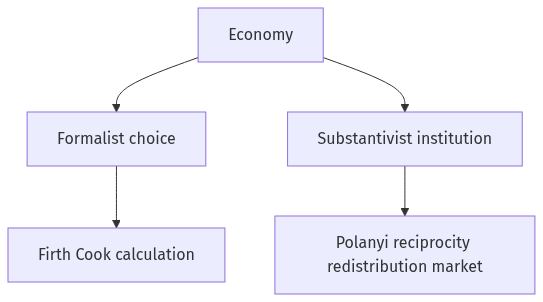
- Karl Polanyi said the economy is instituted process. Reciprocity, redistribution, and market exchange are historically specific, so scarcity-maximising models do not fit the Trobriand kula or a temple granary.
- Formalists such as Raymond Firth, Robbins Burling, and Scott Cook answered that choice under scarcity is universal. A Trobriand gardener still allocates labour, even if he does not quote a rupee price.
- George Dalton and Paul Bohannan used African and Melanesian cases to show spheres of exchange. A cow, a brass rod, and a wife-wealth good are not one money.
Case and limit
- Malinowski’s kula and Evans-Pritchard’s Nuer cattle show prestige and kinship locking goods that a supermarket model would treat as substitutes.
- Later economic anthropology, from Marshall Sahlins to Stephen Gudeman, kept Polanyi’s embeddedness but admitted calculation. The useful settlement is that formal tools need substantivist context.
Flow diagram
Conclusion
Formalism asks how people choose. Substantivism asks in which institution they choose. Anthropology needs both, and it must not treat the market as the only real economy.
Quick related
Students also ask
-
Discuss the principles governing production, distribution and exchange in simple societies.
Next question on this syllabus topic (2016 · Q4(a)). View answer →
-
Did the debate end with a winner?
No. Most field studies now mix calculation with instituted meaning. The error is to treat either pole as the whole of economic anthropology.
-
Is a temple donation a market act?
It may involve cost, but the institution is redistribution and piety. That is Polanyi’s point.
Same topic · past papers
UPSC has asked this before
These previous-year questions sit on the same topic. Open one to practise the earlier ask.
-
2025 · Q2(b) · Anthropology GS 1 · 15 marks
Compare and contrast the symbolic approaches of Clifford Geertz and Victor Turner to understand culture -
2023 · Q3(b) · Anthropology GS 1 · 15 marks
How did Clifford Geertz look at religion. Differentiate between anthropological and psychological approaches to the study of religion. -
2022 · Q7(c) · Anthropology GS 1 · 15 marks
Discuss the approaches of Leslie White, Julian Steward and Marshall Sahlins in the light of cultural evolution -
2016 · Q3(c) · Anthropology GS 1 · 15 marks
Critically examine different Anthropological approaches to Religion.
More from this topic
Q7(c) · UPSC Mains 2023 · Anthropology GS 1 · 15 marks · Solution
Discuss political and methodological aspects of national character studies. Elucidate the contemporary relevance of such studies.
Economic Organization
National character work grew from culture-and-personality, especially Benedict on Japan. It was politically funded as wartime culture-at-a-distance. Methods were life history, projective tests, film, and émigré interview. Faults are stereotyping, sample bias, and the ecological fallacy. Geertz moved the field from private character to public meaning. Today the genre survives in branding and populism; anthropology uses it as a caution.
Q6(b) · UPSC Mains 2023 · Anthropology GS 1 · 15 marks · Solution
Discuss the impact of globalization on the economic systems of indigenous communities.
Economic Organization
Wolf already placed local peoples inside world markets. Globalization intensifies land commodification, wage labour, and branded culture. Niyamgiri and dam displacement are Indian cases of resource enclosure. Remittances and tourism can feed and hollow the same household. New brokers create internal inequality. Friction, law, and cooperatives are the counter-moves, not a return to a closed isolate.
Q4(a) · UPSC Mains 2016 · Anthropology GS 1 · 20 marks · Solution
Discuss the principles governing production, distribution and exchange in simple societies.
Economic Organization
Production is household and lineage labour on common or clan land. Distribution follows reciprocity and redistribution more than wage. Exchange is gift, kula-like partnership, and spheres of goods. Polanyi and Sahlins name the principles. Price market is not the default law.