
Revision summary
Customary law governs land, water, and forest through taboo, fine, and office. Sacred groves in Kodagu, Kerala, and Meghalaya are standard Indian examples. Ostrom’s commons design matches many of those local rules. Chipko and Niyamgiri show custom in political defence of habitat. Custom can fail under market pressure, so recognition must be empirical, as in the Forest Rights Act.
Model answer
Copper italics in this answer — like this — are the key facts. Each one is unpacked in the Facts & figures rail.
Introduction
Customary law is the local rule of land, water, forest, and sanction. It can conserve an environment when the rule and the habitat still fit each other.
Body
Custom as conservation
- Sacred groves such as kaavu in Kerala, devara kadu in Kodagu, and law kyntang in Meghalaya close felling and hunting by ritual fine, which Madhav Gadgil and others have treated as living conservation.
- Elinor Ostrom showed that commons need nested rules, monitors, and sanctions; many customary systems already have those, without a state forest code.
- Chipko in the Garhwal Himalaya and Dongria Kondh defence of Niyamgiri show custom joining protest when the state or a company claims the hill.
Limits and law
- Custom can also exhaust a resource when population, market timber, or elite capture break the old restraint, so custom is not automatically green.
- The Forest Rights Act, 2006, and related PESA rules try to recognise community forest rights rather than treat all local use as theft.
- Anthropology’s task is to record tenure, taboo, and sanction, then ask whether those rules still match ecology under new markets.
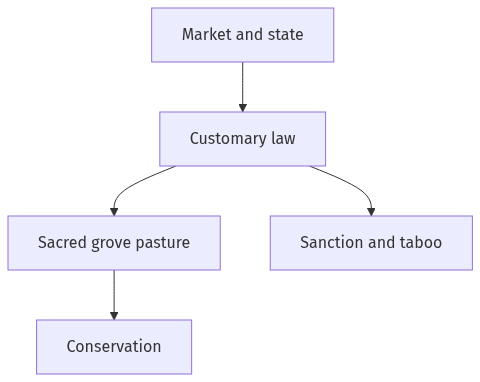
Flow diagram
Conclusion
Customary law can protect groves, pastures, and hills when rights and sanctions are real. Conservation policy works better when it recognises those rules instead of erasing them.
Quick related
Students also ask
-
Incest Taboos.
Next question on this syllabus topic (2015 · Q1(c)). View answer →
-
Does custom always conserve nature?
No. Custom conserves when rules, monitors, and ecology still match. Market timber and elite capture can empty the same grove.
-
Is this only a tribal topic?
No. Peasant irrigation panchayats, pastoral routes, and caste-linked tanks are also customary environmental law.
Same topic · past papers
UPSC has asked this before
These previous-year questions sit on the same topic. Open one to practise the earlier ask.
-
2022 · Q2(c) · Anthropology GS 1 · 15 marks
Discuss with suitable examples the typo-technological problems in Indian palaeolithic industry with reference to environmental hypotheses
More from this topic
Q3(b) · UPSC Mains 2026 · Anthropology GS 1 · 15 marks · Solution
Discuss 'incest taboo' as the basis of development of kinship systems in human societies
Marriage
• The incest taboo is a universal cultural rule banning sexual and marital relations between primary close kin. • It directly enforces exogamy, forcing individuals to seek marriage partners outside their immediate family unit. • E.B. Tylor argued early societies had to "marry out or be killed out" to achieve broad societal integration and peace. • Claude Lévi-Strauss viewed the taboo as the negative side of reciprocity, driving the circulation of partners to build inter-group alliances. • Leslie White noted the taboo is uniquely human, marking the exact threshold where biology (nature) transforms into culture (kinship). • Far from being just a restriction, it acts as a generative principle that weaves isolated biological units into expansive social webs.
Q7(c) · UPSC Mains 2024 · Anthropology GS 1 · 15 marks · Solution
Discuss the applicability of various sampling techniques in selecting the study group.
Marriage
Simple random and systematic sampling require a usable frame. Stratification ensures analytically important minorities are represented. Cluster and multistage designs suit dispersed regional surveys but need design-effect adjustment. Purposive sampling selects information-rich cases; theoretical sampling develops concepts. Snowball sampling reaches hidden groups but carries network bias. Anthropological sampling should combine transparent inference, ethnographic depth, non-response analysis and ethics.
Q1(c) · UPSC Mains 2015 · Anthropology GS 1 · 10 marks · Solution
Incest Taboos.
Marriage
Incest taboos forbid sex inside a culturally named kin set. Lévi-Strauss tied the rule to exogamy and alliance. Westermarck tied it to childhood familiarity. Genetics adds inbreeding cost but not the cousin map. Gotra and clan extend the ban beyond the nuclear house.