
Revision summary
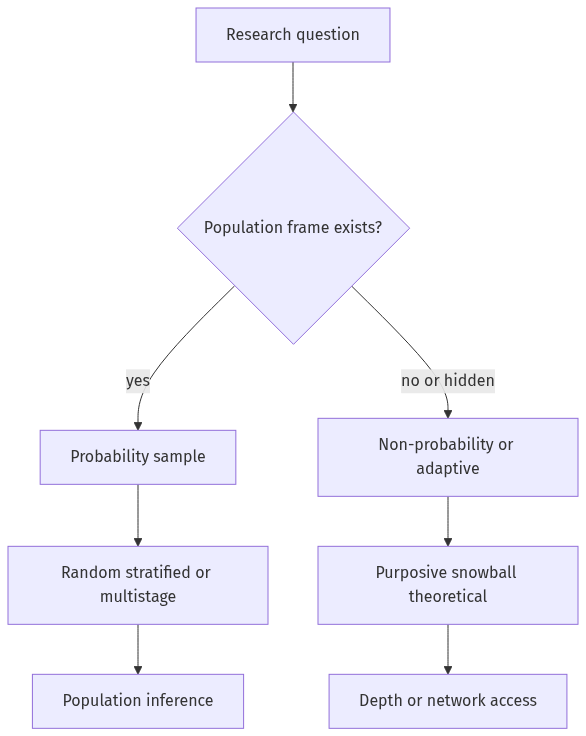
Simple random and systematic sampling require a usable frame. Stratification ensures analytically important minorities are represented. Cluster and multistage designs suit dispersed regional surveys but need design-effect adjustment. Purposive sampling selects information-rich cases; theoretical sampling develops concepts. Snowball sampling reaches hidden groups but carries network bias. Anthropological sampling should combine transparent inference, ethnographic depth, non-response analysis and ethics.
Model answer
Copper italics in this answer — like this — are the key facts. Each one is unpacked in the Facts & figures rail.
Introduction
Sampling selects cases from a defined population so that fieldwork is feasible. Its quality depends not on one universally best technique but on fit among research question, sampling frame, mobility, social boundaries and the inference claimed.
Body
Probability designs
- Simple random sampling gives every listed unit a known equal chance; suitable for a complete village household register, but costly over dispersed terrain.
- Systematic sampling takes every kth unit after a random start; efficient in settlement lists, unless periodic ordering creates bias.
- Stratified sampling samples within relevant strata such as sex, age, caste or ecological zone. It ensures small subgroups are represented and can improve precision.
- Cluster and multistage sampling first select villages or census blocks, then households and persons. This is practical for regional nutrition or morbidity surveys, though intra-cluster similarity enlarges sampling error.
Probability designs support estimable sampling error and population inference, provided non-response and frame omissions are addressed.
Non-probability and adaptive designs
Purposive sampling selects information-rich ritual specialists, healers or fossil collections; quota sampling fills categories without random selection; convenience sampling is fast but weak for generalisation. Snowball sampling, associated with referral chains, reaches stigmatised or hidden groups such as migrants, sex workers or drug users, but over-represents network hubs. Respondent-driven sampling attempts to model referral probabilities under strong assumptions. Theoretical sampling in grounded theory selects new cases to develop emerging concepts until saturation.
Classic intensive ethnography—Malinowski in the Trobriands or M. N. Srinivas in Rampura—often chose a site purposively, then used a census, genealogy and case studies within it. Statistical representativeness and ethnographic depth answer different questions.
Gatekeeper access, seasonal absence, household definitions, refusal and digital exclusion can bias any design. Tribal or vulnerable populations require community consent and protection from re-identification; oversampling a small group must not become extractive surveillance.
Flow diagram
Conclusion
Use random, stratified or multistage designs when estimating population patterns; use purposive, theoretical or network designs when mechanisms, rare expertise or hidden populations are the object. Triangulation and honest limits matter more than calling every sample representative.
Quick related
Students also ask
-
Customary laws and Environmental conservation.
Next question on this syllabus topic (2023 · Q1(d)). View answer →
-
Is a large convenience sample representative?
No. Size reduces random error but cannot repair systematic selection bias.
-
Can one study mix sampling techniques?
Yes. A multistage household survey can be combined with purposive life histories, provided each supports a distinct claim.
Same topic · past papers
UPSC has asked this before
These previous-year questions sit on the same topic. Open one to practise the earlier ask.
-
2015 · Q4(a) · Anthropology GS 1 · 20 marks
Critically examine the Formalists' and Substantivists' views on the applicability of economic laws in the study of primitive societies
More from this topic
Q3(b) · UPSC Mains 2026 · Anthropology GS 1 · 15 marks · Solution
Discuss 'incest taboo' as the basis of development of kinship systems in human societies
Marriage
• The incest taboo is a universal cultural rule banning sexual and marital relations between primary close kin. • It directly enforces exogamy, forcing individuals to seek marriage partners outside their immediate family unit. • E.B. Tylor argued early societies had to "marry out or be killed out" to achieve broad societal integration and peace. • Claude Lévi-Strauss viewed the taboo as the negative side of reciprocity, driving the circulation of partners to build inter-group alliances. • Leslie White noted the taboo is uniquely human, marking the exact threshold where biology (nature) transforms into culture (kinship). • Far from being just a restriction, it acts as a generative principle that weaves isolated biological units into expansive social webs.
Q1(d) · UPSC Mains 2023 · Anthropology GS 1 · 10 marks · Solution
Customary laws and Environmental conservation.
Marriage
Customary law governs land, water, and forest through taboo, fine, and office. Sacred groves in Kodagu, Kerala, and Meghalaya are standard Indian examples. Ostrom’s commons design matches many of those local rules. Chipko and Niyamgiri show custom in political defence of habitat. Custom can fail under market pressure, so recognition must be empirical, as in the Forest Rights Act.
Q1(c) · UPSC Mains 2015 · Anthropology GS 1 · 10 marks · Solution
Incest Taboos.
Marriage
Incest taboos forbid sex inside a culturally named kin set. Lévi-Strauss tied the rule to exogamy and alliance. Westermarck tied it to childhood familiarity. Genetics adds inbreeding cost but not the cousin map. Gotra and clan extend the ban beyond the nuclear house.