
Revision summary
Mehrgarh on the Kachi plain begins as an aceramic farming village around the seventh millennium BCE. Wheat, barley, sickle gloss, grinding stones and storage together demonstrate cultivation. Sheep, goat and cattle management is inferred from morphology, kill profiles and changing abundance. Later phases add pottery, specialised crafts, ornaments and wider exchange. The site shows both western connections and strong local development, especially around zebu cattle. Mehrgarh is a long predecessor to Indus urbanism, not an early Harappan city.
Model answer
Copper italics in this answer — like this — are the key facts. Each one is unpacked in the Facts & figures rail.
Introduction
Mehrgarh, excavated by the French Archaeological Mission led by Jean-François Jarrige on the Kachi plain of Baluchistan, records a long transition from early aceramic farming around the seventh millennium BCE to craft-rich Chalcolithic village life. It is the clearest north-west South Asian bridge between foraging and the later Indus tradition.
Body
Evidence of food production
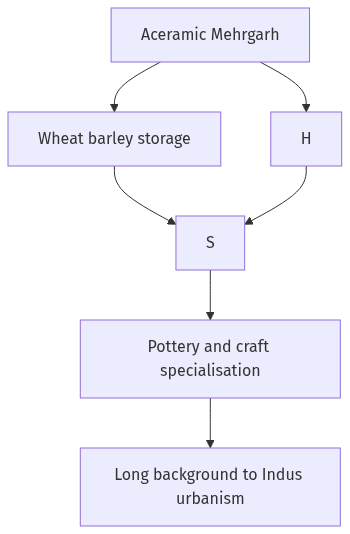
Mehrgarh Period I had mud-brick, compartmented buildings, storage facilities, grinding stones and chipped-stone blades with sickle gloss. Carbonised plant remains include domesticated wheat and barley, while later phases broadened cultivation and processing. The combined evidence—crop morphology, harvesting tools, storage and sedentary architecture—is stronger than any grain found alone.
Burials beneath or near settlement floors, repeated rebuilding and demographic growth indicate durable village residence. In later ceramic Neolithic and Chalcolithic levels, wheel-made pottery, larger storage, terracotta figurines and specialised crafts in shell, stone and beads show intensification. Cotton fibres/seeds are reported from early Mehrgarh and are important for the history of textile production, though their scale is uncertain.
Evidence of animal domestication
Faunal assemblages include sheep, goat and cattle. Domestication is inferred from changing horn-core and body size, age–sex kill profiles, increasing frequency through time and management within a settled economy—not from species presence alone. Sheep and goats likely reflect connections with western Asian domesticates. Zebu cattle (Bos indicus) became increasingly important and are often argued to include local domestication or strong local management; the precise wild-to-domestic pathway remains debated.
Significance
- It demonstrates that food production in South Asia began well before Harappan urbanism.
- Indigenous development and westward contacts interacted; diffusion versus independent invention is too simple.
- Craft specialisation, dental drilling, ornaments and differentiated grave goods reveal technical skill and emerging social distinctions.
- Its wheat–barley–herding package, mud-brick architecture and craft networks supplied foundations later transformed within the Indus civilisation.
- Skeletal and dental evidence also records the costs of sedentism: workload, disease and dietary change accompanied surplus.
Mehrgarh is not a miniature Harappa and no straight ethnic line can be assumed. Flooding, uneven preservation and chronological revision require phase-specific claims.
Flow diagram
Conclusion
At Mehrgarh, plants, faunal profiles, tools, storage and settlement reinforce one another as evidence of production and herd management. Its significance lies in a long, locally worked transition—not a sudden imported revolution—from village farming to the economic and craft base of the greater Indus world.
Quick related
Students also ask
-
Describe the features of early farming cultures and Neolithic of the Near East
Next question on this syllabus topic (2021 · Q2(c)). View answer →
-
Did agriculture arrive fully formed from West Asia?
Wheat, barley, sheep and goats show western connections, but cattle management and the regional sequence show local selection and transformation.
-
Why is storage important evidence?
Compartmented buildings and storage facilities connect harvested crops to planned surplus and sedentary household organisation.
Same topic · past papers
UPSC has asked this before
These previous-year questions sit on the same topic. Open one to practise the earlier ask.
-
2022 · Q3(b) · Anthropology GS 1 · 15 marks
Enumerate the evidence of animal domestication in Indian microlithic industry
More from this topic
Q7(b) · UPSC Mains 2025 · Anthropology GS 1 · 15 marks · Solution
What are the major theories proposed in support of the origin of food production? How the change in subsistence economy brought revolution during this period?
Neolithic
Childe saw a Neolithic revolution driven by post-glacial crowding around oases. Braidwood placed origins in hilly flanks where wild cereals already grew. Binford and Cohen stressed packing and population pressure on the margins. Bender and Hodder stressed social and symbolic demand. Mehrgarh is the South Asian early-farming example. The revolution is surplus, sedentism, labour and inequality, not automatic better health.
Q2(c) · UPSC Mains 2021 · Anthropology GS 1 · 15 marks · Solution
Describe the features of early farming cultures and Neolithic of the Near East
Neolithic
Near Eastern Neolithic grows from Natufian sedentary harvest. PPNA and PPNB villages add plaster houses, ritual skulls, and herds. Jericho’s tower and Çatalhöyük’s crowded houses are type sites. Founder crops and sheep–goat define the package; pottery comes later. Childe named a revolution; current work stresses a long, mosaic process.
Q5(c) · UPSC Mains 2016 · Anthropology GS 1 · 10 marks · Solution
Neolithic Cultures of India
Neolithic
The Indian Neolithic is early farming with ground stone. Burzahom, southern ashmounds, and Ganga sites are type regions. Mehrgarh anchors the northwest farming story. Pottery and sedentism arrive in local orders. It is several cultures, not one Neolithic people.