
Revision summary
Magh Mela is the annual Magha gathering of kalpavasis at Prayagraj Sangam. Kumbh repeats the same tirtha on a twelve-year cycle, with Ardh Kumbh in the sixth year. Salient Kumbh features are akhara processions, amrit snan, and a planned tent city. UNESCO recognised Kumbh Mela in 2017. Both melas organise UP river faith as season, vow, and crowd.
Model answer
Introduction
Prayagraj’s Sangam hosts an annual Magh Mela and, in a twelve-year cycle, the Kumbh. Their significance in Uttar Pradesh culture is pilgrimage, kalpavas, and a temporary sacred city on the Ganga–Yamuna–Saraswati confluence.
Body
Significance in UP culture
- Magh Mela every winter makes the Sangam a living tirtha for kalpavasis who camp, bathe, and hear katha through the month of Magha.
- Kumbh, and the sixth-year Ardh Kumbh, scale that same rite into a civilisational gathering that the State treats as both faith and public management.
- UNESCO listed Kumbh Mela as intangible cultural heritage in 2017, which named a UP practice as a world heritage of pilgrimage.
- Akharas, pandas, and Ganga-Yamuna identity of Prayagraj, Kashi, and Ayodhya sit in one Hindu geography of Uttar Pradesh.
Salient features of Magh Mela
- It is annual, smaller than Kumbh, and centred on Magha snans and month-long kalpavas.
- Temporary ashrams, annakshetras, and boat crossings are the ordinary infrastructure.
Salient features of Kumbh
- The cycle is twelve years at Prayagraj, with royal baths on announced bathing dates when akharas process in order.
- A planned tent city, pontoon bridges, and health and police grids turn the floodplain into a short-life metropolis.
- Amrit snan, the meeting of four tirthas in the wider Kumbh circuit, and the myth of the nectar pot are the ritual core.
- The 2019 Kumbh and the 2025 Maha Kumbh at Prayagraj showed the same features at very large scale.
Shared meaning
- Both melas teach that UP river culture is organised time, not only a temple visit: season, vow, and crowd become one civic-religious event.
Flow diagram
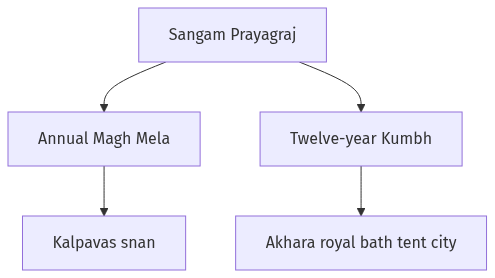
Conclusion
Magh Mela is the yearly Sangam discipline of kalpavas; Kumbh is its twelve-year magnification with akhara baths and a planned tent city. Together they are the chief living pilgrimage culture of Uttar Pradesh at Prayagraj.
Quick related
Students also ask
-
How did cities of Meerut, Lucknow, Kanpur and Jhansi in Uttar Pradesh contribute to the 1857 Revolt and what were the key events that took place in the State during this pivotal period?
Next question in the 2025 paper (Q13). View answer →
-
Is Magh Mela the same as Kumbh?
No. Magh Mela is annual. Kumbh is the magnified twelve-year (and sixth-year Ardh) form of the same Sangam rite.
-
Why do both matter to UP culture?
They fix Prayagraj as a living tirtha and train a whole administration around pilgrimage, not only around temples.
Same topic · past papers
UPPSC has asked this before
These previous-year questions sit on the same topic. Open one to practise the earlier ask.
-
2024 · Q11 · UPGS5 · 12 marks
What are the salient features of the architecture of Uttar Pradesh? Describe its key elements and styles.
More from this paper
Q1 · UPSC Mains 2025 · UPGS5 · 8 marks · Solution
Describe the cultural significance of 'Ayodhya' on the basis of ancient literature.
UP history, civilisation and culture
The Ramayana makes Ayodhya the Kosalan capital of Rama. The Skanda Purana’s Ayodhya Mahatmya places it among the moksha-puris. Buddhist texts remember Saketa, and Jain books remember Tirthankara births at Vinita or Saketa. Together these books give Ayodhya its lasting cultural weight in Uttar Pradesh.
Q2 · UPSC Mains 2025 · UPGS5 · 8 marks · Solution
Agra's Indo-Islamic architecture has a blend of Indian, Persian and Islamic styles. Comment.
UP history, civilisation and culture
Agra’s Mughal buildings mix Indian craft, Persian gardens, and Islamic tombs. Agra Fort shows Akbar’s sandstone and Shah Jahan’s marble in one complex. The Taj Mahal is a Persian garden-tomb built by Indian workshops. Itimad-ud-Daulah is an early white-marble inlay tomb in Agra.
Q3 · UPSC Mains 2025 · UPGS5 · 8 marks · Solution
Discuss in short the contribution of Arya Samaj in education of Uttar Pradesh.
Health and education in UP
Arya Samaj treated Vedic and modern schooling as one programme in the United Provinces. DAV schools and colleges became the main urban chain. Gurukul Kangri and kanya gurukuls modelled residential and girls’ education. Hindi as a medium was a lasting Samaj mark in Uttar Pradesh. The spread was stronger in the west than in Purvanchal.