
Revision summary
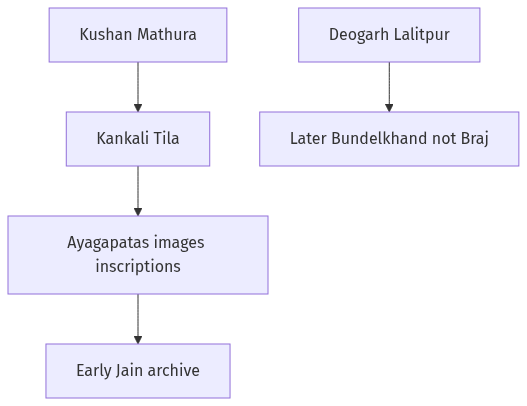
Kankali Tila at Mathura is the main early Jain archaeological mine in Braj. Ayagapatas, Jina images, and Kushan inscriptions form the dated corpus. The womb metaphor means the surviving north Indian stone record, not the birth of Jainism itself. Kaman is culturally Braj but in Rajasthan. Deogarh’s Jain temples are medieval Bundelkhand, not Braj proof.
Model answer
Introduction
Kushan Mathura produced the largest early hoard of Jain images, inscriptions, and ayagapatas in north India. The statement is true for Braj archaeology if it is tied to Kankali Tila, not to every later Jain temple in Uttar Pradesh.
Body
Why Mathura is called a womb of Jain sources
- Excavation of Kankali Tila, the Jain mound south of Mathura city, yielded a brick stupa, Tirthankara images, donor inscriptions, and stone ayagapatas of the Kushan centuries.
- Those finds became the main dated corpus from which historians read early Jain iconography, monastic gifts, and the Mathura art school.
- Ayagapatas are square votive slabs with a Jina, stupa, or nandipada; they are characteristic of Mathura and are not a routine find at later medieval Jain sites.
- Inscriptions name lay donors and Jain ganas, so the mound is an archive, not only a sculpture dump.
Other Braj points, kept accurate
- Braj in the strict sense is the Mathura–Vrindavan–Govardhan belt of Uttar Pradesh; Kaman in Bharatpur is culturally Braj but lies in Rajasthan, so it may be named only as a border analogue, not as a UP site.
- Deogarh in Lalitpur has an important medieval Jain temple group, yet it is Bundelkhand, not Braj; it cannot prove the Mathura-as-womb claim.
- Later Jain temples in Vrindavan and elsewhere in Braj are devotionally alive; they are not the Kushan archaeological womb.
Clarification of the statement
- Ancient Mathura was the womb of Jain archaeological sources because Kankali Tila and its ayagapatas still feed the textbook of early Jain art.
- The phrase is metaphorical: Jainism was older and wider than Mathura, but the surviving early stone record of the north is concentrated here.
Flow diagram
Conclusion
The statement holds for Braj if it means Kankali Tila, Kushan Jain images, and ayagapatas at Mathura. Deogarh is later UP Jain architecture, and Kaman is Braj culture across the Rajasthan line, so they must not be folded into the same mound.
Quick related
Students also ask
-
Elucidate the significance of Magh Mela and Kumbh Mela in the culture of Uttar Pradesh and focus on their salient features.
Next question in the 2025 paper (Q12). View answer →
-
Does the statement mean Jainism began at Mathura?
No. It means the richest early Jain stone record of the north comes from Mathura, especially Kankali Tila.
-
Should Deogarh be used as a Braj site?
No. Deogarh is in Lalitpur, Bundelkhand. It shows later UP Jain building, not Kushan Braj archaeology.
Same topic · past papers
UPPSC has asked this before
These previous-year questions sit on the same topic. Open one to practise the earlier ask.
-
2025 · Q1 · UPGS5 · 8 marks
Describe the cultural significance of 'Ayodhya' on the basis of ancient literature.
More from this paper
Q1 · UPSC Mains 2025 · UPGS5 · 8 marks · Solution
Describe the cultural significance of 'Ayodhya' on the basis of ancient literature.
UP history, civilisation and culture
The Ramayana makes Ayodhya the Kosalan capital of Rama. The Skanda Purana’s Ayodhya Mahatmya places it among the moksha-puris. Buddhist texts remember Saketa, and Jain books remember Tirthankara births at Vinita or Saketa. Together these books give Ayodhya its lasting cultural weight in Uttar Pradesh.
Q2 · UPSC Mains 2025 · UPGS5 · 8 marks · Solution
Agra's Indo-Islamic architecture has a blend of Indian, Persian and Islamic styles. Comment.
UP history, civilisation and culture
Agra’s Mughal buildings mix Indian craft, Persian gardens, and Islamic tombs. Agra Fort shows Akbar’s sandstone and Shah Jahan’s marble in one complex. The Taj Mahal is a Persian garden-tomb built by Indian workshops. Itimad-ud-Daulah is an early white-marble inlay tomb in Agra.
Q3 · UPSC Mains 2025 · UPGS5 · 8 marks · Solution
Discuss in short the contribution of Arya Samaj in education of Uttar Pradesh.
Health and education in UP
Arya Samaj treated Vedic and modern schooling as one programme in the United Provinces. DAV schools and colleges became the main urban chain. Gurukul Kangri and kanya gurukuls modelled residential and girls’ education. Hindi as a medium was a lasting Samaj mark in Uttar Pradesh. The spread was stronger in the west than in Purvanchal.