
Revision summary
UP innovation is seed, cane, potato, mint, drip, FPO, and ODOP processing. Yield gains raise income only with price and processing. Rural jobs grow more in mills and food parks than in the field. Mechanisation can cut peak farm labour. Small holdings remain the limit unless irrigation and markets arrive.
Model answer
Introduction
Uttar Pradesh is India’s largest foodgrain and sugarcane State, so agricultural innovation here is about seed, water, processing, and markets, not only machines. The analysis must reach farmer income and rural jobs.
Body
Where innovation is visible
- High-yielding wheat and paddy, tissue-culture sugarcane, and potato seed belts in western and central UP raised output on small holdings.
- Mentha (mint oil) in the Rohilkhand–Tarai belt, mango in Malihabad, and One District One Product clusters added non-cereal cash.
- Drip and sprinkler in Bundelkhand, solar pumps, soil-health cards, and drone spraying are the new public-tech layer.
- Farmer producer organisations, e-NAM, and sugar-mill crushing with cogeneration link the farm to a factory job.
Income
- Diversification into horticulture, dairy, fisheries, and mint can lift cash where price and cold chain exist; it fails where distress sales remain.
- Innovation that only raises yield without procurement or processing can leave the farmer with a glut, as potato and cane arrears have shown.
Rural employment
- Food parks, cane mills, cold stores, and ODOP processing create non-farm work in small towns.
- Mechanisation also trims peak-season labour, so employment gains are in processing and services more than in the field.
- Landless workers gain if dairying and horticulture hire locally; they lose if machines replace weeding without a new job nearby.
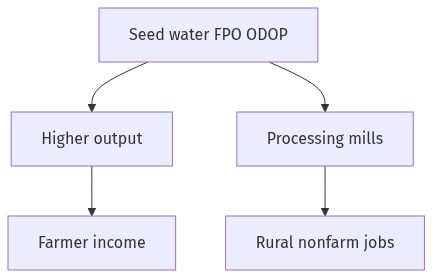
Flow diagram
Conclusion
Agricultural innovation in UP has raised output and opened mint, dairy, and processing incomes, with rural jobs shifting toward mills and ODOP units. The impact on the small farmer is positive only where market and irrigation close the last mile.
Quick related
Students also ask
-
"Ancient Mathura was the womb place of Jain Archaeological sources." Clarify this statement on the basis of Jain Archaeological sites in Braj Region.
Next question in the 2025 paper (Q11). View answer →
-
Does innovation always raise farmer income?
No. Extra yield without a buyer or a mill can crash prices, as potato gluts and cane dues have shown.
-
Where do rural jobs come from?
More from processing, dairy, and logistics than from extra days of field labour after mechanisation.
Same topic · past papers
UPPSC has asked this before
These previous-year questions sit on the same topic. Open one to practise the earlier ask.
More from this paper
Q1 · UPSC Mains 2025 · UPGS5 · 8 marks · Solution
Describe the cultural significance of 'Ayodhya' on the basis of ancient literature.
UP history, civilisation and culture
The Ramayana makes Ayodhya the Kosalan capital of Rama. The Skanda Purana’s Ayodhya Mahatmya places it among the moksha-puris. Buddhist texts remember Saketa, and Jain books remember Tirthankara births at Vinita or Saketa. Together these books give Ayodhya its lasting cultural weight in Uttar Pradesh.
Q2 · UPSC Mains 2025 · UPGS5 · 8 marks · Solution
Agra's Indo-Islamic architecture has a blend of Indian, Persian and Islamic styles. Comment.
UP history, civilisation and culture
Agra’s Mughal buildings mix Indian craft, Persian gardens, and Islamic tombs. Agra Fort shows Akbar’s sandstone and Shah Jahan’s marble in one complex. The Taj Mahal is a Persian garden-tomb built by Indian workshops. Itimad-ud-Daulah is an early white-marble inlay tomb in Agra.
Q3 · UPSC Mains 2025 · UPGS5 · 8 marks · Solution
Discuss in short the contribution of Arya Samaj in education of Uttar Pradesh.
Health and education in UP
Arya Samaj treated Vedic and modern schooling as one programme in the United Provinces. DAV schools and colleges became the main urban chain. Gurukul Kangri and kanya gurukuls modelled residential and girls’ education. Hindi as a medium was a lasting Samaj mark in Uttar Pradesh. The spread was stronger in the west than in Purvanchal.