
Revision summary
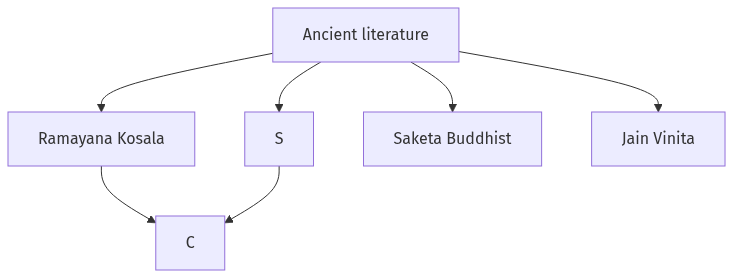
The Ramayana makes Ayodhya the Kosalan capital of Rama. The Skanda Purana’s Ayodhya Mahatmya places it among the moksha-puris. Buddhist texts remember Saketa, and Jain books remember Tirthankara births at Vinita or Saketa. Together these books give Ayodhya its lasting cultural weight in Uttar Pradesh.
Model answer
Introduction
Ayodhya on the Sarayu is remembered in Sanskrit, Buddhist, and Jain books as a holy city of Kosala. A description from ancient literature must stay with those texts, not with later politics.
Body
Epic and Puranic city
- The Valmiki Ramayana treats Ayodhya as the capital of Kosala and the seat of the Ikshvaku line of Rama.
- The city is drawn as a planned town of gates, palaces, and dharma, so it became the model of a righteous capital in later Hindu memory.
- The Ayodhya Mahatmya in the Skanda Purana lists tirthas on the Sarayu and places Ayodhya among the seven moksha-puris.
- The Mahabharata and later Puranas keep the same geography of Kosala, which tied pilgrimage to a named place in today’s Uttar Pradesh.
Other ancient streams
- Buddhist texts know the town as Saketa, a Kosalan city on the trade route, so Ayodhya is not only a Ramayana site.
- Jain tradition names ancient Vinita or Saketa as the birthplace of several Tirthankaras, including Rishabhanatha, which made the city sacred for Jains as well.
- Kalidasa’s Raghuvamsa retells the solar dynasty of Ayodhya, which carried the city’s fame in classical kavya.
Cultural meaning
- Ancient literature therefore made Ayodhya a shared sacred landscape of kingship, pilgrimage, and moksha, not a single-sect shrine.
Flow diagram
Conclusion
On the basis of the Ramayana, the Skanda Purana, Buddhist Saketa, and Jain memory, Ayodhya is culturally significant as Kosala’s holy capital and a moksha-puri on the Sarayu in Uttar Pradesh.
Quick related
Students also ask
-
Agra's Indo-Islamic architecture has a blend of Indian, Persian and Islamic styles. Comment.
Next question in the 2025 paper (Q2). View answer →
-
Is Ayodhya mentioned only in the Ramayana?
No. The Skanda Purana, Buddhist Saketa, Jain Tirthankara lists, and classical kavya also remember the city.
-
What is a moksha-puri?
A city named in Puranic lists as a place where pilgrimage and death are held to aid liberation; Ayodhya is one of the seven.
Same topic · past papers
UPPSC has asked this before
These previous-year questions sit on the same topic. Open one to practise the earlier ask.
More from this paper
Q2 · UPSC Mains 2025 · UPGS5 · 8 marks · Solution
Agra's Indo-Islamic architecture has a blend of Indian, Persian and Islamic styles. Comment.
UP history, civilisation and culture
Agra’s Mughal buildings mix Indian craft, Persian gardens, and Islamic tombs. Agra Fort shows Akbar’s sandstone and Shah Jahan’s marble in one complex. The Taj Mahal is a Persian garden-tomb built by Indian workshops. Itimad-ud-Daulah is an early white-marble inlay tomb in Agra.
Q3 · UPSC Mains 2025 · UPGS5 · 8 marks · Solution
Discuss in short the contribution of Arya Samaj in education of Uttar Pradesh.
Health and education in UP
Arya Samaj treated Vedic and modern schooling as one programme in the United Provinces. DAV schools and colleges became the main urban chain. Gurukul Kangri and kanya gurukuls modelled residential and girls’ education. Hindi as a medium was a lasting Samaj mark in Uttar Pradesh. The spread was stronger in the west than in Purvanchal.
Q4 · UPSC Mains 2025 · UPGS5 · 8 marks · Solution
Elucidate the cultural significance of literature and music in day-to-day life of people of Uttar Pradesh.
UP society, festivals and languages
Ramcharitmanas, Braj bhakti, Kabir, and Premchand enter homes and schools. Thumri, dadra, birha, and kajari mark marriage, monsoon, and harvest. Lucknow, Banaras, and Braj are both literary and musical regions. Daily UP culture is recited and sung, not only read.