Q20 · UPPSC PCS Mains 2025 · GS IV · 12 marks · ~200 words in the hall · 3 min read

← Q19

You hold a responsible position in district. One day in the morning you received a call from the school of your 11-year-old son that you are required to come and meet the principal. You proceed to the school and find your son in the principal's office. The principal informs you that your son had been found wandering aimlessly in the ground during the time classes were in progress. The class teacher further informs you that your son has lately become a loner and did not respond to the questions in the class, he has also been unable to perform well in the football trials held recently. You bring your son back from the school and in the evening along with your wife try to find out the reasons for your son's changed behaviour. After repeated cajoling your son shares that some children had been making fun of him in the class as well as in the WhatsApp group of the student by calling him stunted, stupid and frog. He tells you the names of a few children who were the main culprits but pleaded with you to let the matter rest. After a few days, during a sporting event, where you and your wife have gone to watch your son play, one of your colleague's son shows you a video in which students have caricatured your son. Further, he also points out to the perpetrators who were sitting in the stand. You purposefully walk past them with your son and go home. Next day you find on social media, a video denigrating you, your son and even your wife, stating that you were engaged in physical bullying of children on the sports field. The video became viral on social media. Your friends and colleagues began calling you to find out the details. One of your juniors advised you to make a counter video giving the background and explaining that nothing had happened on the field. You, in turn, posted a video which you had captured during the sports event, identifying the likely perpetrators who were responsible for your son's predicament. You have also narrated what has actually happened in the field and made attempts to bring out the adverse effects of the misuse of social media. (a) Based on the above case study, discuss the ethical issues involved in the use of social media. (b) Discuss the pros and cons of using social media by you to put across facts to counter the fake propaganda against your family.

Topic: Case studies. Syllabus: Case studies on the above issues. Same official PYQ from year-wise 2025 and Case studies.

Revision summary

The officer is both a parent and the district’s power, which is the core conflict. Social-media ethics here are truth, the child’s dignity, privacy of named minors, and due process. A calm correction of a forged clip can stop a hunt; naming alleged child perpetrators can become a public verdict. Silence can also harm if rumour turns violent. The better path is police and school process, recusal, and a nameless note about the fake clip.

Model answer

Introduction

The case is a district officer who answers a viral false video about his child by posting a named counter video. The ethics sit in the office’s power, the child’s dignity, and the public’s right to truth.

Body

(a) Ethical issues in social media use

  • Truth versus speed: a counter video can correct a lie, and it can also freeze an untried accusation as a public verdict.
  • Dignity of the child: repeating the bullying story, even to deny it, can re-traumatise an eleven-year-old and leave a permanent search trail.
  • Privacy of the named children or parents: office power plus a public handle can look like the State branding minors as criminals.
  • Conflict of interest: the officer is a parent and also the district’s coercive authority, so personal grief can look like official punishment.
  • Impartiality: future files involving those families will be read as revenge unless the officer recuses from related inquiries.
  • Due process: police and school processes exist; a viral naming skips the hearing that Article 21 still owes even to an alleged bully.
  • Official voice: followers may treat the handle as an FIR, which is an ethical misuse of institutional trust.
  • Proportionality: a district-wide audience is a heavy tool for a schoolyard harm, even a grave one.
  • Record and retention: once posted, deletion rarely erases forwards, so the means are hard to recall.
  • Staff imitation: subordinates may copy public shaming as a style of administration.

(b) Pros and cons of a counter video against fake propaganda

  • Pro: silence can let a lie define the child and the office; a factual, calm correction can limit panic and copycat rumour.
  • Pro: the public has an interest in not letting a forged clip set off a riot or a hunt.
  • Pro: a short statement that the matter is with the school and the police can model lawful process.
  • Con: naming alleged perpetrators on a personal-official hybrid handle can defame, especially if they are children.
  • Con: the post can look like using the district’s fear to settle a family injury.
  • Con: it may weaken later prosecution if the defence calls it extra-judicial.
  • Con: it invites a pile-on that the officer cannot control, which is new harm.
  • Better options: a written police complaint, school inquiry, a press note without names of minors, recusal from the investigation, and a request to platforms to tag the fake clip.
  • If any public reply is unavoidable, keep it brief, unnamed as to accused children, and pointed at process, not at revenge.

Flow diagram
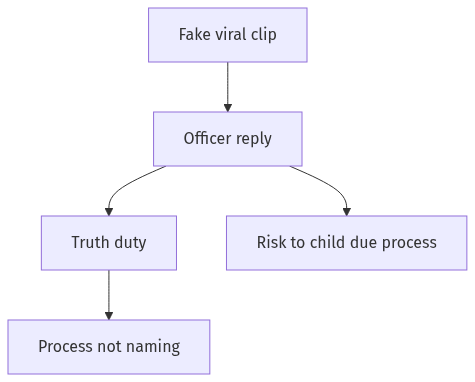
flowchart TD
  F[Fake viral clip] --> O[Officer reply]
  O --> T[Truth duty]
  O --> R[Risk to child due process]
  T --> P[Process not naming]

Conclusion

Social media here mixes a parent’s wound with the State’s megaphone. Truth may be owed, but naming alleged child perpetrators on a district handle fails dignity, due process, and impartiality.

Quick related

Students also ask

  • Must the officer stay silent forever?

    No. A factual, nameless correction and a police complaint are legitimate. A named public trial is not.

  • Does being a parent cancel official duty?

    Parenthood explains the wound. It does not cancel impartiality, recusal, or the duty not to use the district as a family weapon.

PYQ trend

When UPSC asked this

Related PYQs from other years, newest first. Open a question to read it.

  1. 2024 · Q15 · UPGS4 · 12 marks

    You are a city commissioner. There is a reputed college in your city, which has the maximum number of girl students. The condition of the toilets/washrooms in this college is very poor and pathetic, due to which the girl students have to face many mental, physical and hygiene-related problems every day. The college administration is not paying any attention to these basic facilities of the girl students. As a city commissioner, what steps will you take to improve this basic facility for the girl students and address the indifference of the college administration?

    View answer →

  2. 2020 · Q5 · UPGS4 · 8 marks

    An employee was taking a bribe in his office. His officer caught him red-handed. The officer knows that if the employee is dismissed from service, his old parents will become homeless and destitute. Therefore, the officer leaves him with a warning only. Imagine that you are the same officer. What will you do in these circumstances? Discuss in detail.

    View answer →

  3. 2020 · Q15 · UPGS4 · 12 marks

    You are working in the Pension Department as an investigating officer. A retired government employee, Mr. Ashok Kumar, transfers about 30% of his monthly pension every month to Mr. Prem Chopra, whose wife is a senior officer in your pension office. You suspect the money may be illicit gratification. Mr. Kumar claims the payments are gratitude because Prem Chopra and his wife care for him. Identify the ethical issues, options available, and the option you would choose with reasons.

    View answer →

  4. 2020 · Q20 · UPGS4 · 12 marks

    You are a civil servant posted in a State where elections were held recently. To ban the sale of alcohol was the main promise in the election manifesto of the newly elected Chief Minister. To fulfil this promise, the Chief Minister has ordered a total ban on sale and purchase of alcohol in this State. Whether the government should interfere in the matter which is considered by many to be a matter of personal choice? Comment logically.

    View answer →

  5. 2019 · Q10 · UPGS4 · 8 marks

    You are an honest and responsible civil servant. You often observe the following: (A) There is a general perception that adhering to ethical conduct may face difficulties to yourself and cause problem for the family, whereas unfair practices may help to reach the career goals. (B) When the number of people adopting unfair means is large, a small minority having a preference towards ethical means make no difference. Examine the above statements with their merits and demerits.

    View answer →

  6. 2019 · Q15 · UPGS4 · 12 marks

    You are trying to become a P.C.S. officer and after clearing various stages you are now eligible for the personal interview. While on your way to the interview you see an elderly man walking with his grand-daughter. Suddenly the old man suffers a heart attack right in front of you and the grand-daughter pleads with you for help. What will you do? Discuss in detail.

    View answer →

More from this paper

Q1 · UPSC Mains 2025 · UPGS4 · 8 marks

Defining value; explain the distinctive features of human values and the role of the family in inculcating these values.

Civil Service aptitude and values

A value is a stable standard that guides worthy choice, not a passing mood. Human values are taught, claim universal worth, join conscience to conduct, and can be justified in public. The family is the first school of trust, empathy, and honour through daily example. A closed home can also plant prejudice, so the family’s power is not automatically ethical. Later schools and offices confirm or correct that first map.

Q2 · UPSC Mains 2025 · UPGS4 · 8 marks

Evaluate the contemporary relevance of Chanakya's life and thoughts in the context of ethical and people-centric governance.

Emotional Intelligence

Kautilya judges the ruler by the happiness and security of subjects. Yogakshema, a tested service, and honest accounts remain usable tests of ethical administration. Danda is lawful restraint of the strong, not personal cruelty. A democracy cannot import palace deceit; rights and publicity now bind the officer. The living lesson is welfare plus fiscal integrity under the Constitution.

Q3 · UPSC Mains 2025 · UPGS4 · 8 marks

Discuss the Aristotelian view of virtues and its application in administrative affairs.

Emotional Intelligence

Aristotle’s moral virtue is a stable habit of the mean, learned by practice. Courage, temperance, and justice are civic virtues an officer must show in files, not only in speech. Phronesis is practical wisdom that finds the right mean in a live case. Administration applies this as honest noting, fiscal restraint, and equal treatment. Office culture can train vice; example and rules can still rebuild the mean.

Toppers' copies

Toppers' copies for this question will be uploaded soon.