
Revision summary
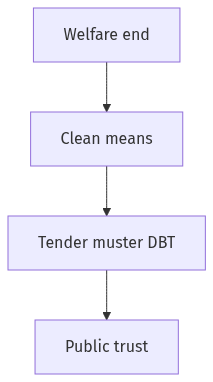
Gandhi refused to separate a good end from a clean means. Public money is a trust, so false bills and rigged tenders fail even a welfare scheme. Trusteeship matches the duty of a drawing and disbursing officer. Livelihood schemes, hospital works, and disaster grants are judged by musters, quality, and the right payee. Social audit and open tenders are institutional forms of purity of means.
Model answer
Introduction
Gandhi held that a good end cannot wash a dirty means. Public money is a trust, so the test of ends and means is not optional in the treasury.
Body
Why the doctrine fits public funds
- Public funds belong to the citizen, so the end of a scheme cannot excuse a false bill, a rigged tender, or a delayed wage.
- Gandhi’s trusteeship treats the holder of surplus as a trustee, which is the same structure as a drawing and disbursing officer.
- Purity of means here is open procurement, correct measurement, and a receipt that matches the work on the ground.
- Speed is a good end in disaster relief, yet a fake muster still steals from the hungry, so the means remain binding.
- Swaraj as self-rule includes self-restraint in the officer who could divert a line item without being caught that day.
Examples
- A rural employment muster that records absent names fails the means test even if the scheme’s end is livelihood.
- A hospital building inaugurated on time with substandard cement fails both safety and honesty, which Gandhi would call a violent means.
- Direct benefit transfer that reaches the right account is a clean means serving a welfare end.
- Diverting a disaster grant to a ceremonial event is a bad means dressed as public purpose.
- Social audit and published tenders are institutional forms of the same insistence that the path be as clean as the promise.
A limit
- Gandhi’s personal austerity is not a substitute for audit manuals, yet the moral rule still judges those manuals’ use.
Flow diagram
Conclusion
Gandhian ends and means are desirable in public finance because the citizen’s rupee is a trust. Welfare ends remain legitimate only when tenders, musters, and transfers stay honest.
Quick related
Students also ask
-
Write the role of self-regulation and its components in improving performance at workplace.
Next question in the 2025 paper (Q6). View answer →
-
Does Gandhi forbid emergency purchase without a tender?
Emergency buying can be a fit means if recorded, limited, and later audited. A fake emergency to avoid a tender is not.
-
Is austerity the same as fiscal honesty?
No. An office can be austere and still pass a false bill. Honesty of the voucher is the first Gandhian test here.
Same topic · past papers
UPPSC has asked this before
These previous-year questions sit on the same topic. Open one to practise the earlier ask.
-
2025 · Q19 · UPGS4 · 12 marks
What do you understand by "moral integrity" and "professional efficiency" in the context of corporate governance in India? Discuss with suitable examples. -
2023 · Q16 · UPGS4 · 12 marks
What are the major principles of public life? Discuss with suitable examples. -
2022 · Q17 · UPGS4 · 12 marks
Explain with suitable examples the ethical issues in corporate governance. -
2021 · Q18 · UPGS4 · 12 marks
Discuss the factors which influence the formation of an individual’s attitude towards social problems with the help of suitable examples. -
2020 · Q9 · UPGS4 · 8 marks
How do the values of tolerance and compassion get manifested in public service towards the weaker sections? Explain with suitable examples.
More from this paper
Q1 · UPSC Mains 2025 · UPGS4 · 8 marks · Solution
Defining value; explain the distinctive features of human values and the role of the family in inculcating these values.
Civil Service aptitude and values
A value is a stable standard that guides worthy choice, not a passing mood. Human values are taught, claim universal worth, join conscience to conduct, and can be justified in public. The family is the first school of trust, empathy, and honour through daily example. A closed home can also plant prejudice, so the family’s power is not automatically ethical. Later schools and offices confirm or correct that first map.
Q2 · UPSC Mains 2025 · UPGS4 · 8 marks · Solution
Evaluate the contemporary relevance of Chanakya's life and thoughts in the context of ethical and people-centric governance.
Emotional Intelligence
Kautilya judges the ruler by the happiness and security of subjects. Yogakshema, a tested service, and honest accounts remain usable tests of ethical administration. Danda is lawful restraint of the strong, not personal cruelty. A democracy cannot import palace deceit; rights and publicity now bind the officer. The living lesson is welfare plus fiscal integrity under the Constitution.
Q3 · UPSC Mains 2025 · UPGS4 · 8 marks · Solution
Discuss the Aristotelian view of virtues and its application in administrative affairs.
Emotional Intelligence
Aristotle’s moral virtue is a stable habit of the mean, learned by practice. Courage, temperance, and justice are civic virtues an officer must show in files, not only in speech. Phronesis is practical wisdom that finds the right mean in a live case. Administration applies this as honest noting, fiscal restraint, and equal treatment. Office culture can train vice; example and rules can still rebuild the mean.