
Revision summary
Induced compliance uses a first act so that attitude later matches the act. Small ownership works better than a heavy bribe that explains the act away. Toilets, first votes, digital files, and local patrols are administrative uses. Shame and impossible penalties are coercion, not this tool. The State must complete the service so the new habit is not mocked.
Model answer
Introduction
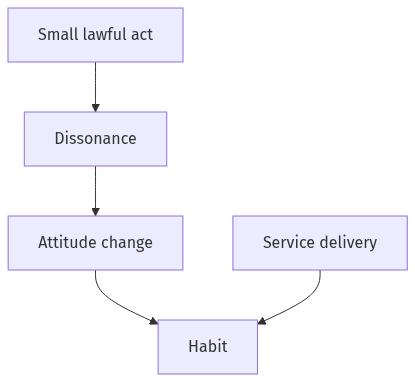
Induced compliance is getting a person to act first so that attitude later follows the act. Administration uses it when a small, lawful step makes the next civic habit easier.
Body
The idea
- In social psychology, induced compliance is a form of cognitive dissonance: after a chosen act, people often adjust belief to match what they did.
- Festinger and Carlsmith’s paid-essay studies showed that a small reward can produce more inner change than a heavy bribe, because the person must own the act.
- In administration the useful core is a voluntary or lightly required first act that is visible, reversible where rights demand it, and tied to a public good.
Practical utilities
- A household that builds a toilet under a subsidy often begins to defend sanitation, which is attitude following the act.
- First-time voters who stand in a queue with neighbours are more likely to treat voting as a normal duty thereafter.
- A written pledge on a wall, if freely given, can support later compliance with a water-use or school-attendance drive.
- E-office first login and digital signature, once used, reduce later resistance to paperless files.
- Community policing that asks residents to walk a night patrol can grow ownership of local safety.
Ethical limits
- Forced public shaming is not induced compliance; it is coercion that breeds fear and false numbers.
- Heavy penalty without a feasible first step produces avoidance, not a changed civic self.
- The officer must keep the first act lawful, affordable, and free of communal targeting.
- Utility is highest when the State then delivers the matching service, such as water after a toilet, so the new attitude is not mocked by failure.
Flow diagram
Conclusion
Induced compliance is useful when a small lawful act helps citizens own a public good. It fails when force, shame, or a missing service make the first act hollow.
Quick related
Students also ask
-
Clearly distinguish between ethical administration and good governance. Which one of these is more important? Explain.
Next question in the 2025 paper (Q11). View answer →
-
Is a fine induced compliance?
A fine is external pressure. Induced compliance aims at inner ownership after a largely chosen act. Fines may still be needed for harm.
-
Does this justify fake achievement numbers?
No. A false toilet count produces no honest dissonance and destroys trust, which is the opposite of utility.
Same topic · past papers
UPPSC has asked this before
These previous-year questions sit on the same topic. Open one to practise the earlier ask.
-
2025 · Q11 · UPGS4 · 12 marks
Clearly distinguish between ethical administration and good governance. Which one of these is more important? Explain. -
2023 · Q9 · UPGS4 · 8 marks
Explain the role of emotional intelligence for good governance and administration. -
2019 · Q18 · UPGS4 · 12 marks
Discuss the utility of Emotional Intelligence in administration. -
2018 · Q9 · UPGS4 · 8 marks
“Effective administration requires dedication towards Public Service.” Explain. -
2025 · Q12 · UPGS4 · 12 marks
In the age of digital governance and big data, public officials rely increasingly on algorithms and automated decision-making systems. Critically examine the ethical risks involved in algorithmic bias, opacity and lack of accountability and suggest guiding principles for responsible use of such technologies in public administration.
More from this paper
Q1 · UPSC Mains 2025 · UPGS4 · 8 marks · Solution
Defining value; explain the distinctive features of human values and the role of the family in inculcating these values.
Civil Service aptitude and values
A value is a stable standard that guides worthy choice, not a passing mood. Human values are taught, claim universal worth, join conscience to conduct, and can be justified in public. The family is the first school of trust, empathy, and honour through daily example. A closed home can also plant prejudice, so the family’s power is not automatically ethical. Later schools and offices confirm or correct that first map.
Q2 · UPSC Mains 2025 · UPGS4 · 8 marks · Solution
Evaluate the contemporary relevance of Chanakya's life and thoughts in the context of ethical and people-centric governance.
Emotional Intelligence
Kautilya judges the ruler by the happiness and security of subjects. Yogakshema, a tested service, and honest accounts remain usable tests of ethical administration. Danda is lawful restraint of the strong, not personal cruelty. A democracy cannot import palace deceit; rights and publicity now bind the officer. The living lesson is welfare plus fiscal integrity under the Constitution.
Q3 · UPSC Mains 2025 · UPGS4 · 8 marks · Solution
Discuss the Aristotelian view of virtues and its application in administrative affairs.
Emotional Intelligence
Aristotle’s moral virtue is a stable habit of the mean, learned by practice. Courage, temperance, and justice are civic virtues an officer must show in files, not only in speech. Phronesis is practical wisdom that finds the right mean in a live case. Administration applies this as honest noting, fiscal restraint, and equal treatment. Office culture can train vice; example and rules can still rebuild the mean.