
Revision summary
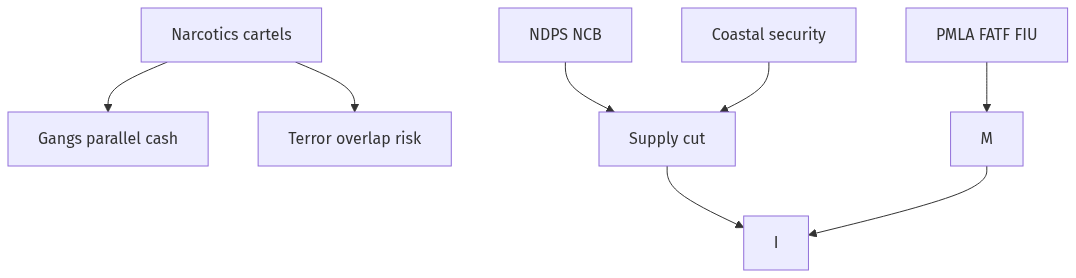
Drug cartels create addiction, gangs, and a cash parallel to the legal economy. Routes overlap with weapons and, in some areas, with insurgency finance. NDPS and NCB are the criminal and coordinating core. PMLA and FATF-aligned rules chase hawala and shell firms. Coastal security tries to close sea routes used after 26/11 lessons.
Model answer
Introduction
Narcotics and organised crime are not only street offences. They buy politicians, arm gangs, and fund terror, which is why they sit on the internal-security file.
Body
Threats
- Heroin, methamphetamine, and pharmaceutical diversion create addiction, gang turf, and a parallel cash economy.
- Cartels use the same routes as weapons and fake currency: the Golden Crescent, Golden Triangle, and sea lanes to the west and east coasts.
- Money is layered through hawala, shell firms, and trade mis-invoicing, which weakens banks and the tax base.
- In some theatres, drug money and organised crime overlap with insurgency or communal muscle, so policing becomes a sovereignty problem, not only a health problem.
Measures
- The NDPS Act, 1985, is the core criminal statute; NCB is the central narcotics agency that coordinates with states and foreign counterparts.
- Financial Intelligence Unit, PMLA, and FATF-aligned rules attack the money trail; listing and seizure matter more than a single arrest.
- Coastal security after 26/11 — marine police, Coast Guard, and port controls — aims to shut dhow and container routes.
- Demand-side de-addiction, precursor control, and dark-net monitoring have to sit beside seizures, or the market simply relocates.
Control is therefore law plus money plus coast, or the crime network regenerates.
Flow diagram
Conclusion
Drugs and organised crime threaten health, money, and in places the State’s monopoly of force. NDPS, NCB, FATF-style financial rules, and coastal security are the main tools; they work as a set, not as one raid.
Quick related
Students also ask
-
"Security is development and development is security." Analyze the symbiotic relationship from India's security perspective.
Next question in the 2025 paper (Q19). View answer →
-
Is drug crime only a health issue?
Health is one face. Gangs, money laundering, and possible terror finance make it an internal-security issue.
-
Can seizures alone win?
No. Precursors, dark-net sales, and hawala survive unless the money trail and demand are also hit.
Same topic · past papers
UPPSC has asked this before
These previous-year questions sit on the same topic. Open one to practise the earlier ask.
-
2020 · Q18 · UPGS3 · 12 marks
Describe in detail the issues of nuclear proliferation and the existing control mechanism.
More from this paper
Q1 · UPSC Mains 2025 · UPGS3 · 8 marks · Solution
Identify the critical challenges faced by the handicraft industries in India and discuss their challenges.
Food processing
Handicrafts are large in jobs but weak in organisation. Costly inputs, middlemen, and machine-made copies cut the artisan’s price. Credit, GST paperwork, and export compliance are hard for household units. GI tags and e-commerce help some clusters, not the whole sector. The challenge is to move skill, credit, and direct sale to the maker.
Q2 · UPSC Mains 2025 · UPGS3 · 8 marks · Solution
"Construction of new airports will facilitate industrialization and development in India." Examine.
Infrastructure
Airports can shorten time to markets and support logistics jobs. UDAN tries to spread air access beyond metros. Land, wetlands, and noise are real costs of greenfield sites. Thin traffic means some airports need heavy subsidy and still do not pull factories. Industrialisation needs hinterland demand, not only a terminal.
Q3 · UPSC Mains 2025 · UPGS3 · 8 marks · Solution
Discuss the concept of unemployment in India as developed by National Sample Survey Office (NSSO).
Poverty, unemployment and inclusive growth
India measures unemployment on more than one reference period because work is often casual. Usual status (ps and ps+ss) uses the last year and usually gives the lowest rate. Current weekly status uses the last seven days. Current daily status counts person-days and captures underemployment. PLFS is the present NSO survey that carries these NSSO concepts.