
Revision summary
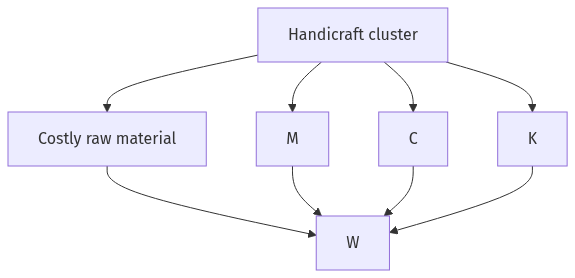
Handicrafts are large in jobs but weak in organisation. Costly inputs, middlemen, and machine-made copies cut the artisan’s price. Credit, GST paperwork, and export compliance are hard for household units. GI tags and e-commerce help some clusters, not the whole sector. The challenge is to move skill, credit, and direct sale to the maker.
Model answer
Introduction
Handicrafts employ millions of rural and household workers and carry India’s design identity into export markets. The industry is still mostly informal, so a brief discussion must name the production, credit, and market problems that keep it weak.
Body
Production and skill
- Raw materials such as wood, cane, metal, silk, and natural dyes are costly and often reach the artisan through middlemen.
- Machine-made copies undercut handmade work on price, which squeezes the household workshop.
- Many young workers leave the craft, so skill is ageing and design is slow to change.
Credit, market, and policy
- Bank credit is thin because artisans rarely have formal accounts or collateral.
- Marketing still depends on fairs and traders; e-commerce and Geographical Indication labels help only a fraction of clusters.
- GST, packing, and export paperwork are heavy for a small unit, even when duty drawback or the National Handicrafts Development Programme exists.
- Poor workspace, weak quality testing, and delayed payments from buyers complete the squeeze.
Flow diagram
Conclusion
The critical challenges are costly inputs, machine competition, ageing skill, thin credit, and weak market access. Policy schemes exist, but the industry stays informal until credit, design, and direct sale reach the artisan.
Quick related
Students also ask
-
"Construction of new airports will facilitate industrialization and development in India." Examine.
Next question in the 2025 paper (Q2). View answer →
-
Is lack of demand the only problem?
No. Demand exists in cities and abroad, but the artisan often does not receive the final price because of middlemen, copies, and weak branding.
-
Do GI tags solve the crisis?
They protect a name and a place. They do not replace credit, design training, or a reliable raw-material chain.
Same topic · past papers
UPPSC has asked this before
These previous-year questions sit on the same topic. Open one to practise the earlier ask.
-
2022 · Q4 · UPGS3 · 8 marks
Financial inclusion is a critical part of the development process to achieve social justice. Comment.
More from this paper
Q2 · UPSC Mains 2025 · UPGS3 · 8 marks · Solution
"Construction of new airports will facilitate industrialization and development in India." Examine.
Infrastructure
Airports can shorten time to markets and support logistics jobs. UDAN tries to spread air access beyond metros. Land, wetlands, and noise are real costs of greenfield sites. Thin traffic means some airports need heavy subsidy and still do not pull factories. Industrialisation needs hinterland demand, not only a terminal.
Q3 · UPSC Mains 2025 · UPGS3 · 8 marks · Solution
Discuss the concept of unemployment in India as developed by National Sample Survey Office (NSSO).
Poverty, unemployment and inclusive growth
India measures unemployment on more than one reference period because work is often casual. Usual status (ps and ps+ss) uses the last year and usually gives the lowest rate. Current weekly status uses the last seven days. Current daily status counts person-days and captures underemployment. PLFS is the present NSO survey that carries these NSSO concepts.
Q4 · UPSC Mains 2025 · UPGS3 · 8 marks · Solution
How are digital payment systems promoting financial inclusion in India?
Budget and financial system
Inclusion needs an account, a cheap payment rail, and public money that arrives. Jan Dhan, Aadhaar, and mobile numbers built the base. UPI, AePS, RuPay, and BHIM make small payments possible without a branch. DBT rides the same rails for pensions and subsidies. Fraud and last-mile cash agents remain the unfinished part.