
Revision summary
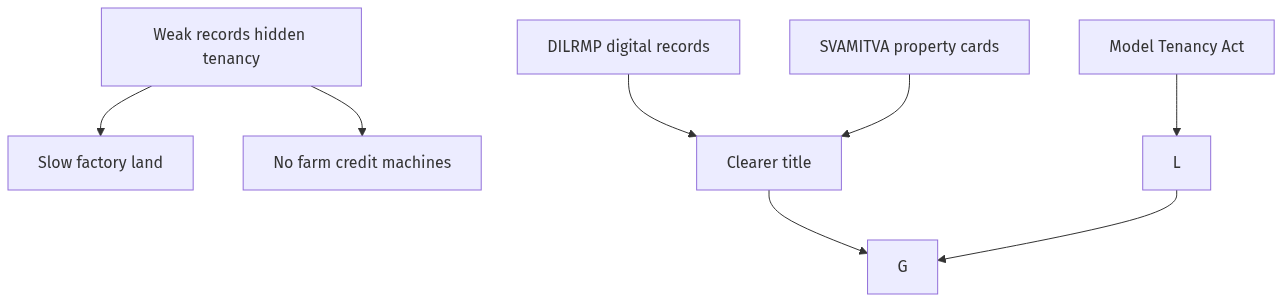
Zamindari abolition did not finish land reform: records and tenancy remain incomplete. Factories need clean title; messy mutation and maps delay plants and raise litigation. Hidden tenants cannot borrow or invest in irrigation and machines. DILRMP digitises records; SVAMITVA issues rural property cards from drone maps. The Model Tenancy Act offers a clearer lease frame, but farm tenancy is still largely with states.
Model answer
Introduction
Land reform in India abolished some zamindari rights but left records messy and tenancy half-legal. Factories and modern farms both need a clean title and a usable lease. Without those, industrialisation and agri-modernisation stall.
Body
Unfinished agenda
- Ceiling and tenancy laws were uneven across states; concealed tenancy still leaves the tiller without credit or insurance.
- Mutation lags, overlapping claims, and village maps that do not match the ground make sale and mortgage slow.
- Industry then faces delayed land acquisition, litigation, and inflated brokers’ prices, which pushes plants toward already titled industrial parks or away from India.
Records and tenancy as the present tools
- The Digital India Land Records Modernisation Programme tries to computerise records, maps, and mutation so that a bank or a factory can trust the title.
- SVAMITVA maps inhabited rural areas with drones and issues property cards, which helps household credit and local planning more than large farm consolidation.
- The Model Tenancy Act, 2021, offers a rental contract frame for cities and, in spirit, for clearer leases; farm tenancy liberalisation is still mostly a state choice.
Why agriculture stays semi-modern
- A tenant who is not on the record will not invest in drip, machines, or soil health.
- Fragmented plots without consolidation or lease markets block farm-as-firm models.
- Industry and agri-business parks need assembled land; messy records make that assembly a court file.
Land reform is therefore unfinished not only as equity but as infrastructure for growth.
Flow diagram
Conclusion
Weak records and half-legal tenancy block factory land and farm investment. DILRMP, SVAMITVA, and the Model Tenancy Act are the current repairs; until states complete them, industrialisation and agri-modernisation stay slow.
Quick related
Students also ask
-
Assess the contribution of Startup schemes of the Government of India in technology transfer, economic growth and overall development of India.
Next question in the 2025 paper (Q16). View answer →
-
Does SVAMITVA replace farm land records?
No. It mainly maps inhabited village areas. Farm parcel records remain a DILRMP and state-settlement task.
-
Can industry grow without tenancy reform?
Parks can. Wide industrialisation and farm modernisation still need clearer leases and titles.
Same topic · past papers
UPPSC has asked this before
These previous-year questions sit on the same topic. Open one to practise the earlier ask.
-
2023 · Q14 · UPGS3 · 12 marks
“Despite various measures to address food security, major challenges remain.” Explain with reference to India.
More from this paper
Q1 · UPSC Mains 2025 · UPGS3 · 8 marks · Solution
Identify the critical challenges faced by the handicraft industries in India and discuss their challenges.
Food processing
Handicrafts are large in jobs but weak in organisation. Costly inputs, middlemen, and machine-made copies cut the artisan’s price. Credit, GST paperwork, and export compliance are hard for household units. GI tags and e-commerce help some clusters, not the whole sector. The challenge is to move skill, credit, and direct sale to the maker.
Q2 · UPSC Mains 2025 · UPGS3 · 8 marks · Solution
"Construction of new airports will facilitate industrialization and development in India." Examine.
Infrastructure
Airports can shorten time to markets and support logistics jobs. UDAN tries to spread air access beyond metros. Land, wetlands, and noise are real costs of greenfield sites. Thin traffic means some airports need heavy subsidy and still do not pull factories. Industrialisation needs hinterland demand, not only a terminal.
Q3 · UPSC Mains 2025 · UPGS3 · 8 marks · Solution
Discuss the concept of unemployment in India as developed by National Sample Survey Office (NSSO).
Poverty, unemployment and inclusive growth
India measures unemployment on more than one reference period because work is often casual. Usual status (ps and ps+ss) uses the last year and usually gives the lowest rate. Current weekly status uses the last seven days. Current daily status counts person-days and captures underemployment. PLFS is the present NSO survey that carries these NSSO concepts.