
Revision summary
DPIIT’s Startup India recognises new firms and eases patents and exits. The Fund of Funds for Startups channels public money through SIDBI into private funds. That pipeline helps lab ideas become companies and pulls some deep-tech into India. Jobs and exports have grown mainly in digital and a few metro hubs. Nationwide development still needs manufacturing-town startups, not only unicorns.
Model answer
Introduction
Startup India, run from DPIIT, treats new firms as a way to move technology into the market and to create jobs outside the old licence factory. An assessment must credit the pipeline and still name the thin spread beyond a few cities.
Body
Technology transfer
- Recognition, patent fast-track, and incubation give a legal home for campus and lab ideas so that they can become a company rather than a paper.
- The Fund of Funds for Startups, through SIDBI, feeds alternate investment funds that then invest in startups, which is how public money crowds in private risk capital.
- Defence, space, and agritech windows have pulled some dual-use and deep-tech work into Indian firms instead of only imported kits.
Growth and development
- Startups have added formal jobs, exportable software, and digital public-goods style products in payments, logistics, and health.
- Tax holidays and easier winding-up cut the cost of trying, which is part of a growth culture, not only a subsidy.
- Development is uneven: most funding and unicorns sit in a few metro clusters; many recognised startups remain small and service-heavy rather than manufacturing deep-tech.
The contribution is therefore real in finance, recognition, and some tech transfer, and still thin as a nationwide industrial transformation.
Flow diagram
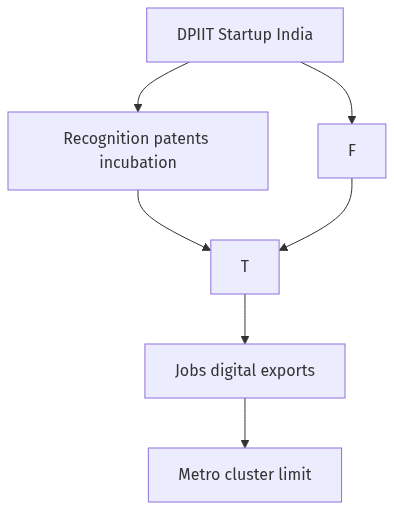
Conclusion
Startup India and the Fund of Funds, under DPIIT, have improved capital, recognition, and some lab-to-firm transfer. They support growth mainly in digital and metro clusters; overall development needs the same energy in manufacturing towns and in deep tech.
Quick related
Students also ask
-
Information technology, Space technology and Biotechnology are playing important roles in transforming India into a developed nation. Discuss with examples.
Next question in the 2025 paper (Q17). View answer →
-
Does the Fund of Funds give grants to every startup?
No. It invests in funds. Those funds then pick startups.
-
Is Startup India only for software?
The policy is sector-open. In practice, software and consumer internet have taken a large share of capital.
Same topic · past papers
UPPSC has asked this before
These previous-year questions sit on the same topic. Open one to practise the earlier ask.
-
2022 · Q13 · UPGS3 · 12 marks
Discuss the effects of globalisation and liberalisation policies on Indian economy with particular reference to foreign trade, capital flows and technology transfer. -
2019 · Q20 · UPGS3 · 12 marks
What do you mean by 'Technology Transfer'? How far can this be useful in disseminating complex technology? Explain. -
2024 · Q13 · UPGS3 · 12 marks
Assess the role of States and Central Government in developing irrigation infrastructure in India. How has Pradhan Mantri Krishi Sinchayee Yojana (P.M.K.S.Y.) helped in improving irrigation access across the country?
More from this paper
Q1 · UPSC Mains 2025 · UPGS3 · 8 marks · Solution
Identify the critical challenges faced by the handicraft industries in India and discuss their challenges.
Food processing
Handicrafts are large in jobs but weak in organisation. Costly inputs, middlemen, and machine-made copies cut the artisan’s price. Credit, GST paperwork, and export compliance are hard for household units. GI tags and e-commerce help some clusters, not the whole sector. The challenge is to move skill, credit, and direct sale to the maker.
Q2 · UPSC Mains 2025 · UPGS3 · 8 marks · Solution
"Construction of new airports will facilitate industrialization and development in India." Examine.
Infrastructure
Airports can shorten time to markets and support logistics jobs. UDAN tries to spread air access beyond metros. Land, wetlands, and noise are real costs of greenfield sites. Thin traffic means some airports need heavy subsidy and still do not pull factories. Industrialisation needs hinterland demand, not only a terminal.
Q3 · UPSC Mains 2025 · UPGS3 · 8 marks · Solution
Discuss the concept of unemployment in India as developed by National Sample Survey Office (NSSO).
Poverty, unemployment and inclusive growth
India measures unemployment on more than one reference period because work is often casual. Usual status (ps and ps+ss) uses the last year and usually gives the lowest rate. Current weekly status uses the last seven days. Current daily status counts person-days and captures underemployment. PLFS is the present NSO survey that carries these NSSO concepts.