
Revision summary
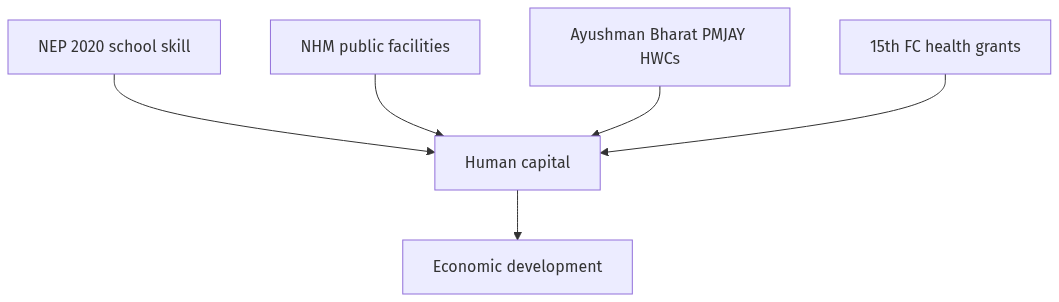
The Union treats health and education as the base of growth, not leftover welfare. NEP 2020 links school, vocational training, and higher education and states a higher public-spend ambition. NHM funds public facilities and preventive care so illness does not erase wages. Ayushman Bharat combines primary wellness centres with PM-JAY hospital cover for the poor. The Fifteenth Finance Commission’s health grants push money to local public health infrastructure.
Model answer
Introduction
The Union’s stated view is that growth is not only machines and roads. A healthy, schooled workforce is the foundation, because firms hire skills and households stay productive only if they are not bankrupted by illness.
Body
Education as foundation
- NEP 2020 treats school, vocational, and higher education as one ladder and asks for a higher public spend toward a 6 per cent of GDP education goal.
- Foundational literacy, teacher training, and the Academic Bank of Credits are meant to raise the quality of the labour that industry will hire.
- Without this, PLI and factories import skill or stay capital-heavy, which is the jobless-growth problem in another form.
Health as foundation
- The National Health Mission funds rural and urban public facilities, immunisation, and maternal care so that illness does not wipe out a season’s wages.
- Ayushman Bharat has two arms: Health and Wellness Centres (now Ayushman Arogya Mandirs) for primary care, and PM-JAY insurance for hospitalisation of poor families.
- The Fifteenth Finance Commission gave tied health grants to local bodies for diagnostics, buildings, and block-level public health, which is the Union’s federal way of saying health is core infrastructure.
GoI therefore budgets health and education as economic policy, not only as welfare. Delivery gaps remain, but the official view is no longer that these heads are residual charity.
Flow diagram
Conclusion
NEP 2020, NHM, Ayushman Bharat, and Fifteenth Finance Commission health grants show the Union treating school and clinic as growth capital. Development rests on that human base, not only on physical capital.
Quick related
Students also ask
-
"Land reforms in India remain an unfinished agenda." Explain how the lack of proper land records and tenancy reforms act as hurdles in the industrialization and modernisation of agriculture in India.
Next question in the 2025 paper (Q15). View answer →
-
Is this only a welfare view?
No. The official claim is that sick and unschooled workers cannot sustain high growth.
-
Did the 15th FC create Ayushman Bharat?
No. Ayushman Bharat is a Union scheme. The Commission added tied local health grants on top.
More from this paper
Q1 · UPSC Mains 2025 · UPGS3 · 8 marks · Solution
Identify the critical challenges faced by the handicraft industries in India and discuss their challenges.
Food processing
Handicrafts are large in jobs but weak in organisation. Costly inputs, middlemen, and machine-made copies cut the artisan’s price. Credit, GST paperwork, and export compliance are hard for household units. GI tags and e-commerce help some clusters, not the whole sector. The challenge is to move skill, credit, and direct sale to the maker.
Q2 · UPSC Mains 2025 · UPGS3 · 8 marks · Solution
"Construction of new airports will facilitate industrialization and development in India." Examine.
Infrastructure
Airports can shorten time to markets and support logistics jobs. UDAN tries to spread air access beyond metros. Land, wetlands, and noise are real costs of greenfield sites. Thin traffic means some airports need heavy subsidy and still do not pull factories. Industrialisation needs hinterland demand, not only a terminal.
Q3 · UPSC Mains 2025 · UPGS3 · 8 marks · Solution
Discuss the concept of unemployment in India as developed by National Sample Survey Office (NSSO).
Poverty, unemployment and inclusive growth
India measures unemployment on more than one reference period because work is often casual. Usual status (ps and ps+ss) uses the last year and usually gives the lowest rate. Current weekly status uses the last seven days. Current daily status counts person-days and captures underemployment. PLFS is the present NSO survey that carries these NSSO concepts.