
Revision summary
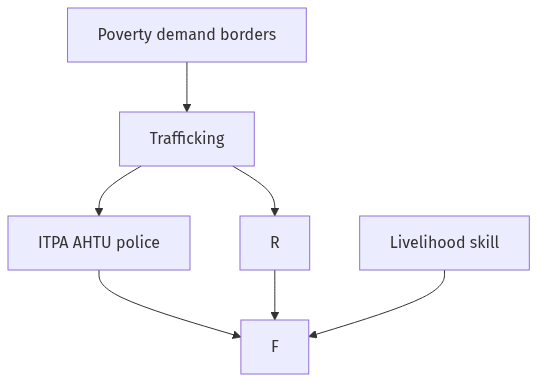
Poverty, debt, cheap-labour demand, and fake overseas jobs drive trafficking. ITPA 1956 is the older law against immoral traffic; newer criminal codes also punish trafficking. Anti-Human Trafficking Units handle rescue and investigation in districts. Ujjawala supports shelter and rehabilitation for women in sexual exploitation. Nirbhaya Fund projects add women-safety and victim support; livelihood after rescue is the real test.
Model answer
Introduction
Human trafficking is trade in persons for sex, labour, begging, or organs. Poverty and weak borders feed it; law and shelters are how the State answers.
Body
Causes
- Poverty, debt, and disaster push families to send children with agents who then sell them.
- Demand for cheap labour and commercial sex, plus caste and gender power, keep the market alive.
- Porous borders, fake jobs abroad, and internet luring have made recruitment easier.
Protection and rehabilitation
- The Immoral Traffic (Prevention) Act, 1956, is the older criminal frame against commercial sexual exploitation; the Bharatiya Nyaya Sanhita and IPC successor provisions also punish trafficking.
- Anti-Human Trafficking Units in districts rescue, investigate, and coordinate with police and NGOs.
- Ujjawala funds homes for prevention, rescue, and rehabilitation of women in commercial sexual exploitation.
- The Nirbhaya Fund has supported women-safety and victim-support projects, including some trafficking-related work.
- Compensation, skills, and witness protection decide whether a rescued person stays free; rescue without a livelihood often fails.
Flow diagram
Conclusion
Trafficking is driven by poverty, demand, and weak borders. ITPA, AHTUs, Ujjawala, and Nirbhaya-backed projects are the State’s protection and rehabilitation tools; they work only when shelter is followed by work and safety.
Quick related
Students also ask
-
Rainfall and irrigation systems are complementary to each other as agriculture sector is highly vulnerable to weather variability. Justify with supportive data.
Next question in the 2025 paper (Q11). View answer →
-
Is trafficking only about sex work?
No. Forced labour, begging, domestic work, and organs are also trafficking.
-
Does rescue complete rehabilitation?
No. Shelter, compensation, skill, and protection from the old network must follow.
Same topic · past papers
UPPSC has asked this before
These previous-year questions sit on the same topic. Open one to practise the earlier ask.
-
2020 · Q9 · UPGS3 · 8 marks
Analyse 'Money Laundering' and 'Human Trafficking' as non-traditional security challenges.
More from this paper
Q1 · UPSC Mains 2025 · UPGS3 · 8 marks · Solution
Identify the critical challenges faced by the handicraft industries in India and discuss their challenges.
Food processing
Handicrafts are large in jobs but weak in organisation. Costly inputs, middlemen, and machine-made copies cut the artisan’s price. Credit, GST paperwork, and export compliance are hard for household units. GI tags and e-commerce help some clusters, not the whole sector. The challenge is to move skill, credit, and direct sale to the maker.
Q2 · UPSC Mains 2025 · UPGS3 · 8 marks · Solution
"Construction of new airports will facilitate industrialization and development in India." Examine.
Infrastructure
Airports can shorten time to markets and support logistics jobs. UDAN tries to spread air access beyond metros. Land, wetlands, and noise are real costs of greenfield sites. Thin traffic means some airports need heavy subsidy and still do not pull factories. Industrialisation needs hinterland demand, not only a terminal.
Q3 · UPSC Mains 2025 · UPGS3 · 8 marks · Solution
Discuss the concept of unemployment in India as developed by National Sample Survey Office (NSSO).
Poverty, unemployment and inclusive growth
India measures unemployment on more than one reference period because work is often casual. Usual status (ps and ps+ss) uses the last year and usually gives the lowest rate. Current weekly status uses the last seven days. Current daily status counts person-days and captures underemployment. PLFS is the present NSO survey that carries these NSSO concepts.