
Revision summary
India measures unemployment on more than one reference period because work is often casual. Usual status (ps and ps+ss) uses the last year and usually gives the lowest rate. Current weekly status uses the last seven days. Current daily status counts person-days and captures underemployment. PLFS is the present NSO survey that carries these NSSO concepts.
Model answer
Introduction
Unemployment in India is not one number. The National Sample Survey Office, now through the Periodic Labour Force Survey, measures it on different reference periods because much work is casual and seasonal.
Body
Usual status
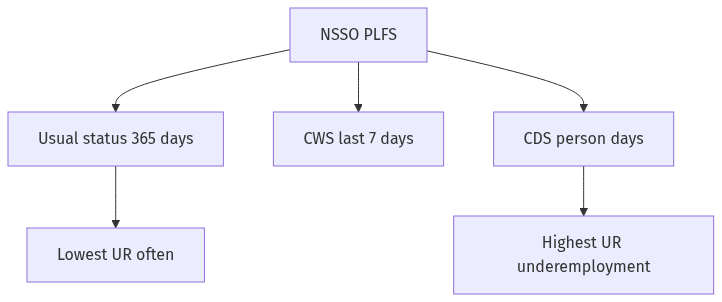
- Usual principal status asks what a person did for the major part of the last 365 days.
- Usual principal-plus-subsidiary status (UPSS) also counts a shorter secondary activity, so the unemployment rate is usually the lowest of the three.
- This long-period measure is useful for structural unemployment, but it can hide short spells without work.
Current weekly and daily status
- Current weekly status (CWS) looks at the last seven days. A person who worked even one hour in that week is employed.
- Current daily status (CDS) counts person-days in the week. It captures underemployment and is usually the highest unemployment rate.
- PLFS, run by the National Statistical Office, is the present vehicle for these concepts in both usual status and CWS for rural and urban India.
The concept is therefore a set of clocks, not a single clock. Policy must say which clock it is using.
Flow diagram
Conclusion
NSSO unemployment is usual status for the year, CWS for the week, and CDS for person-days. PLFS continues those clocks. The daily measure shows more unused labour than the yearly measure.
Quick related
Students also ask
-
How are digital payment systems promoting financial inclusion in India?
Next question in the 2025 paper (Q4). View answer →
-
Why do three rates differ?
They use different clocks. A person with some work in the year may still have idle days in the week.
-
Did PLFS replace the idea of usual status?
No. PLFS still publishes usual status and CWS. It is a new survey series, not a new definition of work.
Same topic · past papers
UPPSC has asked this before
These previous-year questions sit on the same topic. Open one to practise the earlier ask.
More from this paper
Q1 · UPSC Mains 2025 · UPGS3 · 8 marks · Solution
Identify the critical challenges faced by the handicraft industries in India and discuss their challenges.
Food processing
Handicrafts are large in jobs but weak in organisation. Costly inputs, middlemen, and machine-made copies cut the artisan’s price. Credit, GST paperwork, and export compliance are hard for household units. GI tags and e-commerce help some clusters, not the whole sector. The challenge is to move skill, credit, and direct sale to the maker.
Q2 · UPSC Mains 2025 · UPGS3 · 8 marks · Solution
"Construction of new airports will facilitate industrialization and development in India." Examine.
Infrastructure
Airports can shorten time to markets and support logistics jobs. UDAN tries to spread air access beyond metros. Land, wetlands, and noise are real costs of greenfield sites. Thin traffic means some airports need heavy subsidy and still do not pull factories. Industrialisation needs hinterland demand, not only a terminal.
Q4 · UPSC Mains 2025 · UPGS3 · 8 marks · Solution
How are digital payment systems promoting financial inclusion in India?
Budget and financial system
Inclusion needs an account, a cheap payment rail, and public money that arrives. Jan Dhan, Aadhaar, and mobile numbers built the base. UPI, AePS, RuPay, and BHIM make small payments possible without a branch. DBT rides the same rails for pensions and subsidies. Fraud and last-mile cash agents remain the unfinished part.