
Revision summary
Airports can shorten time to markets and support logistics jobs. UDAN tries to spread air access beyond metros. Land, wetlands, and noise are real costs of greenfield sites. Thin traffic means some airports need heavy subsidy and still do not pull factories. Industrialisation needs hinterland demand, not only a terminal.
Model answer
Introduction
Airports move people, cargo, and investment. New greenfield airports and the UDAN regional network are therefore sold as industrial tools. An examination must weigh that connectivity against land, environment, and empty runways.
Body
How airports can help industry
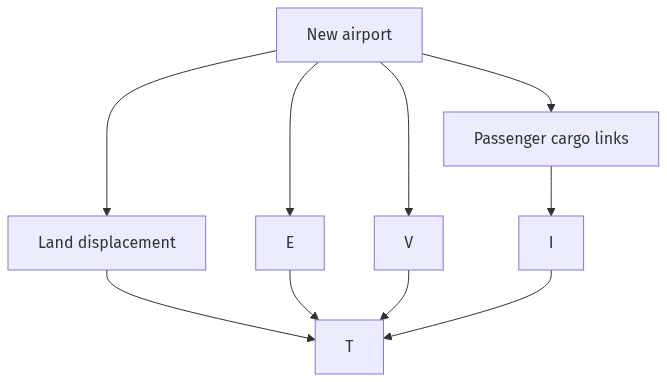
- Faster passenger and cargo links cut time to ports, metros, and export buyers.
- Ancillary jobs in logistics, hotels, and services grow around a working airport.
- UDAN and the National Civil Aviation Policy aim to put smaller cities on the air map so that industry is not trapped in a few metros.
Limits and costs
- Land acquisition for runways and approach funnels displaces farms and can stall the project for years.
- Wetlands, bird hits, and noise make many sites environmentally costly.
- Several regional airports have thin traffic, so the subsidy is large and industrial clustering does not automatically follow a terminal building.
- Rail, road, and power still decide factory location more than a weekly flight.
A fair examination therefore says that airports help where cargo, tourism, and a hinterland already exist. They do not, by themselves, industrialise a district.
Flow diagram
Conclusion
New airports can ease industrialisation where connectivity, cargo, and demand are real. Land, environment, and viability tests show that a runway without hinterland is not development.
Quick related
Students also ask
-
Discuss the concept of unemployment in India as developed by National Sample Survey Office (NSSO).
Next question in the 2025 paper (Q3). View answer →
-
Does every new airport industrialise its district?
No. Industry follows cargo demand and other infrastructure. Some regional airports stay thinly used.
-
Is the environmental cost only noise?
No. Land, wetlands, bird-hit risk, and approach-path restrictions also matter.
Same topic · past papers
UPPSC has asked this before
These previous-year questions sit on the same topic. Open one to practise the earlier ask.
-
2025 · Q6 · UPGS3 · 8 marks
How can inclusive and sustainable industrialization (SDG 9) drive economic growth (SDG 8), while ensuring environmental sustainability (SDG 12, 13) in India? -
2025 · Q15 · UPGS3 · 12 marks
"Land reforms in India remain an unfinished agenda." Explain how the lack of proper land records and tenancy reforms act as hurdles in the industrialization and modernisation of agriculture in India.
More from this paper
Q1 · UPSC Mains 2025 · UPGS3 · 8 marks · Solution
Identify the critical challenges faced by the handicraft industries in India and discuss their challenges.
Food processing
Handicrafts are large in jobs but weak in organisation. Costly inputs, middlemen, and machine-made copies cut the artisan’s price. Credit, GST paperwork, and export compliance are hard for household units. GI tags and e-commerce help some clusters, not the whole sector. The challenge is to move skill, credit, and direct sale to the maker.
Q3 · UPSC Mains 2025 · UPGS3 · 8 marks · Solution
Discuss the concept of unemployment in India as developed by National Sample Survey Office (NSSO).
Poverty, unemployment and inclusive growth
India measures unemployment on more than one reference period because work is often casual. Usual status (ps and ps+ss) uses the last year and usually gives the lowest rate. Current weekly status uses the last seven days. Current daily status counts person-days and captures underemployment. PLFS is the present NSO survey that carries these NSSO concepts.
Q4 · UPSC Mains 2025 · UPGS3 · 8 marks · Solution
How are digital payment systems promoting financial inclusion in India?
Budget and financial system
Inclusion needs an account, a cheap payment rail, and public money that arrives. Jan Dhan, Aadhaar, and mobile numbers built the base. UPI, AePS, RuPay, and BHIM make small payments possible without a branch. DBT rides the same rails for pensions and subsidies. Fraud and last-mile cash agents remain the unfinished part.