
Revision summary
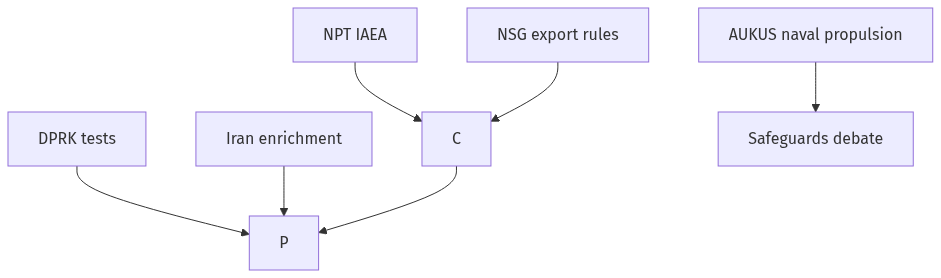
The NPT and NSG made civilian nuclear trade safer and limited new weapon states. DPRK left the treaty and tested nuclear devices. Iran’s deal stalled; enrichment remains a proliferation file. India’s NSG waiver shows the regime can bend for a non-NPT state with safeguards. AUKUS is nuclear propulsion for conventionally armed submarines, not a warhead transfer, but it still strains export norms.
Model answer
Introduction
The Nuclear Non-Proliferation Treaty promised a freeze on new weapon states. The record is mixed: fewer bombs than a free-for-all, yet Iran, the Democratic People’s Republic of Korea, and new naval-nuclear deals still test the system.
Body
What the regime did
- The NPT split the world into recognised weapon states and the rest, with IAEA safeguards on civilian fuel.
- The Nuclear Suppliers Group tightened export of sensitive technology after 1974.
- Test bans, UN sanctions, and the JCPOA with Iran showed that diplomacy can freeze a programme for a time.
Why the challenge remains
- DPRK walked out, tested devices, and showed that a determined state can still build a bomb.
- Iran’s JCPOA stalled; enrichment capacity remains a live proliferation risk even without a declared weapon.
- Three NPT outsiders — India, Pakistan, Israel — sit outside the treaty, which critics call a fairness hole even after India’s 2008 NSG waiver.
- AUKUS is a pact for nuclear-powered, conventionally armed submarines for Australia. The careful point is naval nuclear propulsion and fuel, not a transfer of warheads; even so, some states argue it stretches NPT and NSG practice.
- The statement is therefore true in direction: proliferation is contained, not closed.
Flow diagram
Conclusion
NPT and NSG reduced casual spread but did not end determined programmes. DPRK and Iran show the gap; AUKUS raises a propulsion-rules debate, not a new bomb sale. International security still lives with nuclear risk.
Quick related
Students also ask
-
Discuss the major causes of human trafficking and describe with examples, the role of the government in ensuring the protection and rehabilitation of the victims.
Next question in the 2025 paper (Q10). View answer →
-
Does AUKUS give Australia nuclear weapons?
No. It supports nuclear-powered submarines with conventional arms. The dispute is safeguards and fuel, not warheads.
-
Has the NPT failed completely?
No. Most states never built bombs. Failure is partial: DPRK, Iran’s file, and outsiders to the treaty.
Same topic · past papers
UPPSC has asked this before
These previous-year questions sit on the same topic. Open one to practise the earlier ask.
-
2023 · Q14 · UPGS3 · 12 marks
“Despite various measures to address food security, major challenges remain.” Explain with reference to India.
More from this paper
Q1 · UPSC Mains 2025 · UPGS3 · 8 marks · Solution
Identify the critical challenges faced by the handicraft industries in India and discuss their challenges.
Food processing
Handicrafts are large in jobs but weak in organisation. Costly inputs, middlemen, and machine-made copies cut the artisan’s price. Credit, GST paperwork, and export compliance are hard for household units. GI tags and e-commerce help some clusters, not the whole sector. The challenge is to move skill, credit, and direct sale to the maker.
Q2 · UPSC Mains 2025 · UPGS3 · 8 marks · Solution
"Construction of new airports will facilitate industrialization and development in India." Examine.
Infrastructure
Airports can shorten time to markets and support logistics jobs. UDAN tries to spread air access beyond metros. Land, wetlands, and noise are real costs of greenfield sites. Thin traffic means some airports need heavy subsidy and still do not pull factories. Industrialisation needs hinterland demand, not only a terminal.
Q3 · UPSC Mains 2025 · UPGS3 · 8 marks · Solution
Discuss the concept of unemployment in India as developed by National Sample Survey Office (NSSO).
Poverty, unemployment and inclusive growth
India measures unemployment on more than one reference period because work is often casual. Usual status (ps and ps+ss) uses the last year and usually gives the lowest rate. Current weekly status uses the last seven days. Current daily status counts person-days and captures underemployment. PLFS is the present NSO survey that carries these NSSO concepts.