
Revision summary
Jobless growth is output rising faster than employment. Manufacturing elasticity is extra jobs per extra output, and it has been weak. Automation, imported machines, and capital-heavy sectors hire fewer workers. Contract labour and skill gaps also keep organised factory jobs from rising with output. Labour-intensive lines face import competition, which further flattens hiring.
Model answer
Introduction
Jobless growth means output rises faster than jobs. In India this worry is sharpest in manufacturing, where employment elasticity — extra jobs per extra unit of output — has been weak for years.
Body
Why elasticity stagnated in manufacturing
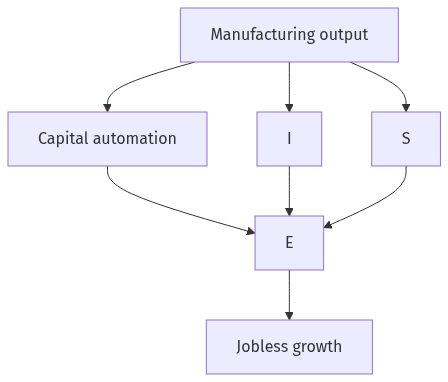
- Factories have become more capital- and machine-intensive; automation and imported machinery raise output without a matching rise in shop-floor jobs.
- Labour laws, contract labour, and inspection fear pushed many firms toward machines or toward tiny informal units that do not show up as organised manufacturing jobs.
- Skill mismatch leaves vacancies beside unemployment: assembly and precision work need training that schools often do not give.
- Import competition in labour-intensive lines such as garments, footwear, and electronics assembly limits expansion of mass hiring.
- Growth has leaned on services and on a few capital-heavy sectors (refining, chemicals, autos), which employ fewer workers per crore of value added.
Jobless growth is therefore not a mystery of GDP. It is a manufacturing path that saves labour.
Flow diagram
Conclusion
Employment elasticity stagnated because manufacturing chose capital, contract labour, and import-competing product mix. Output can rise while factory jobs stay flat unless labour-intensive lines and skills expand.
Quick related
Students also ask
-
How can inclusive and sustainable industrialization (SDG 9) drive economic growth (SDG 8), while ensuring environmental sustainability (SDG 12, 13) in India?
Next question in the 2025 paper (Q6). View answer →
-
Does high GDP growth always raise factory jobs?
No. If growth is in capital-heavy sectors, elasticity stays low.
-
Is services growth a full answer?
Services absorb many workers, but a large workforce still needs labour-intensive manufacturing as well.
Same topic · past papers
UPPSC has asked this before
These previous-year questions sit on the same topic. Open one to practise the earlier ask.
More from this paper
Q1 · UPSC Mains 2025 · UPGS3 · 8 marks · Solution
Identify the critical challenges faced by the handicraft industries in India and discuss their challenges.
Food processing
Handicrafts are large in jobs but weak in organisation. Costly inputs, middlemen, and machine-made copies cut the artisan’s price. Credit, GST paperwork, and export compliance are hard for household units. GI tags and e-commerce help some clusters, not the whole sector. The challenge is to move skill, credit, and direct sale to the maker.
Q2 · UPSC Mains 2025 · UPGS3 · 8 marks · Solution
"Construction of new airports will facilitate industrialization and development in India." Examine.
Infrastructure
Airports can shorten time to markets and support logistics jobs. UDAN tries to spread air access beyond metros. Land, wetlands, and noise are real costs of greenfield sites. Thin traffic means some airports need heavy subsidy and still do not pull factories. Industrialisation needs hinterland demand, not only a terminal.
Q3 · UPSC Mains 2025 · UPGS3 · 8 marks · Solution
Discuss the concept of unemployment in India as developed by National Sample Survey Office (NSSO).
Poverty, unemployment and inclusive growth
India measures unemployment on more than one reference period because work is often casual. Usual status (ps and ps+ss) uses the last year and usually gives the lowest rate. Current weekly status uses the last seven days. Current daily status counts person-days and captures underemployment. PLFS is the present NSO survey that carries these NSSO concepts.