
Revision summary
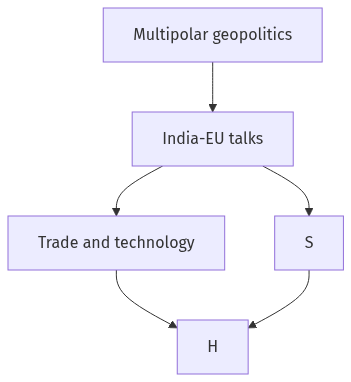
India–EU talks sit in US–China rivalry, Europe’s energy shock, and India’s autonomy. The Trade and Technology Council of 2022 is the institutional companion to FTA negotiations. The agreement should be read as diversification and standard-setting, not as a NATO-like pact. Carbon, digital, and labour rules will shape any deep commercial deal. Over-reading it as only an anti-China bloc ignores both sides’ other trade ties.
Model answer
Introduction
India and the European Union have been negotiating a trade and investment package while they also run a Trade and Technology Council. In a world of US–China rivalry and a war in Europe, that agreement must be read as strategy, not only as tariffs.
Body
Changing geopolitics
- Europe wants less dependence on a single manufacturing power and more trusted partners for green technology, data, and critical minerals.
- India wants market access, technology, and diplomatic space without joining a formal military alliance, which matches strategic autonomy.
- The Russia–Ukraine war and energy shocks pushed the EU to look at India as a large democracy and a growing market, even while India kept its own Russia ties.
How to view the agreement
- The India–EU track, including FTA talks and the 2022 Trade and Technology Council, should be viewed as a diversification deal in a fragmented trading system.
- Standards on carbon, labour, and digital trade will travel with any deep agreement, so geopolitics here is also rule-setting, not only goods.
- Defence, maritime, and connectivity conversations sit beside commerce, which is why the package is a hedge against over-reliance on any one bloc.
Caution
- A slow FTA does not cancel the strategic value of the talks; unfinished chapters themselves show how hard values and market access are to align.
- Viewing the agreement only as an anti-China pact would overstate it; both sides still trade heavily with China.
Flow diagram
Conclusion
The India–EU Agreement should be viewed as a geopolitical hedge and a rules partnership in a multipolar economy. It is not a military alliance, and its worth will be judged by market access and technology, not by communiqués alone.
Quick related
Students also ask
-
Analyze the geopolitical significance of Sri Lanka in the context of India's Foreign Policy.
Next question in the 2025 paper (Q9). View answer →
-
Is the India–EU FTA already a single signed treaty covering all goods?
A comprehensive FTA has been under negotiation for years. The relationship is better read as talks plus the TTC, not as a finished customs union.
-
Does the agreement replace India’s US or Quad ties?
No. It is an additional European pillar. India still deals separately with the United States and with Asian partners.
Same topic · past papers
UPPSC has asked this before
These previous-year questions sit on the same topic. Open one to practise the earlier ask.
-
2025 · Q9 · UPGS2 · 8 marks
Analyze the geopolitical significance of Sri Lanka in the context of India's Foreign Policy.
More from this paper
Q1 · UPSC Mains 2025 · UPGS2 · 8 marks · Solution
What role do Joint Parliamentary Committees (JPCs) play in the Indian legislative process? How do they contribute to effective law-making? Analyse.
Parliament and State legislatures
A JPC is an ad hoc joint committee used for complex bills or major controversies. It gathers evidence that floor debate cannot gather at the same depth. Reports have shaped later drafting after inquiries such as Bofors and 2G. The committee cannot enact law; the Houses may still ignore the report. Effective law-making follows only when Parliament uses that record to amend the bill.
Q2 · UPSC Mains 2025 · UPGS2 · 8 marks · Solution
How does Alternative Dispute Resolution (ADR) strengthen efficient governance and enhance the effectiveness of the justice delivery system in India? Analyze.
Separation of powers
Section 89 CPC and the 1996 Arbitration Act, with the 2023 Mediation Act, give ADR a legal base. Lok Adalats under the 1987 Legal Services Authorities Act clear compoundable claims in bulk. Governance gains when contracts and welfare complaints do not wait years for a trial. Justice delivery gains only if weaker parties are not forced into unfair bargains. Courts remain necessary for crime and for constitutional rights.
Q3 · UPSC Mains 2025 · UPGS2 · 8 marks · Solution
"Legislature is supreme within its domain, yet it is not sovereign." Examine this statement in the constitutional context with examples.
Indian Constitution
Articles 245 and 246 make a legislature supreme on its constitutional list. Kesavananda and Minerva Mills deny unlimited amending power. Articles 13, 32, and 226 allow courts to void unconstitutional statutes. The NJAC judgment is an example of a constitutional amendment falling to basic structure review. India follows constitutional supremacy, not British parliamentary sovereignty.