
Revision summary
Sri Lanka flanks India’s southern sea lanes and therefore its energy security. Chinese port and infrastructure presence is the main extra-regional worry. India used credit, fuel, and project support during the 2022 Sri Lankan economic crisis. The Tamil question and Palk Bay fishing keep a domestic-political edge on the relationship. Colombo will hedge; Indian policy is influence, not ownership of the island.
Model answer
Introduction
Sri Lanka sits on the sea lanes that carry India’s energy and trade across the Indian Ocean. For Indian foreign policy it is a neighbour, a maritime flank, and a test of Neighbourhood First.
Body
Location and maritime security
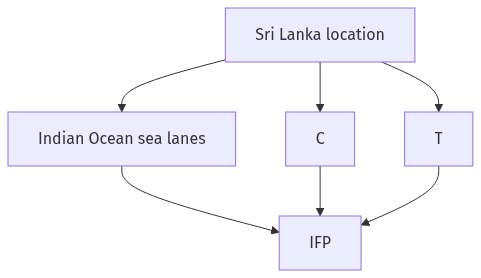
- The island sits near the busiest east–west sea lines of communication south of India, so a hostile or extra-regional naval hold would squeeze India’s security.
- Trincomalee, Colombo, and the southern ports matter for SAGAR and for denying a permanent rival logistics base on India’s southern door.
China and the neighbourhood
- Chinese financing of Hambantota and other projects raised Indian concern about debt and dual-use infrastructure in the inner ring.
- India’s answer has been credit lines, fuel, currency support, and port and energy projects, especially visible during Sri Lanka’s 2022 economic crisis.
Ethnic and political layer
- The Tamil question in the north and east, and the Thirteenth Amendment debate, still shape Tamil Nadu politics and India’s credibility as a neighbour.
- Fishing disputes in the Palk Bay are a daily geopolitical irritant, not a small local file.
Foreign-policy reading
- Sri Lanka is significant because geography cannot be changed and because extra-regional presence there would alter the Indian Ocean balance.
- Analysis must also admit limits: Colombo hedges among India, China, and the West, so New Delhi cannot treat the island as a client.
Flow diagram
Conclusion
Sri Lanka’s geopolitical weight for India is location, China competition, and a shared ethnic history. Indian policy works when it mixes security, economics, and Tamil sensitivity, and it fails when it looks like pressure without relief.
Quick related
Students also ask
-
Assess the strategic significance of the 25th Shanghai Cooperation Organization (SCO) Summit, 2025 Declaration, in endorsing India's long-standing position on cross-border terrorism.
Next question in the 2025 paper (Q10). View answer →
-
Is Sri Lanka only a China problem for India?
No. Geography, Tamil politics, fishing, and trade would matter even if China were absent. China has intensified the file.
-
Did the 1987 Accord settle the Tamil question?
No. The Accord and the Thirteenth Amendment remain reference points. Implementation and politics in Colombo are still unfinished.
Same topic · past papers
UPPSC has asked this before
These previous-year questions sit on the same topic. Open one to practise the earlier ask.
More from this paper
Q1 · UPSC Mains 2025 · UPGS2 · 8 marks · Solution
What role do Joint Parliamentary Committees (JPCs) play in the Indian legislative process? How do they contribute to effective law-making? Analyse.
Parliament and State legislatures
A JPC is an ad hoc joint committee used for complex bills or major controversies. It gathers evidence that floor debate cannot gather at the same depth. Reports have shaped later drafting after inquiries such as Bofors and 2G. The committee cannot enact law; the Houses may still ignore the report. Effective law-making follows only when Parliament uses that record to amend the bill.
Q2 · UPSC Mains 2025 · UPGS2 · 8 marks · Solution
How does Alternative Dispute Resolution (ADR) strengthen efficient governance and enhance the effectiveness of the justice delivery system in India? Analyze.
Separation of powers
Section 89 CPC and the 1996 Arbitration Act, with the 2023 Mediation Act, give ADR a legal base. Lok Adalats under the 1987 Legal Services Authorities Act clear compoundable claims in bulk. Governance gains when contracts and welfare complaints do not wait years for a trial. Justice delivery gains only if weaker parties are not forced into unfair bargains. Courts remain necessary for crime and for constitutional rights.
Q3 · UPSC Mains 2025 · UPGS2 · 8 marks · Solution
"Legislature is supreme within its domain, yet it is not sovereign." Examine this statement in the constitutional context with examples.
Indian Constitution
Articles 245 and 246 make a legislature supreme on its constitutional list. Kesavananda and Minerva Mills deny unlimited amending power. Articles 13, 32, and 226 allow courts to void unconstitutional statutes. The NJAC judgment is an example of a constitutional amendment falling to basic structure review. India follows constitutional supremacy, not British parliamentary sovereignty.